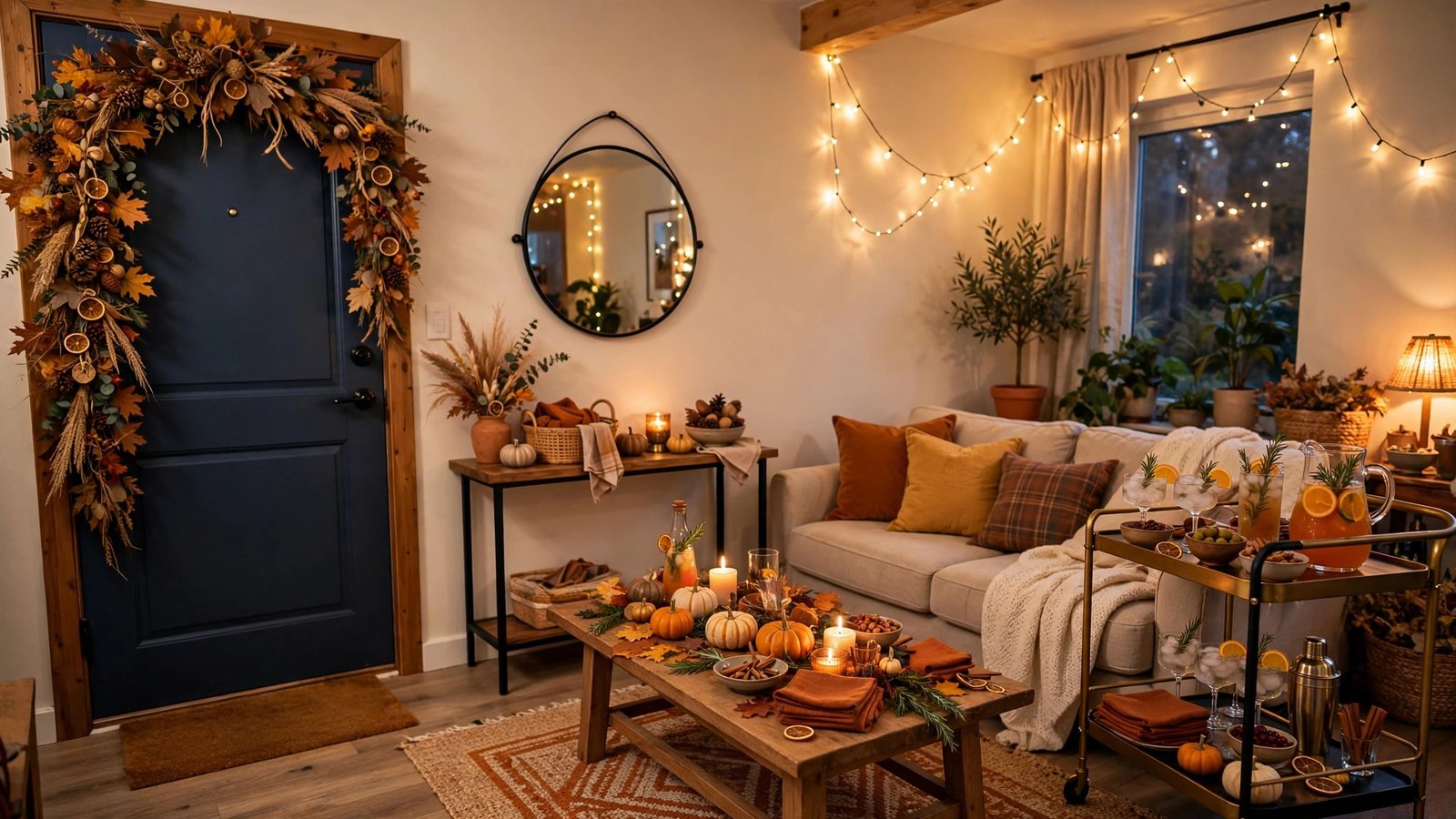
Hosting Friendsgiving in a small apartment is a special kind of beautiful chaos. Your living room is the dining room, the dining room is the kitchen, and somehow twelve of your favorite people are about to squeeze into 600 square feet. You cannot paint an accent wall the night before. You cannot drill into the ceiling for hanging lights. Your lease has opinions about adhesive residue, and your deposit has opinions about everything.
Here is the good news: a small apartment is actually easier to make feel festive than a big house. Every surface is visible from everywhere, so one smart move in the entryway, one glow in the corner, one styled bar cart, and the whole place reads as “party.” I have helped dozens of renters throw holiday gatherings in studios and one-bedrooms, and I have noticed the same thing every time: the hosts who panic are the ones trying to decorate a dining table like a magazine. The hosts who win are the ones who decorate the whole apartment like a party — entryway, corners, lighting, and flow — so guests feel the celebration the second they walk in.
These twelve ideas are all renter-tested: no drilling, no painting, nothing your landlord can complain about, and everything comes down in under an hour the next morning. Plan the arrival, the light, and the flow, and the smallness becomes the charm. Let us turn your small apartment into the Friendsgiving everyone talks about.
Executive Summary
- Think party-wide, not table-only: the entryway, lighting, corners, and guest flow do more work in a small apartment than any tablescape.
- Every idea is fully removable: adhesive hooks, battery lights, tension tricks, and freestanding pieces — nothing drilled, painted, or nailed.
- Zone your small space: entryway welcome, drinks station, photo corner, floor lounge, and a buffet line along the kitchen counter so twelve people can move without a traffic jam.
- Light and scent are cheap decor: battery fairy lights and a simmer pot transform the atmosphere for a few dollars and zero wall damage.
- Plan the teardown, too: every idea below comes down in minutes, so your deposit stays as safe as your security deposit should be.
1. Frame the Door, Not the Walls: No-Drill Garland Over the Entry
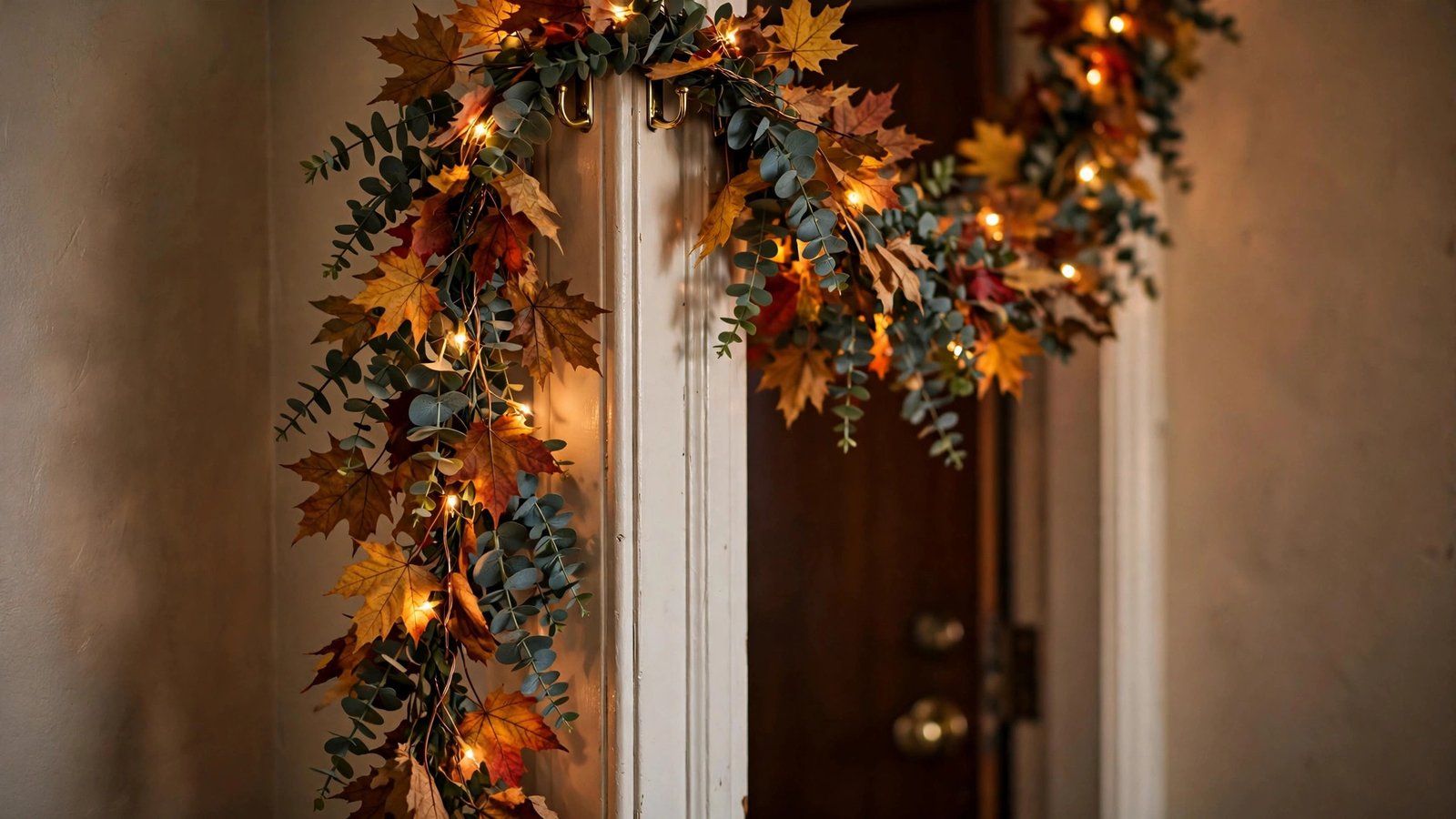
Your front door is the first thing guests see, and in a small apartment it is also the only vertical surface you fully control — the inside of your entry door. A garland draped across the top of the door frame tells everyone the party started before they even step inside, and it costs almost nothing. I have personally seen a bare hallway apartment feel instantly festive from one garland and a lit candle on the entry table.
Why it works for renters: removable adhesive hooks hold the garland to the door frame or the wall above the door — no nails, no screws, no patching. When the party ends, the hooks peel off cleanly and the garland folds into a bag.
How to do it:
- Hang two removable adhesive hooks on the door frame, about six inches below the top corners, and one in the center. Press firmly and wait the time the package says before loading them.
- Drape a faux fall garland — eucalyptus, maple leaves, or wheat stems — so it swags gently between the three hooks. Let the middle dip about eight inches for that natural, abundant look.
- Weave a short string of battery fairy lights through the garland so it glows after dark. Tuck the battery pack behind the garland where it hides.
- Add three or four small clip-on ornaments or mini pumpkins wired to the stems for a harvest touch. Step back and adjust until both sides mirror each other.
Approximate cost: $8–$20 for the garland, $5–$10 for a battery light string — about $15–$30 total if you are starting from scratch.
2. A Chalkboard Welcome Sign That Greets Guests Before You Can
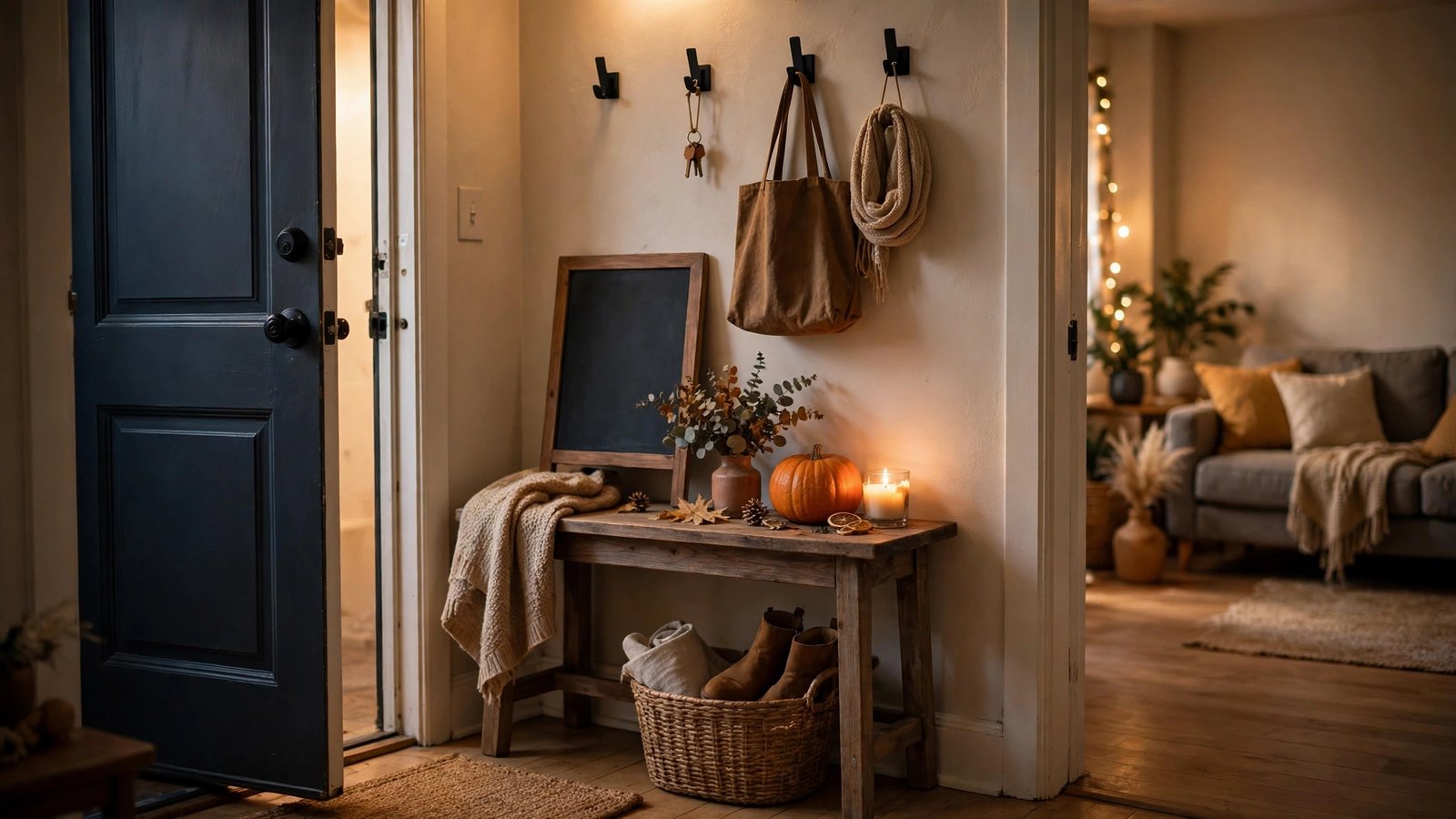
In a small apartment, you will be in the kitchen when the doorbell rings. A freestanding chalkboard sign by the door does the hosting for you: “Friendsgiving! Coats go left, drinks go right, you’re home.” I have noticed guests visibly relax when they arrive and the apartment is already telling them where to go — it turns a cramped entry into a planned arrival.
Why it works for renters: an A-frame or tabletop chalkboard stands on its own — it leans against the wall or sits on a console, touching nothing permanently. Zero wall contact, zero risk.
How to do it:
- Set a small A-frame chalkboard (about 12 by 18 inches) just inside or outside your door where the entry naturally funnels guests.
- Write the welcome in big chalk letters: the event name, then three lines — where coats go, where drinks are, and one warm line like “so glad you’re here.”
- Frame the message with simple chalk doodles: leaves, a pumpkin, a border line. Imperfect handwriting is part of the charm.
- Stand a battery candle or a tiny pumpkin beside it so the sign reads as intentional decor, not a leftover from a coffee shop.
- After the party, erase it and reuse it as a grocery list board — the most practical decoration you will ever buy.
Approximate cost: $10–$18 for the chalkboard, $2–$5 for chalk markers.
3. Battery Fairy Lights: Rent-Safe Glow in Every Corner
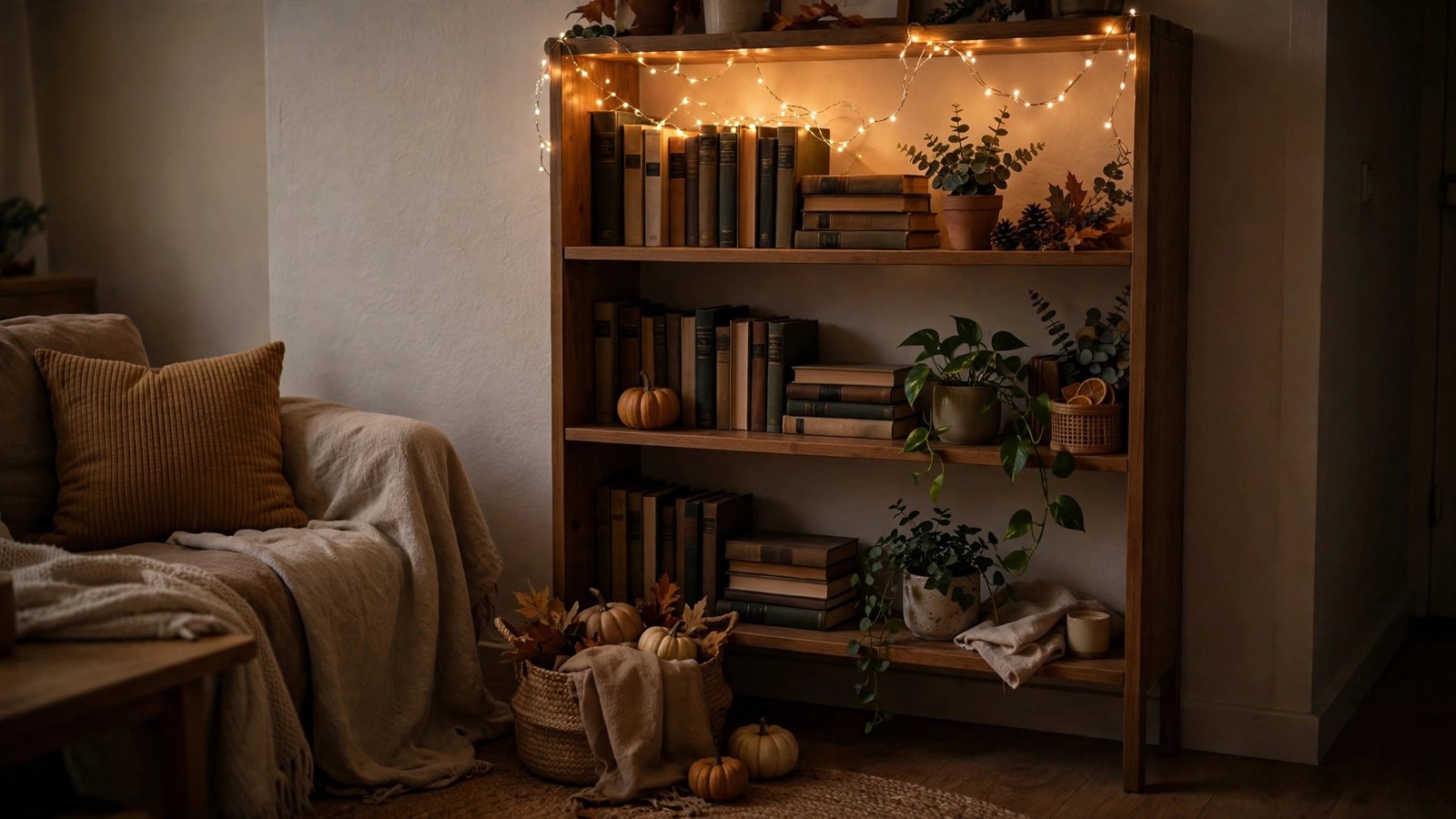
Overhead apartment lighting is the enemy of atmosphere — that single flush-mount ceiling light makes everything look like a dentist’s office. Battery fairy lights are the renter’s cheat code: warm, tiny, and placeable anywhere without a single outlet or drilled clip. I have helped renters transform a beige rental living room into something genuinely cozy with nothing but three light strings and a dimmed ceiling light.
Why it works for renters: battery packs mean no cords trailing to outlets and no adhesive damage. The lights drape over furniture, bookshelves, and curtain rods — surfaces that need no modification at all.
How to do it:
- Buy three to five warm-white (not cool-white) battery fairy light strings, 20 to 30 feet each. Warm white reads as candlelight; cool white reads as a hardware store.
- Drape one along the top of a bookshelf or media console, letting the ends trail down the sides. The battery pack hides behind a book.
- Wind a second string through a houseplant, a basket of pinecones, or around the neck of a big floor vase — instant glowing centerpiece for a corner.
- Lay a third inside a glass bowl or hurricane vase on the coffee table for a contained, fire-safe glow.
- Turn your overhead lights OFF or down, and let the fairy lights plus lamps carry the room. Flip the switch on each pack as guests arrive — it feels like lighting candles, minus the fire hazard.
Approximate cost: $4–$8 per string — about $15–$30 for a whole-apartment glow.
4. Style a Bar Cart (or a Bookshelf) Into a Drinks Station
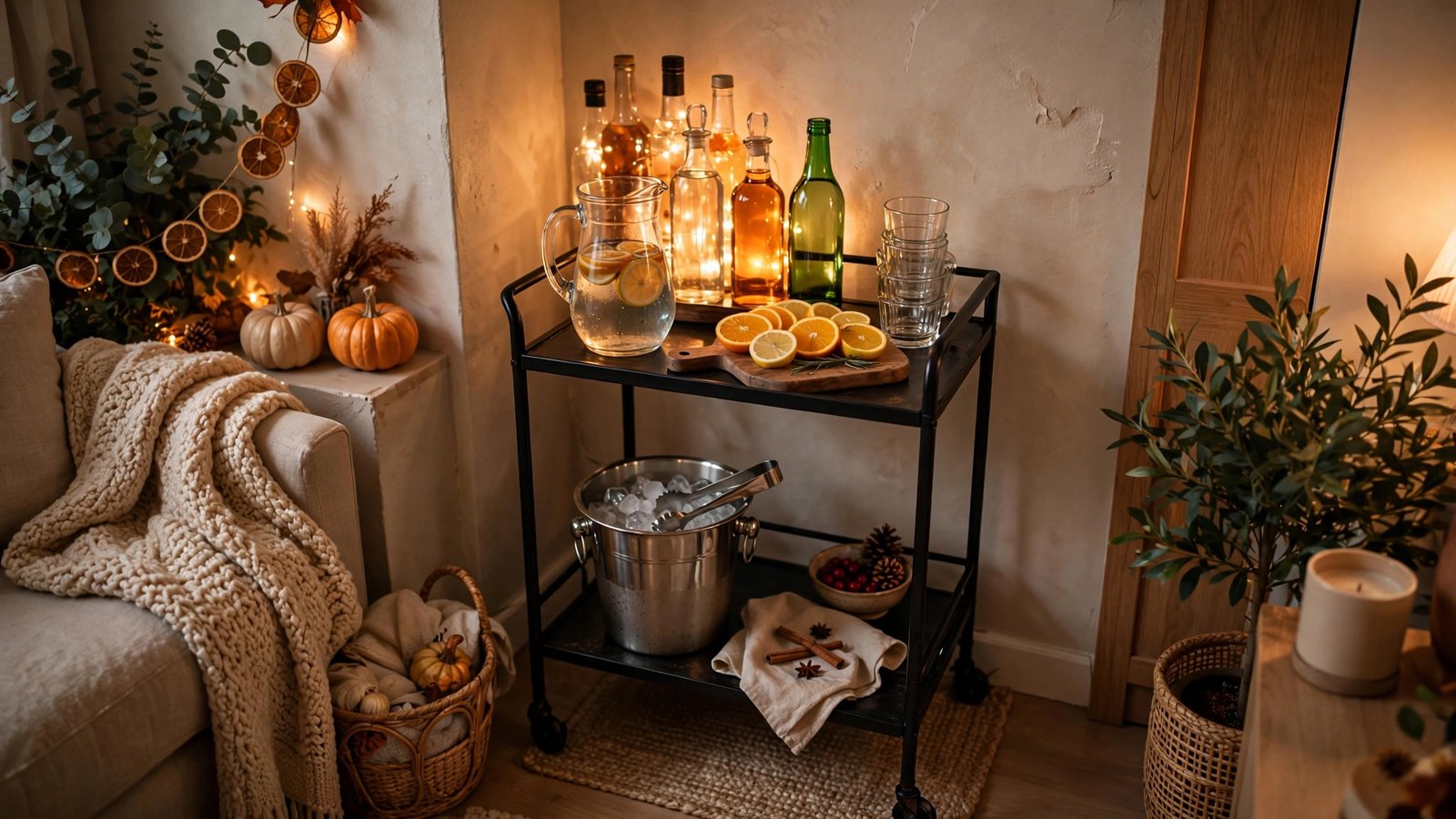
Every Friendsgiving needs a drinks station, and in a small apartment the bar cart is the hardest-working piece of furniture you own. Even if you do not own a bar cart, one shelf of a bookcase, the top of a dresser, or a cleared kitchen counter corner does the job. The trick is styling it like a station, not a cluttered shelf: everything drinks-related in one zone, labeled and lit.
Why it works for renters: a drinks station is furniture you already own, rearranged for one night. Nothing mounts to a wall, nothing gets damaged, and it consolidates drink traffic into one spot so guests are not opening every cabinet looking for glasses.
How to do it:
- Clear one surface — a bar cart, a console, or one bookshelf shelf — and wipe it down. This is now the drinks zone; everything else moves to a closet for the night.
- Group by function, back to front: bottles and a pitcher at the back, glasses in the middle, napkins, a small cutting board with sliced citrus, and a bucket of ice at the front.
- Add height with what you own: stack two coffee-table books under the bottle tray, or set the pitcher on a small cake stand. Height differences make it look styled instead of crowded.
- Hang or lean a small handwritten sign — “Help yourself!” — in a frame you already own. It gives guests permission to pour, which keeps you out of bartender duty.
- Tuck a battery fairy light string around the base or behind the bottles. Backlit bottles at a party look expensive; they are not.
Approximate cost: $0 if you shop your own shelves, $10–$25 for a tray, pitcher, or citrus and ice you did not already have.
5. A Removable Photo-Backdrop Corner for the Group Shot
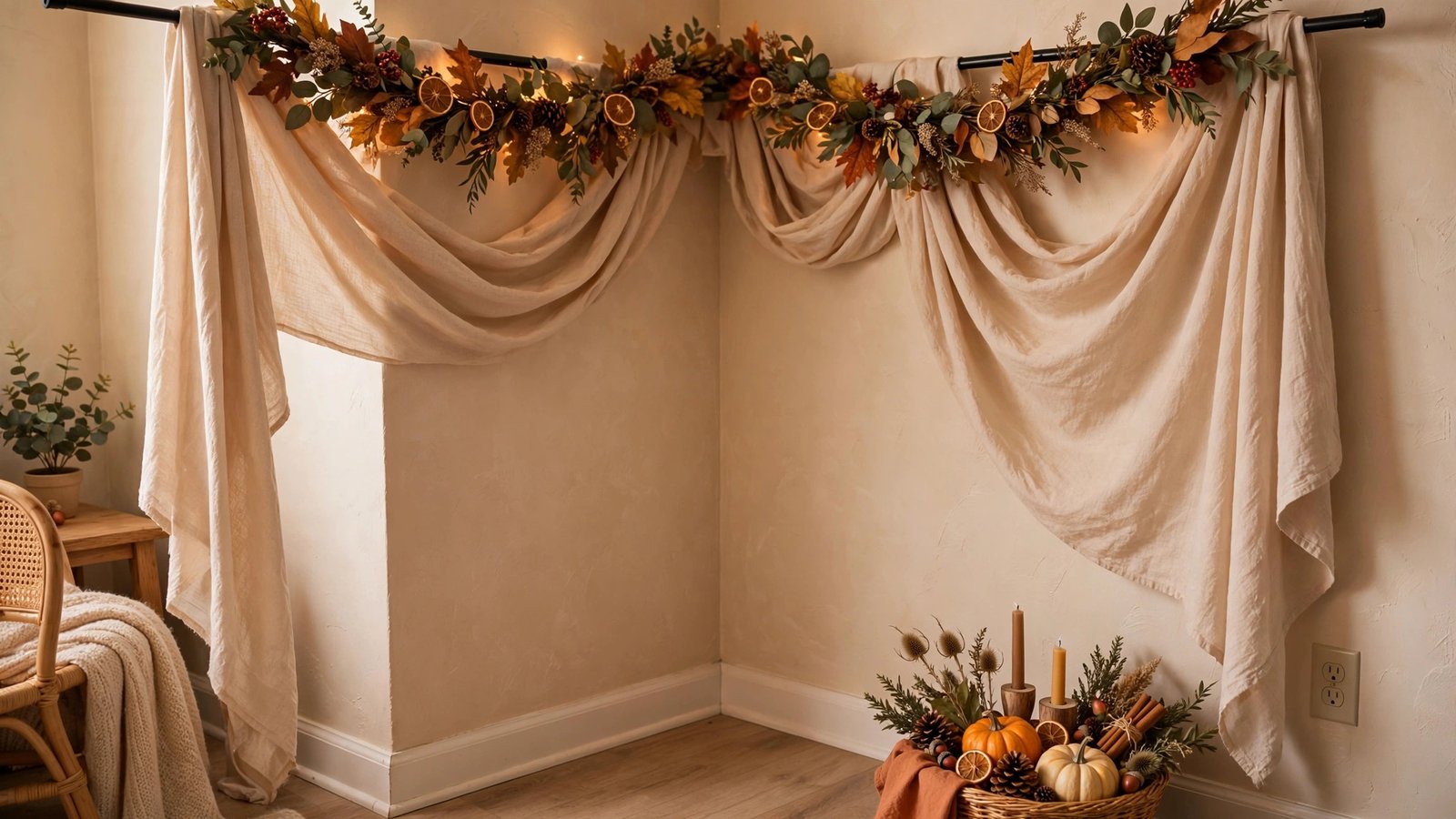
Friendsgiving photos happen whether you plan for them or not — so plan for them. One corner with a simple backdrop turns blurry kitchen selfies into the group photo everyone actually posts. I have personally seen guests spend twenty minutes taking pictures in a corner that took the host fifteen minutes to set up, using nothing that touched the wall with anything stronger than removable adhesive.
Why it works for renters: the backdrop hangs from removable adhesive hooks or a tension rod wedged in a doorway — never nailed, never taped directly to paint. Everything peels away clean.
How to do it:
- Pick the corner with the best natural light — usually near a window, facing into the room so faces are lit.
- Hang a simple backdrop: a thrifted curtain panel, a flat bedsheet in a warm solid color, or a paper tablecloth taped to itself. Use two removable adhesive hooks on the wall above, or wedge a spring tension rod in a nearby doorway and drape the fabric over it.
- Layer one garland or balloon cluster across the top edge of the backdrop to frame it — this is what makes it read as “photo spot” instead of “laundry.”
- Place two or three props nearby in a basket: funny paper mustaches on sticks, a mini chalkboard that says “Grateful for ___,” oversized fall leaves. Props make shy guests participate.
- Clear the floor in front of the backdrop — move one chair or side table — so a group of six to eight can actually fit in the frame.
Approximate cost: $0–$10 using fabric you own, $10–$25 for a backdrop panel, hooks, and a balloon cluster.
6. A Floor-Seating Lounge That Fits Twelve in 600 Square Feet
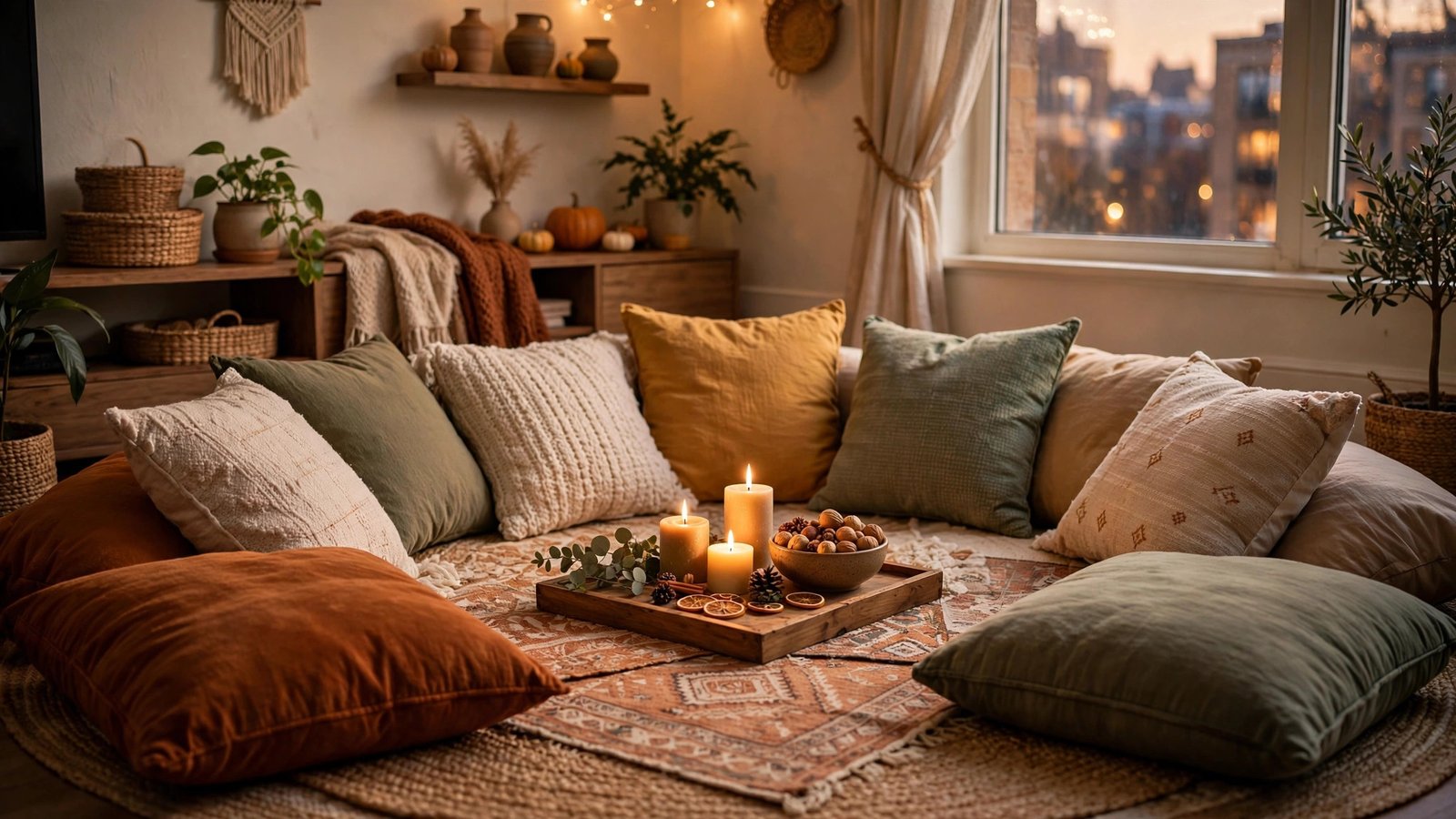
Here is the math problem of small-apartment Friendsgiving: twelve guests, seating for six. The answer is a floor lounge — layered rugs, big cushions, and floor pillows arranged in the living room like a cozy nest. Done right, it does not look like “we ran out of chairs.” It looks like the intentional, boho gathering spot everyone migrates to after dinner.
Why it works for renters: every piece already lives in your apartment — couch cushions, throw pillows, blankets, a spare rug. Nothing is bought for one night, nothing is mounted, nothing is damaged. You are rearranging, not renovating.
How to do it:
- Move the coffee table against a wall or into the bedroom for the night. This single move creates the floor space you need.
- Layer your rugs: your regular rug plus a second rug, blanket, or quilt on top, slightly offset. Layers read as intentional; one bare rug reads as a waiting room.
- Pull every cushion in the apartment into a loose circle or U-shape: couch cushions, throw pillows, bed pillows in pillowcases you like, even a folded duvet as a floor mat.
- Drape throw blankets over the back of the couch behind the lounge so guests can grab one — small apartments run warm with twelve bodies, then cold near windows, and blankets solve both.
- Set a low tray in the center with the battery candle, a bowl of nuts, and a small stack of coasters. It becomes the lounge’s “coffee table” and keeps drinks off the rug.
Approximate cost: $0 using what you own, $15–$40 for one or two extra floor pillows if your cushion supply is thin.
7. Run the Buffet Along the Kitchen Counter, Not the Table

In a small apartment, the dining table should be for people, not food. Run your Friendsgiving buffet as a line along the kitchen counter or island: guests flow in one end, plate up, and flow out to the table or the floor lounge. I have noticed this single decision prevents the number-one small-party disaster — a bottleneck of hungry people trapped between the stove and the fridge.
Why it works for renters: your counter is already there, already food-safe, already easy to wipe down. No folding tables to rent, no furniture to borrow, no floor space sacrificed.
How to do it:
- Clear the entire kitchen counter or island the morning of the party. Everything non-food moves into cabinets or the bedroom — a clear runway is the whole trick.
- Lay a washable runner, a long piece of kraft paper, or a flat bedsheet down the center as a “buffet cloth.” It protects the counter and makes mismatched dishes look unified.
- Order the food the way guests will walk it: plates and napkins first, then sides in the middle, then the main dish, then bread and condiments last. Put drinks at the FAR end so nobody doubles back.
- Elevate two or three dishes on overturned pots, sturdy boxes wrapped in kraft paper, or cake stands. A buffet with height looks abundant; a flat buffet looks like a line at a cafeteria.
- Tuck small handwritten labels in front of each dish — tented index cards work — so guests with allergies or preferences can serve themselves without interrogating you mid-cooking.
Approximate cost: $0–$10 for kraft paper, index cards, and tape you probably already own.
8. Thrifted Mismatched Serveware, Styled on Purpose
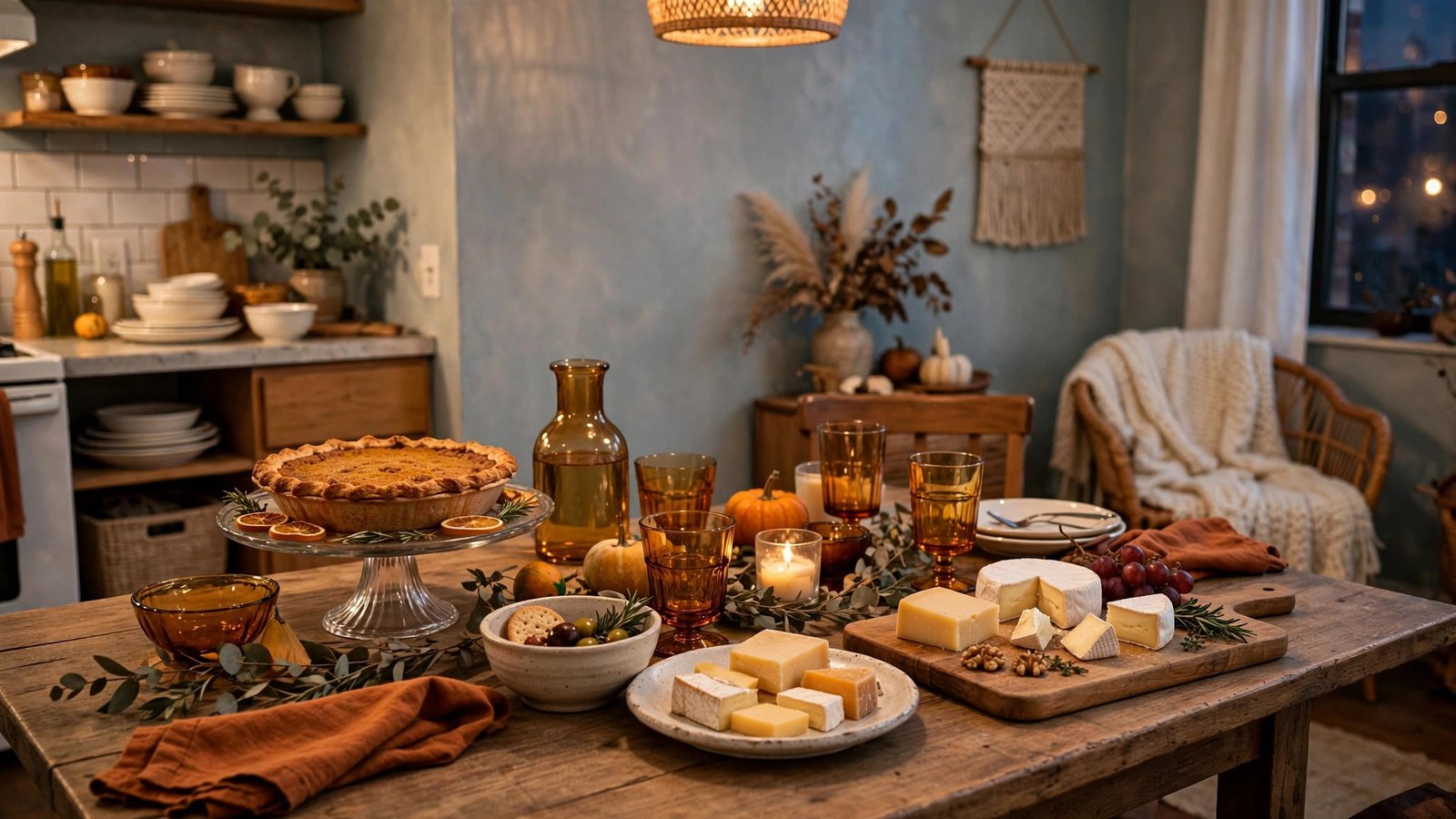
Twelve guests and six matching plates is not a problem — it is an aesthetic. Mismatched thrifted serveware, styled with intention, looks warmer and more personal than a matching set ever could. The secret is a unifying element: one color family, one material, or one repeating shape that tells the eye “this is a collection, not an accident.”
Why it works for renters: thrifted plates cost almost nothing, they do not need to match your everyday dishes, and there is zero anxiety about a guest chipping your good set. After the party, donate back what you do not love.
How to do it:
- Visit a thrift store a week before the party and buy plates, bowls, and serving pieces in one loose color family — all warm whites, all amber glass, all speckled stoneware. Aim for twelve place settings’ worth of plates.
- Wash everything well and inspect for chips. A small chip on a thrifted plate is character; a crack is a trash can.
- Unify with linens: one set of inexpensive cloth napkins in a single fall color — rust, mustard, or deep green — ties every mismatched plate together on the table.
- Mix heights on the buffet: a thrifted cake stand under the pie, a wooden cutting board under the cheese, a big bowl for the salad. The variety looks curated when the color story holds.
- After the party, keep your three favorite pieces and re-donate the rest. Your cabinets stay uncluttered and your next party gets a fresh hunt.
Approximate cost: $0.50–$2 per plate at thrift stores — roughly $10–$25 for a full mismatched set for twelve.
9. A Coat-and-Bag Drop Station for a Full House
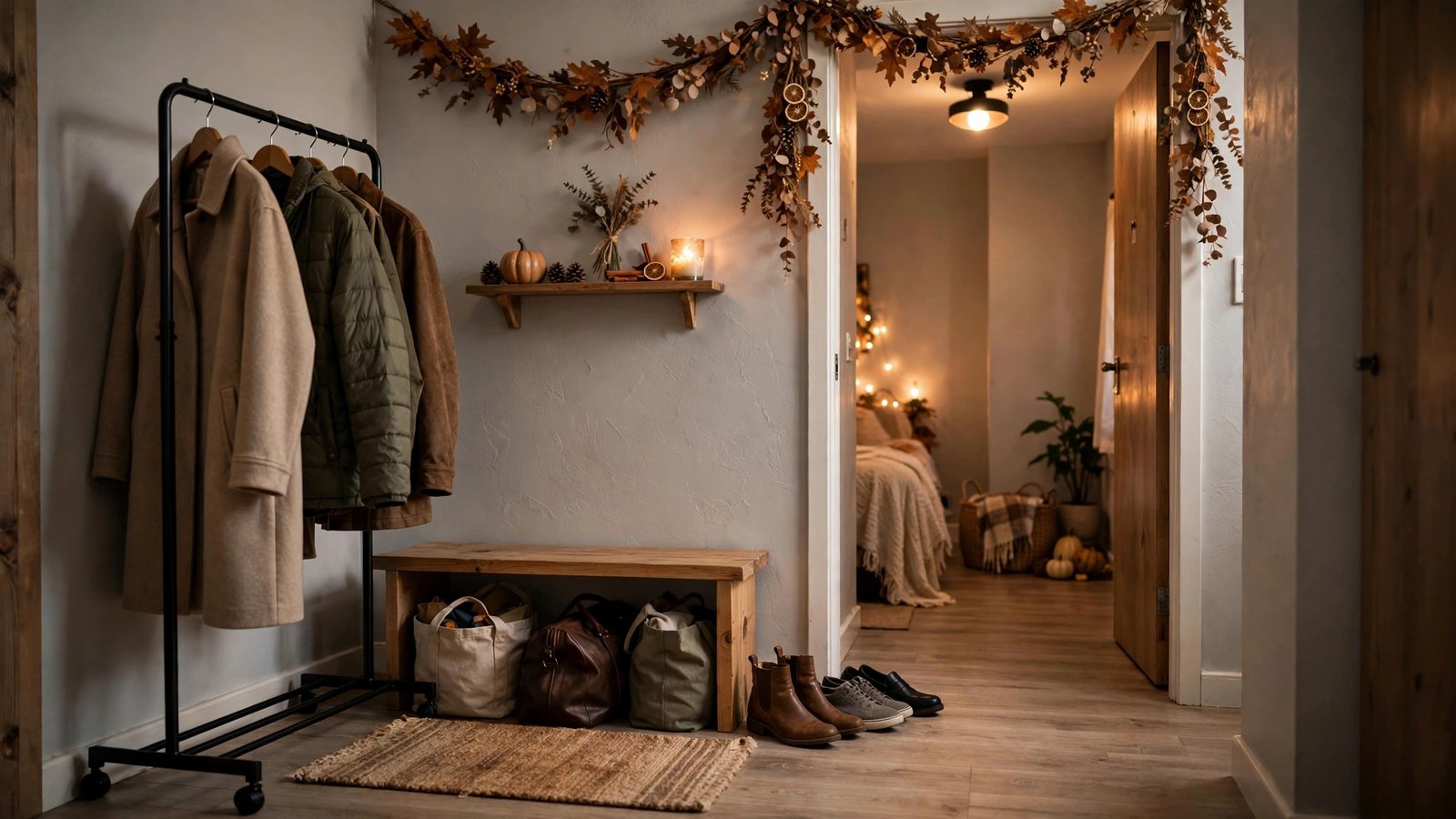
Twelve guests arrive with twelve coats, twelve bags, and twelve pairs of shoes, and your entryway is four feet wide. Without a plan, your bed becomes the coat pile — and then someone sits on someone’s purse. A designated drop station near the door keeps the whole apartment breathable and saves you from playing coat-check all night.
Why it works for renters: a freestanding garment rack, an over-the-door hook rail, or even a cleared closet rod handles the load with zero wall damage. Over-the-door hooks use the door you already have.
How to do it:
- Clear one closet rod, set up a freestanding garment rack, or hang an over-the-door multi-hook rail on the bedroom or entry door. Aim for at least ten hangers or hooks.
- Place a low bench, ottoman, or sturdy storage box beneath it for bags, and a washable mat or tray beside it for shoes. Vertical stacking — coats above, bags middle, shoes below — fits a crowd in a tiny footprint.
- Put a small sign on it: “Coats & bags here!” Guests will use a labeled station; they will not guess where to put things.
- Keep the station near the door but out of the food flow — the bedroom doorway or a hallway corner works better than the kitchen entrance.
- At night’s end, the rack folds flat into a closet. Nothing was ever attached to anything.
Approximate cost: $0 using your closet, $15–$30 for a folding garment rack or over-the-door hook rail.
10. Mood Lighting Without Dimmer Switches
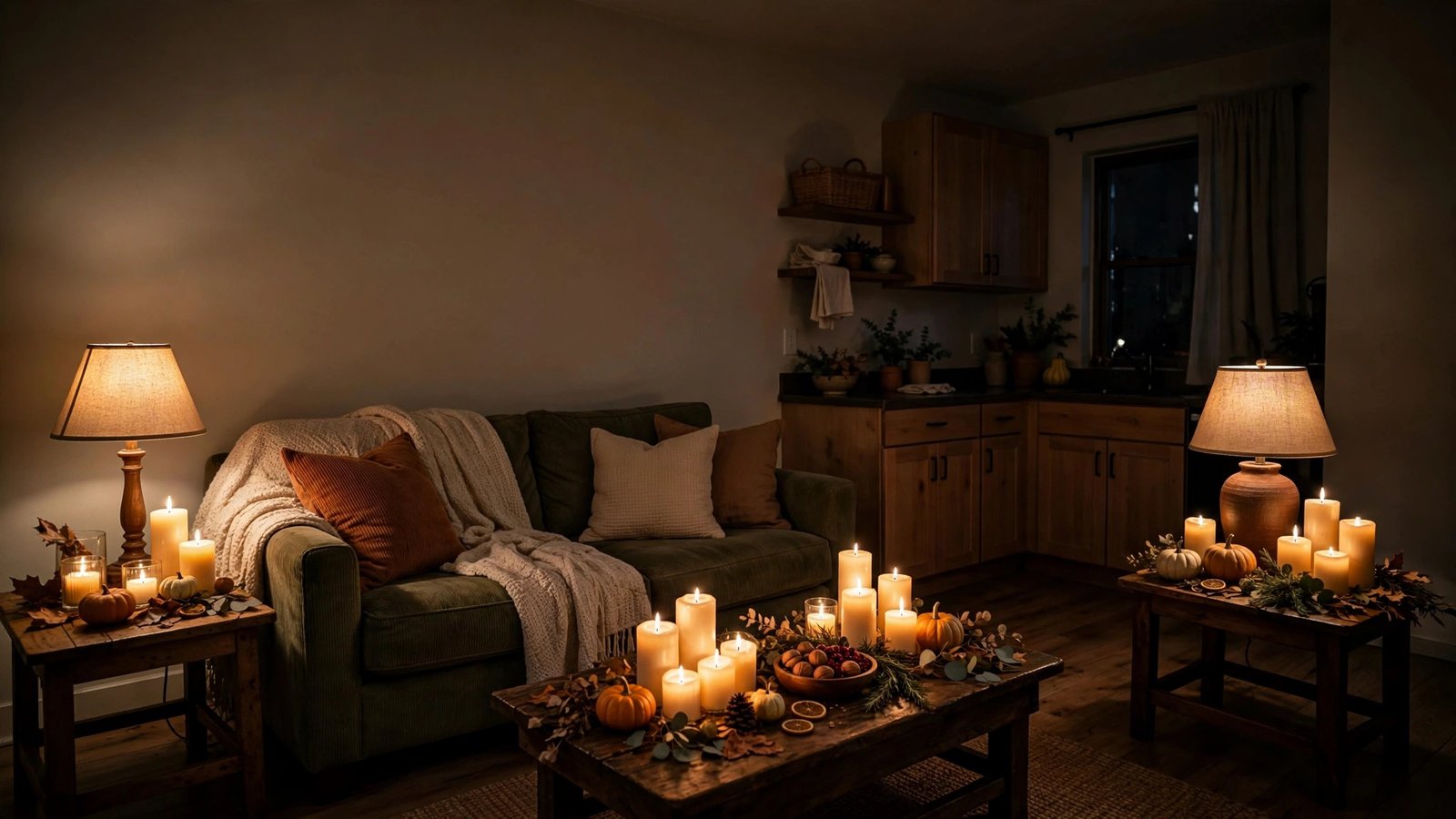
You cannot rewire your rental’s lighting, and you should not try. But you can absolutely fake dimmer switches: the trick is turning OFF the harsh overheads and letting every lamp, candle, and string light in the apartment do the work instead. Warm, low, layered light is what makes a small apartment feel like a candlelit gathering instead of a waiting room.
Why it works for renters: you are using the lamps and outlets you already have — just differently. No electrician, no landlord permission, no hardware changes. Smart plugs make it even easier and move with you to the next apartment.
How to do it:
- An hour before guests arrive, turn off every overhead ceiling light in the living and dining areas. This is the single biggest atmosphere upgrade available to you, and it is free.
- Switch every table and floor lamp to its warmest, lowest-wattage bulb — or just turn on two lamps instead of four. Fewer, warmer light sources beat many bright ones.
- Add real or flameless candles in clusters: three pillar candles of different heights on the coffee table, a row of tea lights along the windowsill, one big candle on the bathroom counter for guests.
- Plug one or two lamps into inexpensive smart plugs or simple plug-in dimmers so you can lower them further from your phone as the evening gets cozier — no rewiring, just a plug.
- Keep the kitchen brighter than the living room — guests need to see the buffet — and let the living room stay dim and glowy. The contrast makes each zone feel intentional.
Approximate cost: $0 using your own lamps and candles, $10–$25 for a smart plug or plug-in dimmer and extra tea lights.
11. Simmer-Pot Scent: The Cheapest “Decor” in the Apartment
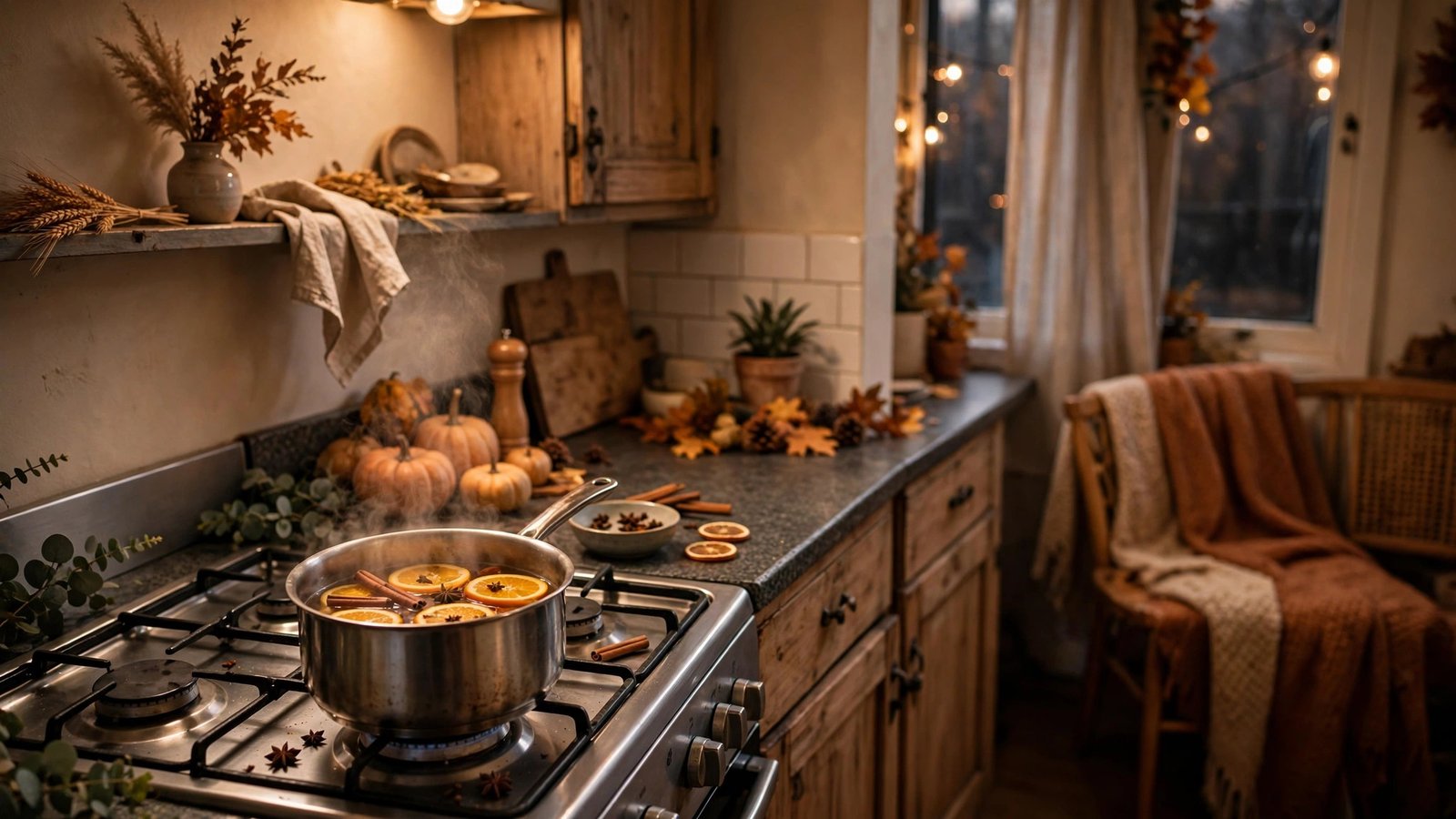
Decor is not only what guests see — it is what they smell when they walk in. A simmer pot (water, fruit, and spices kept at the lowest heat on your stove) fills a small apartment with fall scent in about twenty minutes, and in a small space, it works better than any candle. I have had guests ask what candle I was burning when the answer was literally an orange and some cinnamon sticks.
Why it works for renters: it uses your stove, your pot, and grocery-store ingredients. No special equipment, nothing mounted, nothing to store afterward — you compost the contents and wash the pot.
How to do it:
- Fill a medium pot three-quarters full with water and add: one sliced orange or apple, a small handful of whole cloves, two or three cinnamon sticks, and a sprig of rosemary if you have it.
- Bring it to the barest simmer — tiny bubbles, not a boil — then reduce to the lowest heat your stove allows. It should steam gently, never boil dry.
- Set a timer to check the water level every 45 minutes and top it up as needed. A dry pot is the only thing that can go wrong here, and the timer prevents it.
- Start the pot about an hour before guests arrive so the scent has time to travel through the whole apartment. Small spaces saturate fast — that is the advantage.
- When the party winds down, turn off the heat and let it cool. Save the mixture in a jar in the fridge and re-simmer it the next day — it works twice.
Approximate cost: $3–$8 for fruit and spices from any grocery store.
12. A Take-Home Favor and Leftover Station by the Door
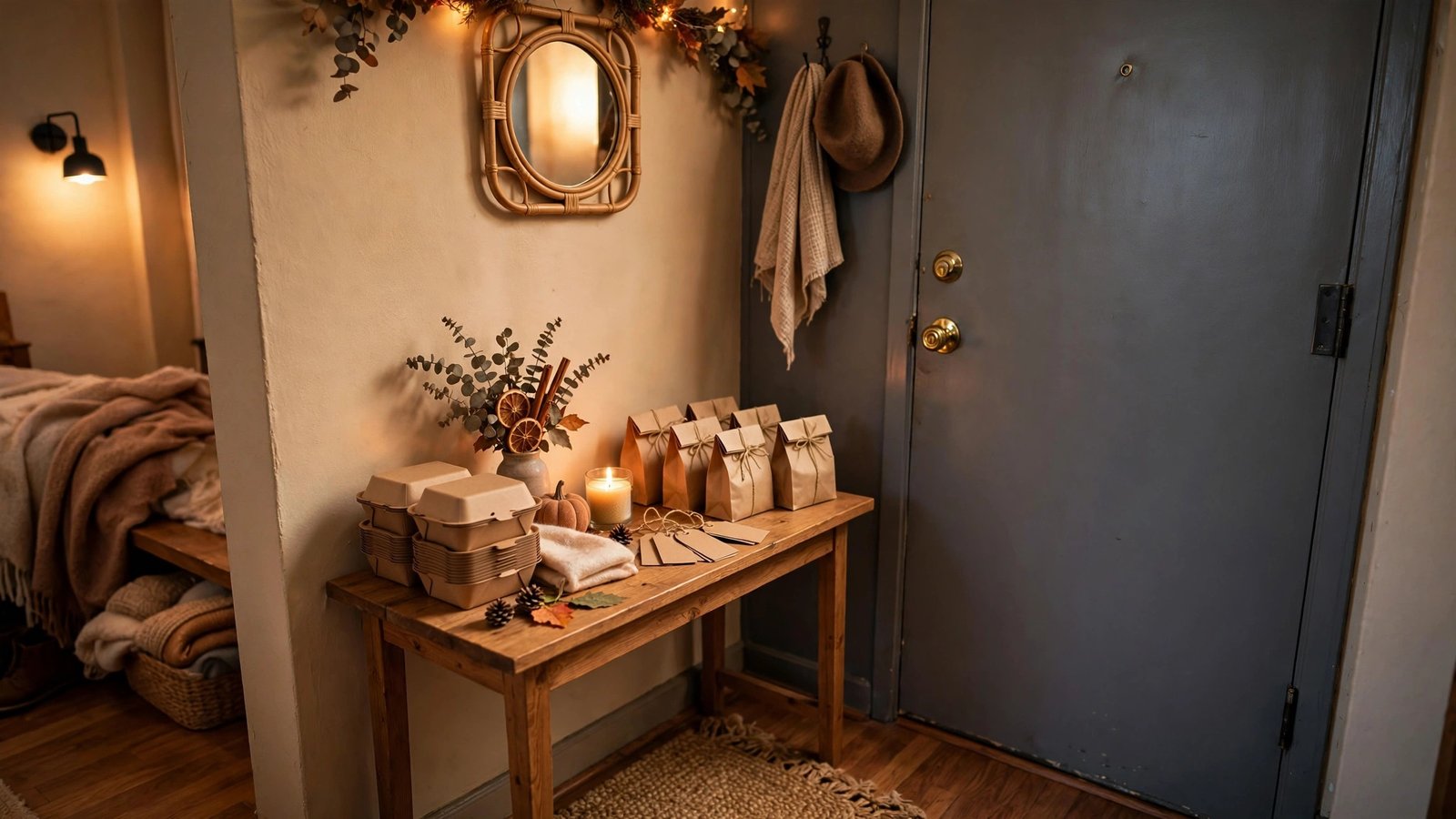
The party ends at the door, so put the goodbye there too: a small station with take-home favor bags and labeled leftover containers turns the chaotic end-of-night into the warmest part of the evening. Guests leave with pie and a little bag of treats, and you do not wake up to a fridge full of food you cannot finish. I have noticed the hosts who do this get thanked twice — once at the door, once in the group chat the next day.
Why it works for renters: it is a cleared entryway surface — a console, a small table, even a sturdy box with a cloth over it. Nothing is installed, nothing is damaged, and it solves the very real small-apartment problem of leftover storage space.
How to do it:
- The day before, buy or save a stack of inexpensive takeout-style containers or paper bags — twelve is the magic number for a full house.
- Set up the station near the door, away from the food flow: containers stacked neatly, a marker for labeling, and a small sign — “Take some love home!”
- Fill a few small favor bags in advance: a cookie or two, a tea bag, a handwritten “thankful for you” tag. Pre-made bags mean you are not assembling during goodbyes.
- As dinner winds down, announce the leftover station and set out the remaining sides with serving spoons. Guests pack their own boxes — you supervise, not serve.
- Keep one container back for yourself first. Host’s privilege, and you will thank yourself at lunch tomorrow.
Approximate cost: $8–$15 for containers, bags, and tags.
Conclusion
A small apartment does not limit your Friendsgiving — it focuses it. When every guest can see the garland from the couch, smell the simmer pot from the door, and find the drinks without asking, your 600 square feet feels fuller, warmer, and more intentional than a house twice the size. None of these ideas asked your landlord for permission, none of them risk your deposit, and all of them come down in under an hour — which means the only thing your Friendsgiving leaves behind is the group photo and the leftovers everyone fought over.
You have already done the hardest part: opening your home to your people. Now give the night the setting it deserves, one removable, renter-safe idea at a time. Please save this visual guide on Pinterest and share it with a fellow renter who is about to host their first Friendsgiving in a small apartment.

Amelia leads HavenlyStyle’s editorial vision with a passion for elegant interiors and practical home living. With years of experience in home décor and lifestyle content, she ensures every article is accurate, inspiring, and easy to follow. From timeless decorating ideas to the latest interior design trends, Amelia is committed to helping readers create beautiful, functional spaces while maintaining HavenlyStyle’s trusted and welcoming voice.