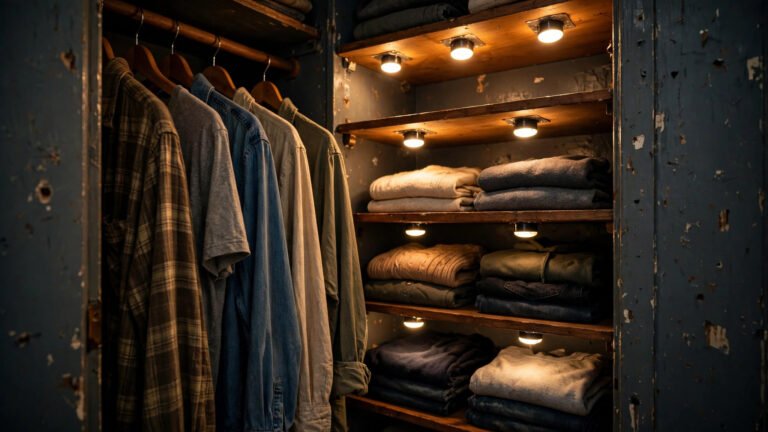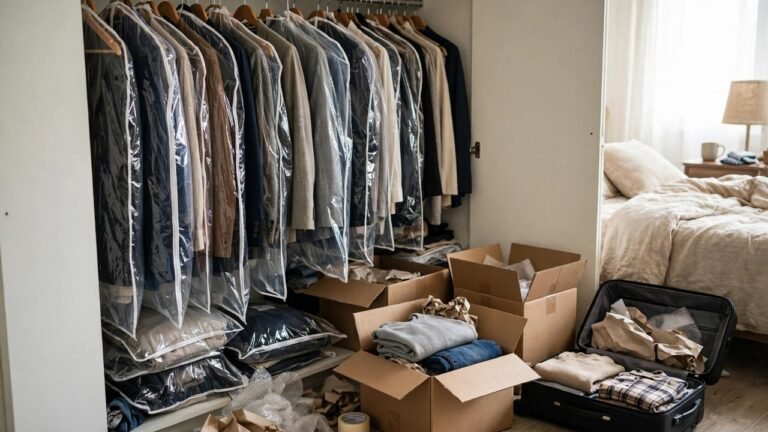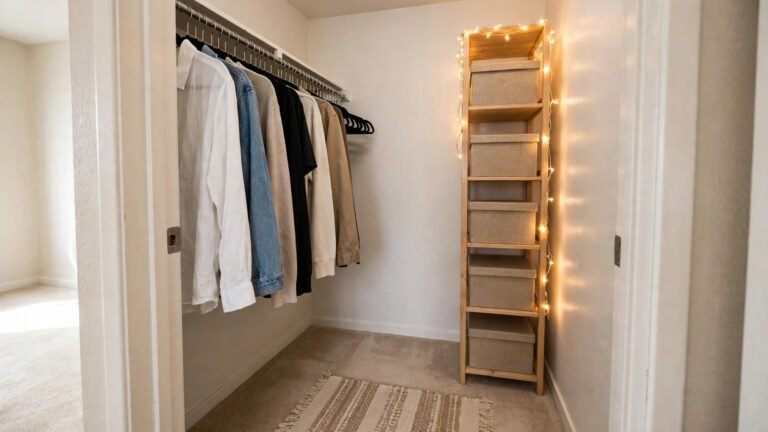
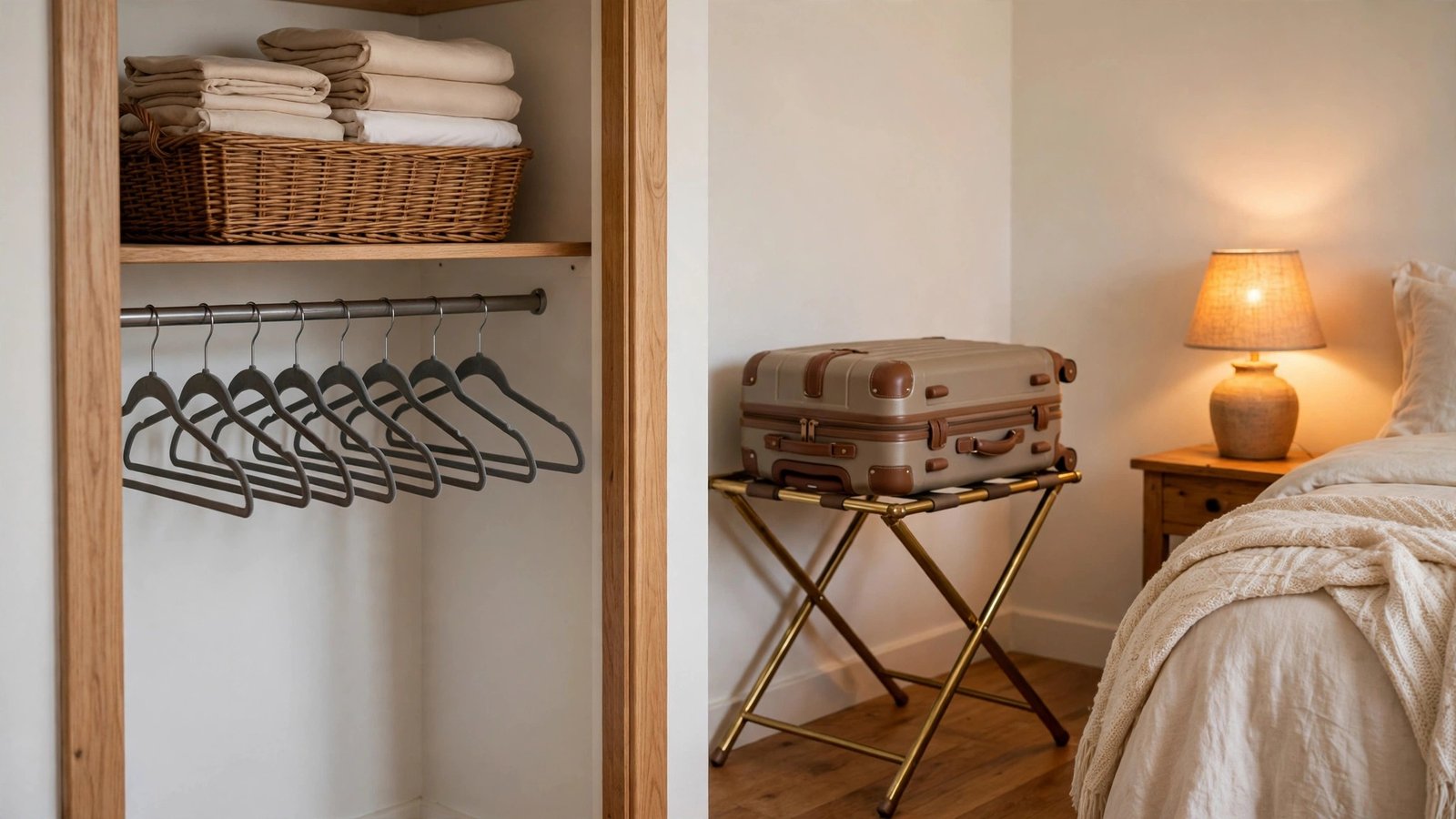
The first time I helped a renter friend host her parents for Thanksgiving, we opened the spare closet door and just stood there. It was doing triple duty: winter coat storage, a graveyard of half-used moving boxes, and the hiding place for the vacuum. Her mom was arriving in six hours. There was nowhere to hang a single coat, nowhere to set a suitcase except the middle of the floor, and the one guest hanger available was the wire kind that creases everything it touches.
That evening taught me something I have seen confirmed in dozens of rental homes since: guests forgive a small apartment, a futon, and a dining table that seats four people on chairs meant for two. What they remember is whether they felt like they had a place — a real, thought-through spot for their things. And in most rentals, that place is the guest closet. Not the whole room, not a renovation. Just one closet, prepped with intention.
The renter’s problem, of course, is that you can’t rebuild the closet. No drilling new rods, no built-in shelving, no paint. But here’s the good news: a welcoming guest closet is a staging job, not a construction job. Everything I’m about to share is removable, reversible, and deposit-safe — the kind of prep that takes one focused afternoon and costs less than a holiday grocery run. I’ve used these exact ideas in studio apartments where the “guest closet” was a corner of the host’s own closet, in rental houses with a spare room nobody touches, and in dorm-style setups where the bar was very, very low.
Work through these twelve ideas in order — they stack. By number twelve, your guest closet will feel less like storage and more like a welcome.
Executive Summary
- Clear before you decorate. The single biggest upgrade is empty space: guests read “empty shelf” as “I was expected.”
- Hangers and a luggage spot are the non-negotiables. Matching slim hangers plus somewhere off the floor for a suitcase cover 90% of what guests actually use.
- Stay deposit-safe the whole way. Every idea here uses no-drill, removable, landlord-friendly tools — over-door hooks, freestanding racks, leaning mirrors, battery lights.
- Freshness is the secret luxury. Light, scent, and a lint roller make a rental closet feel boutique-hotel without touching a single wall.
- Budget for the whole project: approximately $80–$150 if you buy everything new, or nearly free if you shop your own closets first.
1. Empty the Top Shelf Completely
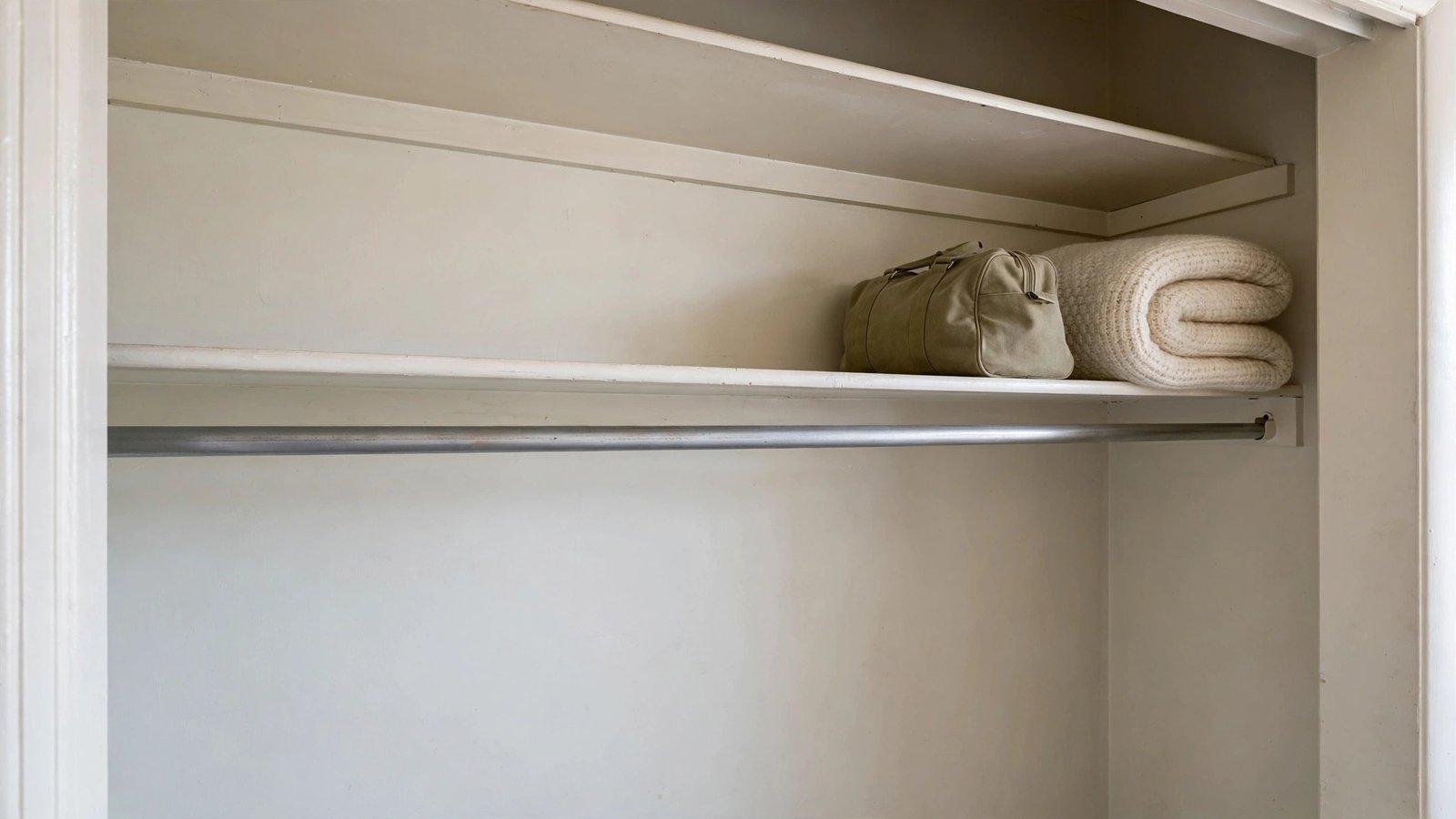
Start with the least glamorous and most transformative step: take everything off the closet’s top shelf. In most rentals that shelf is where good intentions go to fossilize — old tax boxes, a Halloween costume, the iron you never use. Guests read a cleared shelf the way you read a made bed: somebody prepared for me.
This works so well for renters because it costs nothing and changes nothing about the apartment itself. No landlord permission needed, no hardware, no residue. A cleared shelf becomes the landing zone for suitcases, duffel bags, and the extra throw blanket you always wish you’d offered. It also keeps guest belongings off the bed and off your furniture, which — if we’re being honest — is the real reason guest clutter stresses hosts out.
Here’s how I do it in about thirty minutes:
- Pull everything off the shelf and sort into three piles: stays (linens, current-season items), relocates (to your own closet or a storage tote), and leaves the apartment (donate or toss).
- Wipe the shelf down with a damp cloth — closets collect a surprising film of dust, and a clean shelf signals care.
- Line the shelf with a washable shelf liner or a folded flat sheet if the surface is rough or sticky; both lift right out at move-out.
- Place one folded spare blanket and one spare pillow at the far end of the shelf, so the cleared space still looks styled rather than barren.
- Leave the rest of the shelf genuinely empty. Resist the urge to refill it before guests arrive.
Approximate cost: $0–$12 (only if you buy shelf liner new).
2. Add a Freestanding Double Rail for Extra Hanging Room
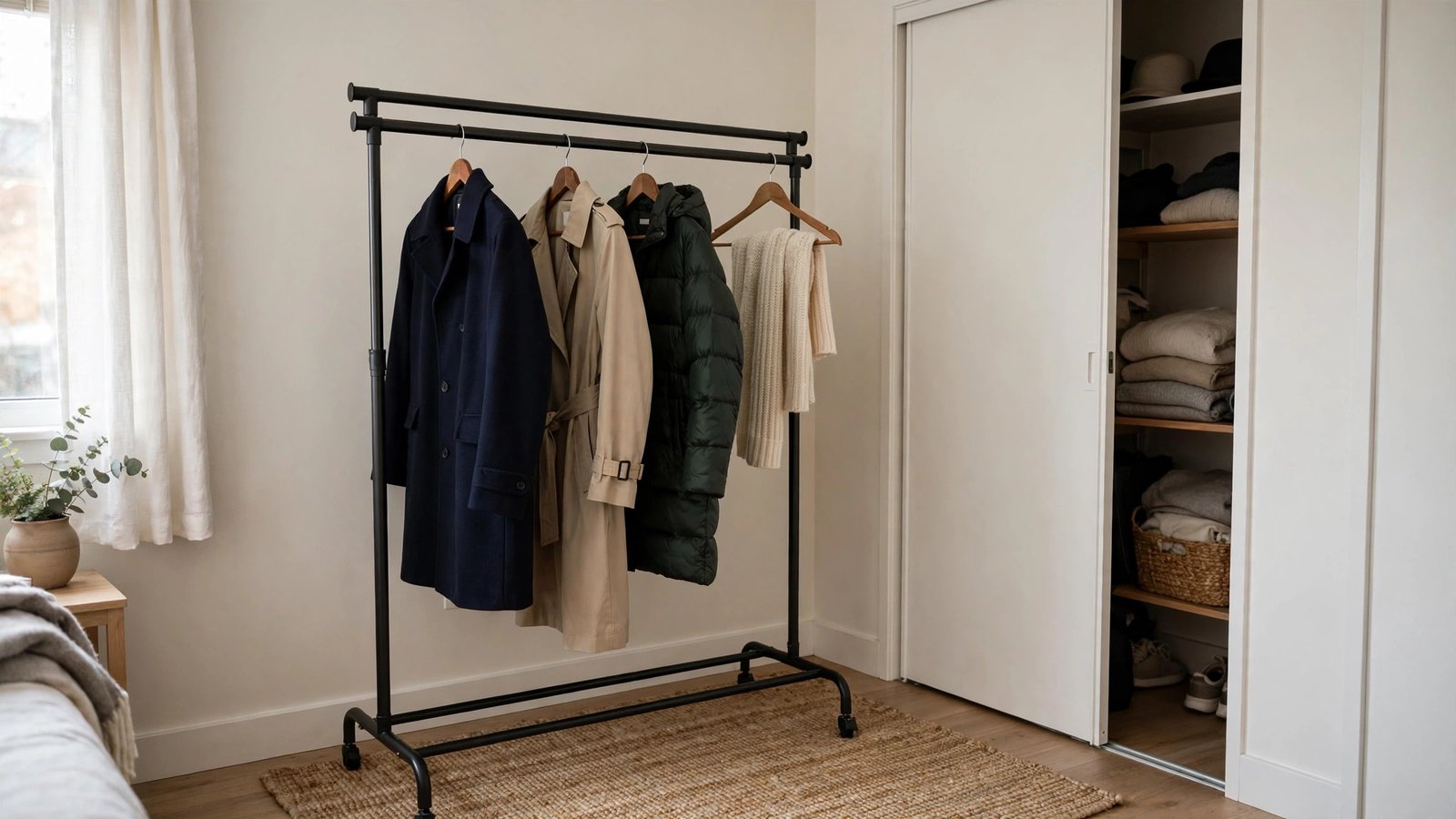
If your guest closet has a single rod — and most rental closets do — your guests’ coats will collide with your own clothes before the first suitcase is unpacked. A freestanding double-rail garment rack solves this without touching a wall. It stands on its own feet, holds two rows of hangers, and folds flat when the holidays are over.
I’ve personally seen this one change the whole dynamic of a small-apartment visit. Instead of guests awkwardly asking “where should I put this?” while holding a damp winter coat, you just point at the rack. It also protects your own closet: set the rack up in the guest room or the living-room corner near the entry, and your personal space stays yours. When visitors leave, the rack collapses and slides behind a couch or into the closet itself.
Setting one up takes ten minutes:
- Choose a spot with at least four feet of width — guest rooms, entryways, and wide hallways all work.
- Assemble the rack per its instructions (no tools beyond what’s included, no wall anchors).
- Load it with ten to twelve slim matching hangers before guests arrive, so it’s ready to receive.
- Put a small rug or washable mat underneath to protect floors from wet coat drips — removable, obviously.
- At visit’s end, fold it flat and store it; it leaves zero marks on walls or floors.
Approximate cost: $25–$45 for the rack, $3–$8 for a washable mat.
3. Swap In Matching Slim Hangers
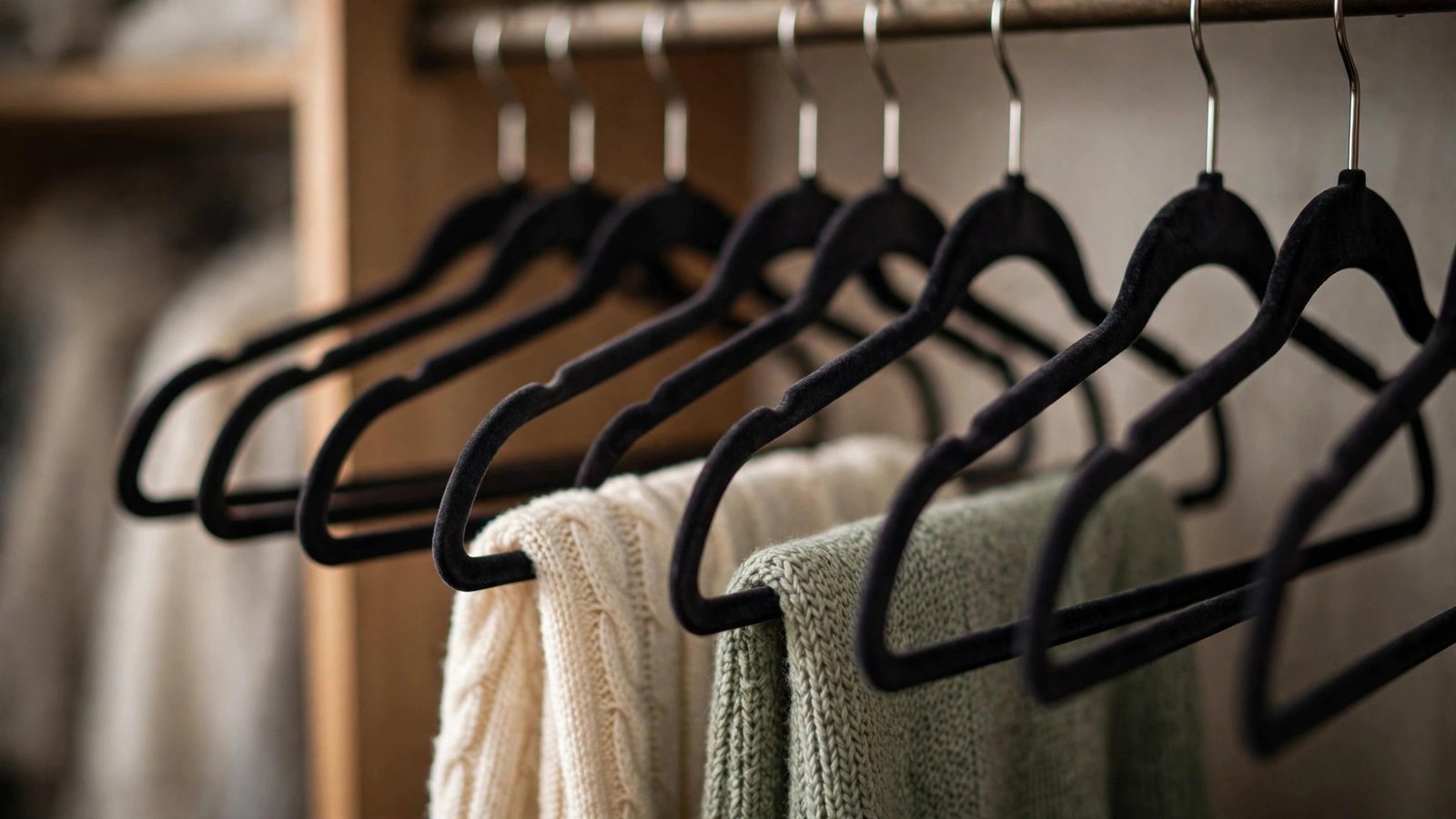
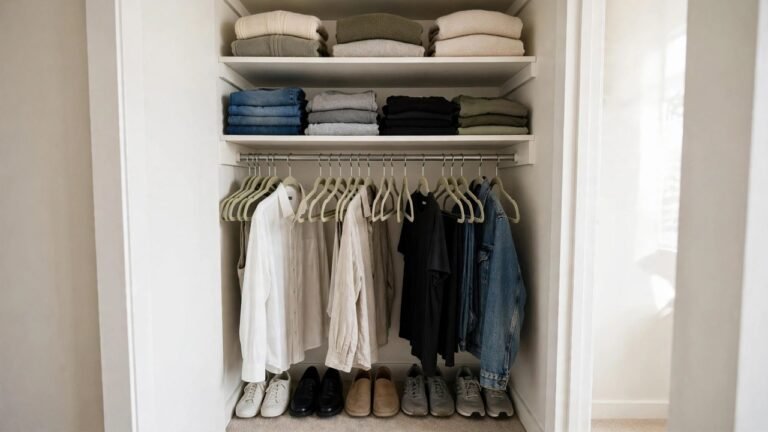
This sounds fussy until you see the difference. A rod holding five wire hangers, three chunky plastic ones, and two dry-cleaner relics looks like an afterthought. A rod of twelve identical slim hangers looks like an invitation. Slim hangers also buy real space — in a shallow rental closet, switching a dozen bulky hangers for slim ones can free up four to six inches of rod, which is exactly the margin a guest’s coat collection needs.
Why it’s perfect for renters: hangers move with you, they work in any closet on the planet, and they are the cheapest per-dollar visual upgrade in home styling. I’ve helped dozens of renters do this and every single one says the same thing: “I can’t believe that was all it took.” Keep your old mixed hangers in a tote for laundry-day overflow; they don’t have to be thrown away.
- Count the rod space you’re dedicating to guests and buy ten to fifteen slim hangers — enough for a coat, a few tops, and a dress or two.
- Remove every wire and mismatched hanger from the guest section.
- Hang the new set evenly spaced, empty, so the section looks intentionally prepared.
- If you share the closet, put the guest section on the most accessible end — near the door, not behind your stuff.
- Stash two extra hangers on the top shelf as backups for the guest who brought more than expected.
Approximate cost: $8–$15 for a ten-pack.
4. Hang an Over-the-Door Hook Rail
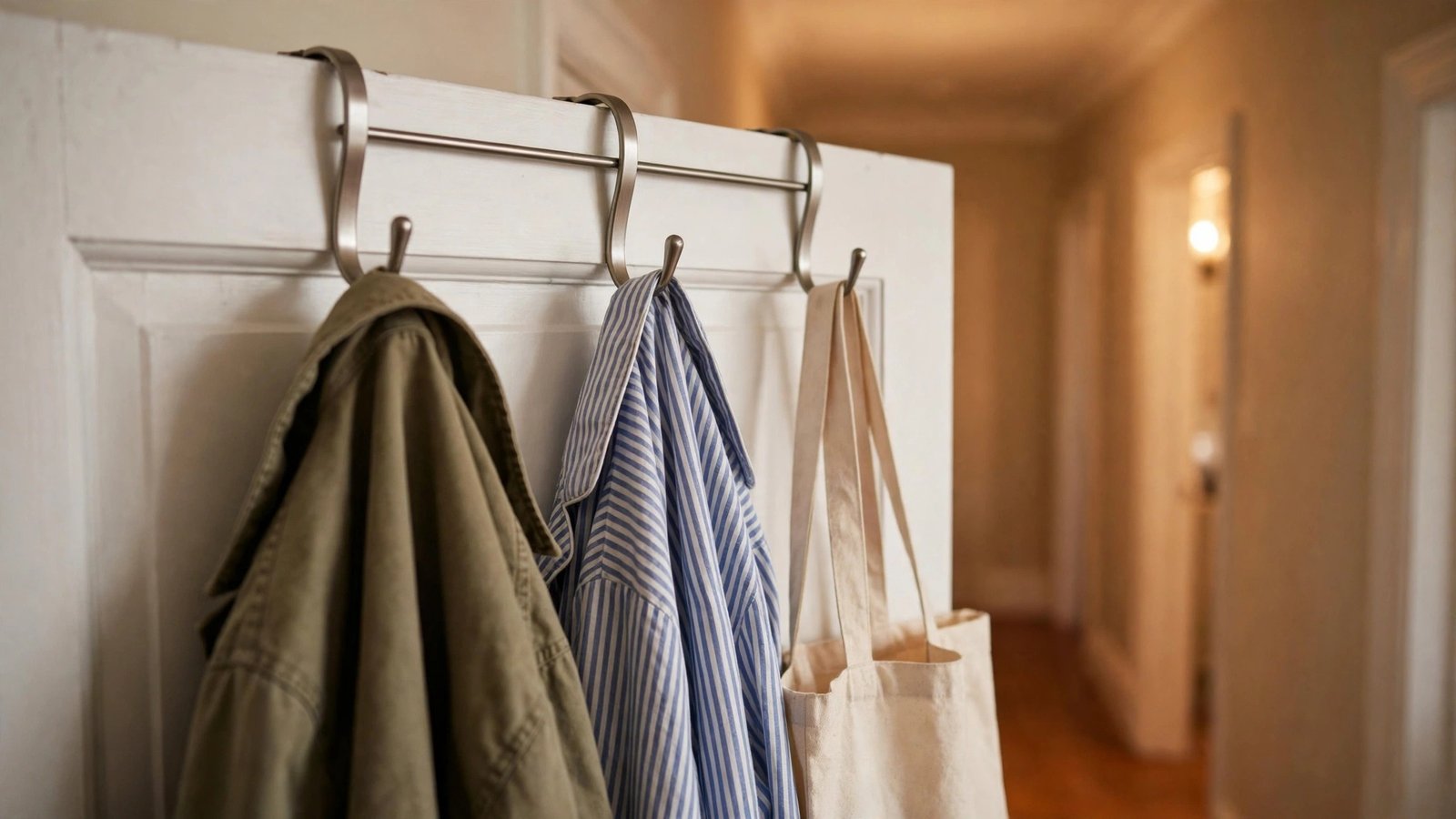
The closet door itself is free real estate. An over-the-door hook rail — the kind that simply slides over the top of the door with padded brackets — gives guests an instant spot for pajamas, tomorrow’s outfit, a robe, or the jacket they don’t want to bother hanging properly. No screws, no adhesive, no landlord conversation.
Renters love this one because doors are the one vertical surface every lease lets you use freely. I’ve put these on closet doors, bedroom doors, and once on a bathroom door for a guest who changed three times before a wedding. The padded brackets protect the door’s top edge, and when you move out, the rail lifts off in five seconds with nothing to patch or paint over.
- Measure your door’s thickness to pick a rail with the right bracket fit — most standard interior doors work with the common adjustable style.
- Slide it over the top of the closet door and press the padded brackets flat.
- Test with a heavy coat to confirm it sits stable and the door still closes fully.
- Leave two or three hooks empty and inviting, with maybe one hook holding a spare tote bag guests can borrow.
- After the visit, lift it off and tuck it in a closet corner — it stores flat.
Approximate cost: $10–$20.
5. Give the Suitcase a Real Spot
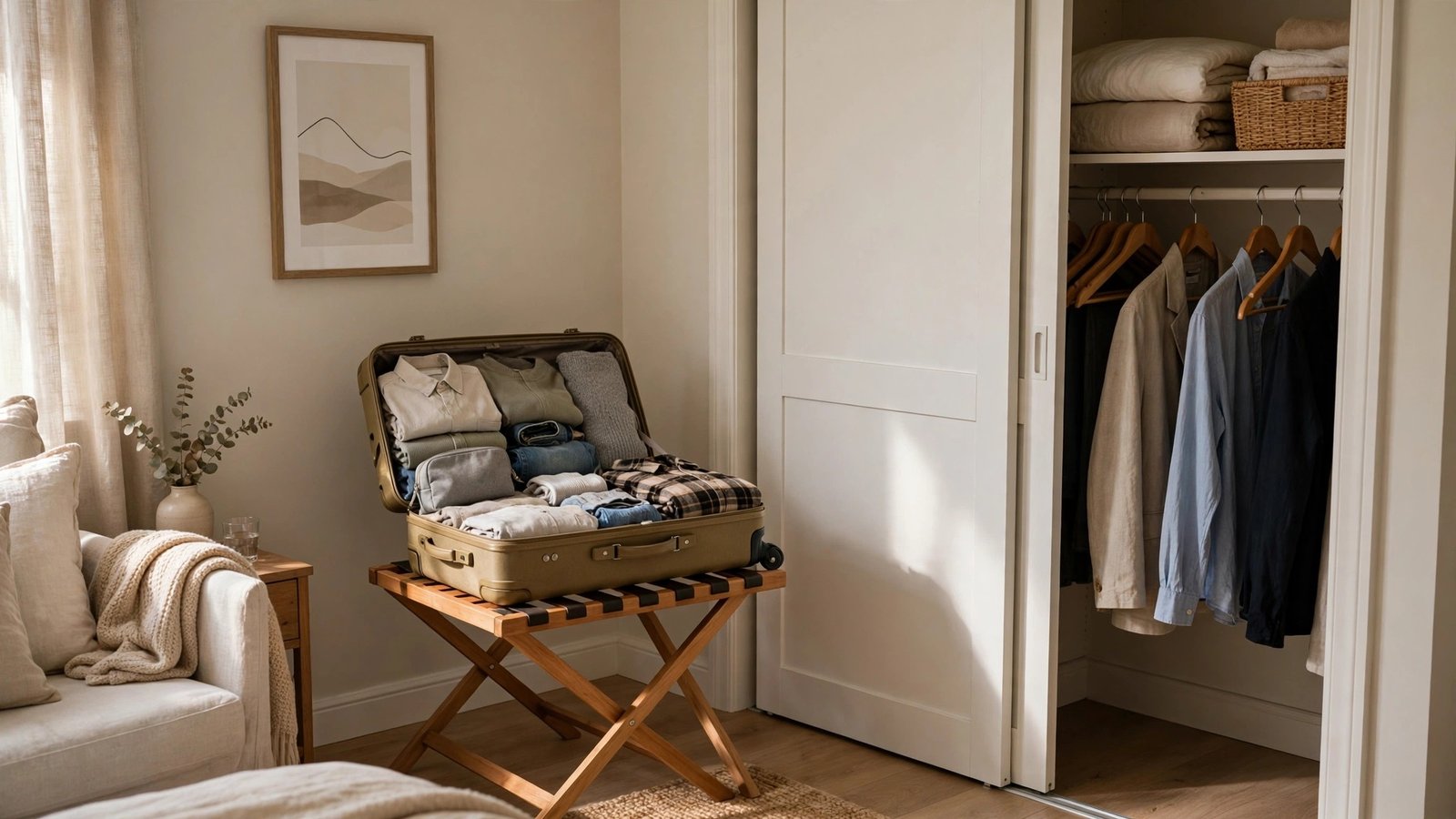
Nothing makes a guest feel like a burden faster than a suitcase living in the middle of the floor for three days. The fix is a folding luggage rack — the X-frame kind hotels use — tucked beside or inside the closet. It lifts the bag to waist height, which makes unpacking ten times easier, and it folds completely flat when not in use.
This is a renter’s dream piece because it requires zero installation and disappears after the holidays. I’ve seen guests visibly relax the moment they see one waiting; it’s the universal signal of “you’re not in the way here.” In studios or one-bedrooms where the closet is too small, the rack can live in the living room corner or at the foot of the guest’s sleeping spot — it works anywhere a person does.
- Open the folding luggage rack and place it within a few steps of the closet or the guest’s sleeping area.
- Test it with your own packed suitcase to make sure it holds steady and doesn’t wobble.
- Leave the straps open on top so guests know it’s theirs to use immediately.
- If floor space is truly zero, clear a sturdy ottoman or bench as the designated suitcase landing zone instead.
- Fold the rack flat after the visit and slide it behind the closet door or under a bed.
Approximate cost: $20–$35.
6. Contain Guest Shoes at the Closet Base
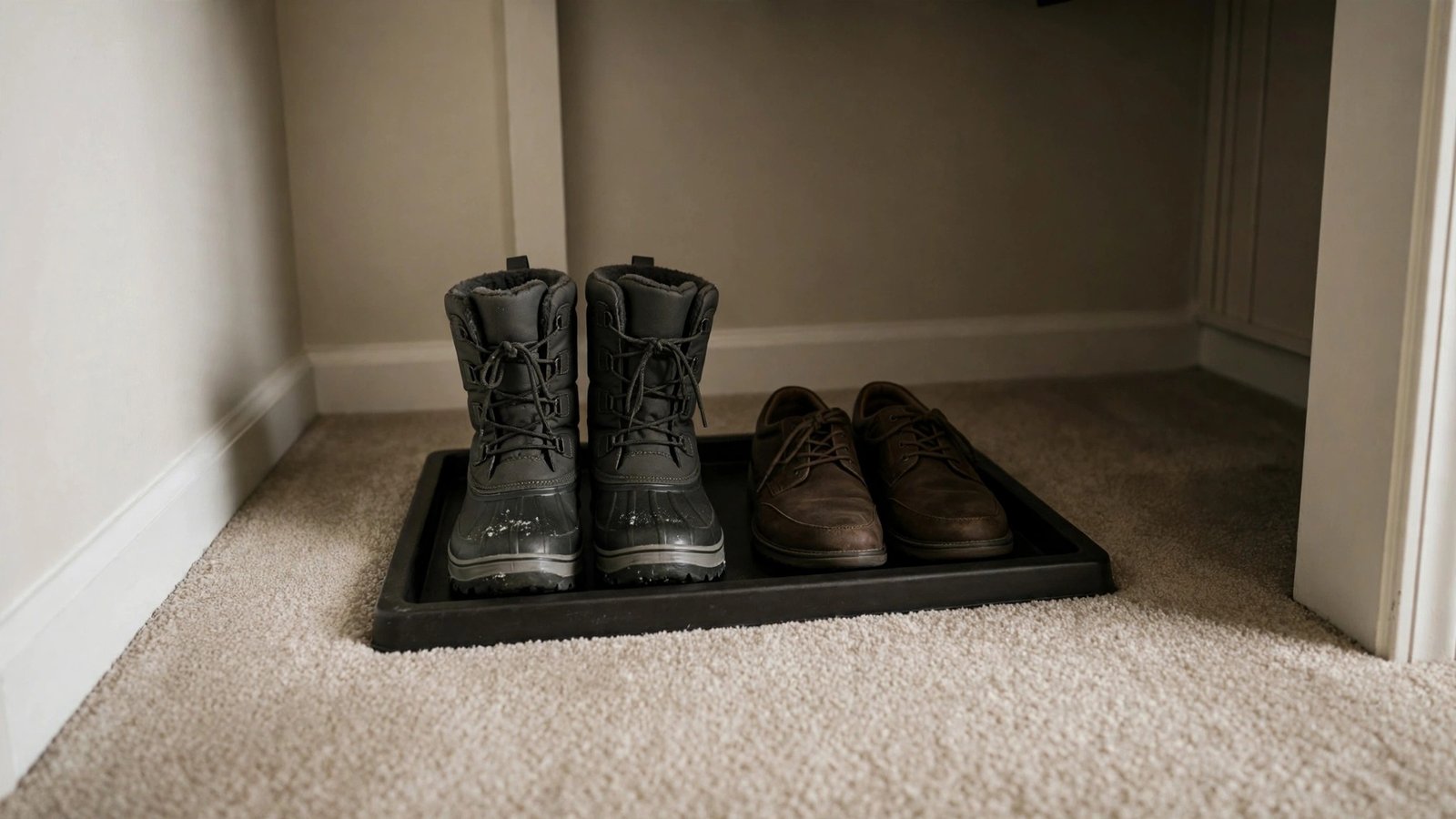
Holiday visits mean winter shoes, and winter shoes mean slush, salt, and grit marching across your floors. A simple drip tray or shallow boot mat at the base of the guest closet corrals all of it. Guests get a clear “shoes go here” signal without you having to say a word, and your carpet or wood floors survive December.
For renters this is pure damage prevention — which is to say, deposit protection. A $15 tray is dramatically cheaper than an argument with a landlord about salt-stained carpet. I’ve watched hosts try to handle this with a towel on the floor; it slides, it soaks through, and it looks sad. A proper tray with a raised edge looks intentional and does the job all season.
- Measure the closet base or the floor space just outside the closet door.
- Set a drip tray or shallow boot mat there, sized for two to three pairs of shoes.
- Wipe it clean before guests arrive so it reads as prepared, not grimy.
- If your floors are light carpet, slip a washable runner under the tray for extra insurance.
- Empty and wipe the tray between guests if you’re hosting in waves.
Approximate cost: $12–$25.
7. Stage Guest Linens in a Labeled Basket
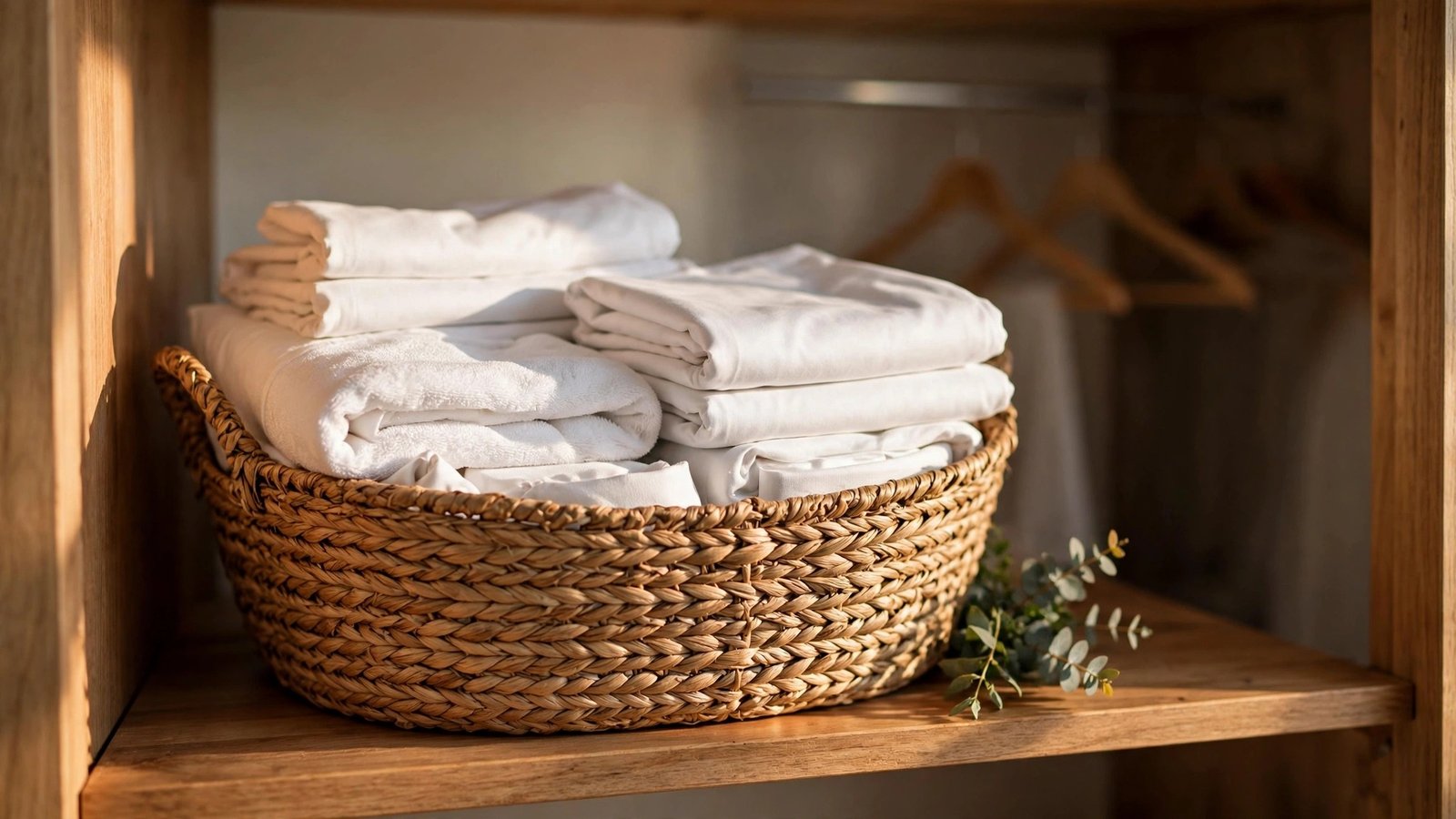
Fresh sheets and towels are the difference between “crashing at someone’s place” and “staying as a guest.” Staging a set of guest linens in an open basket on the cleared closet shelf means visitors can help themselves without opening your linen closet, rifling through your personal towels, or asking you for the third time where the washcloths are.
Renters win here because the basket doubles as decor and storage in one move, with nothing mounted or altered. I’ve noticed guests treat a staged basket as a little gift — they smile when they see it. Use your nicest spare set, fold everything uniformly, and roll the washcloths; the presentation costs nothing extra and reads as genuinely thoughtful. And when the visit ends, the basket goes right back to being your everyday linen storage.
- Wash and fully dry one complete set: sheets, pillowcases, two bath towels, two washcloths.
- Fold everything to roughly the same size and stack largest on the bottom, smallest on top.
- Place the set in an open-top basket or tote on the cleared closet shelf at a reachable height.
- Tuck in one small extra — a spare blanket or a travel-size lotion — as the welcome touch.
- Refill or rewash the set between guest waves so every arrival feels like the first.
Approximate cost: $0 if you own a spare set; $25–$50 for a new budget sheet set.
8. Lean a Small Mirror Instead of Mounting One
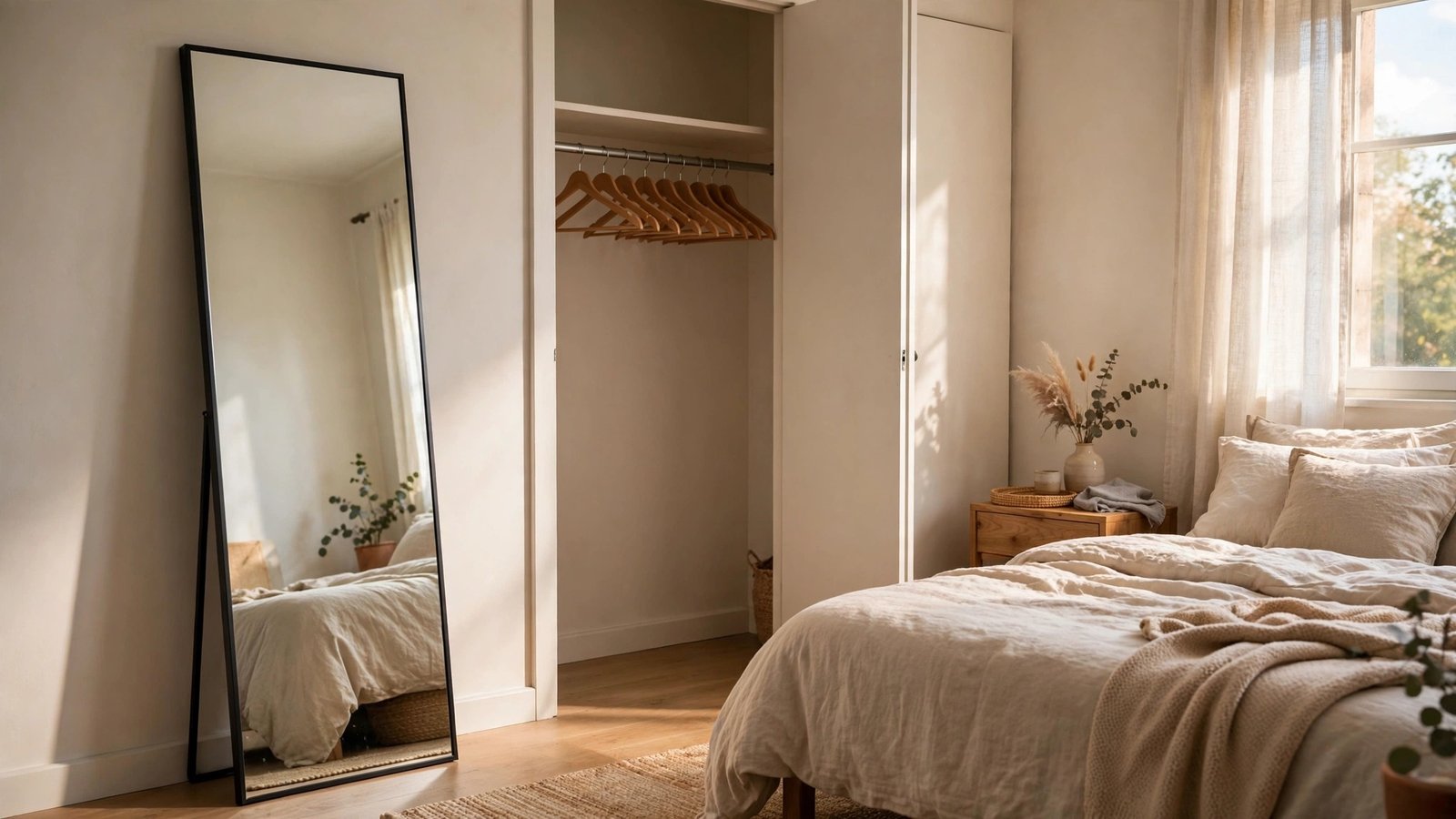
Guests need to check how they look before heading out to holiday dinners, and a dark rental hallway is not the place to do it. A tall, slim mirror leaned against the wall near the closet — never mounted, never drilled — gives them a dressing station and makes the whole space feel bigger and brighter.
Leaning mirrors are one of my favorite renter moves because they dodge the lease entirely: no holes, no anchors, no weight limits to argue about. Pick a mirror with a wide, stable base and lean it at a slight angle against a wall that gets some light. I’ve used this trick in studios where the “guest area” was a curtained corner, and the mirror made that corner feel like a deliberate dressing nook instead of a compromise.
- Choose a full-length or three-quarter mirror with a sturdy frame and a wide footprint.
- Place it against a wall near the closet, angled slightly, with the bottom at least a foot from the baseboard for stability.
- Check that it catches natural or lamp light — a mirror in a dark corner helps nobody.
- Keep the floor in front of it clear so guests can step back and see a full outfit.
- When guests leave, the mirror moves wherever you want it — it’s furniture, not a fixture.
Approximate cost: $30–$60 for a basic leaning mirror; $0 if you already own one you can relocate for the visit.
9. Light the Closet With a Battery Motion Light
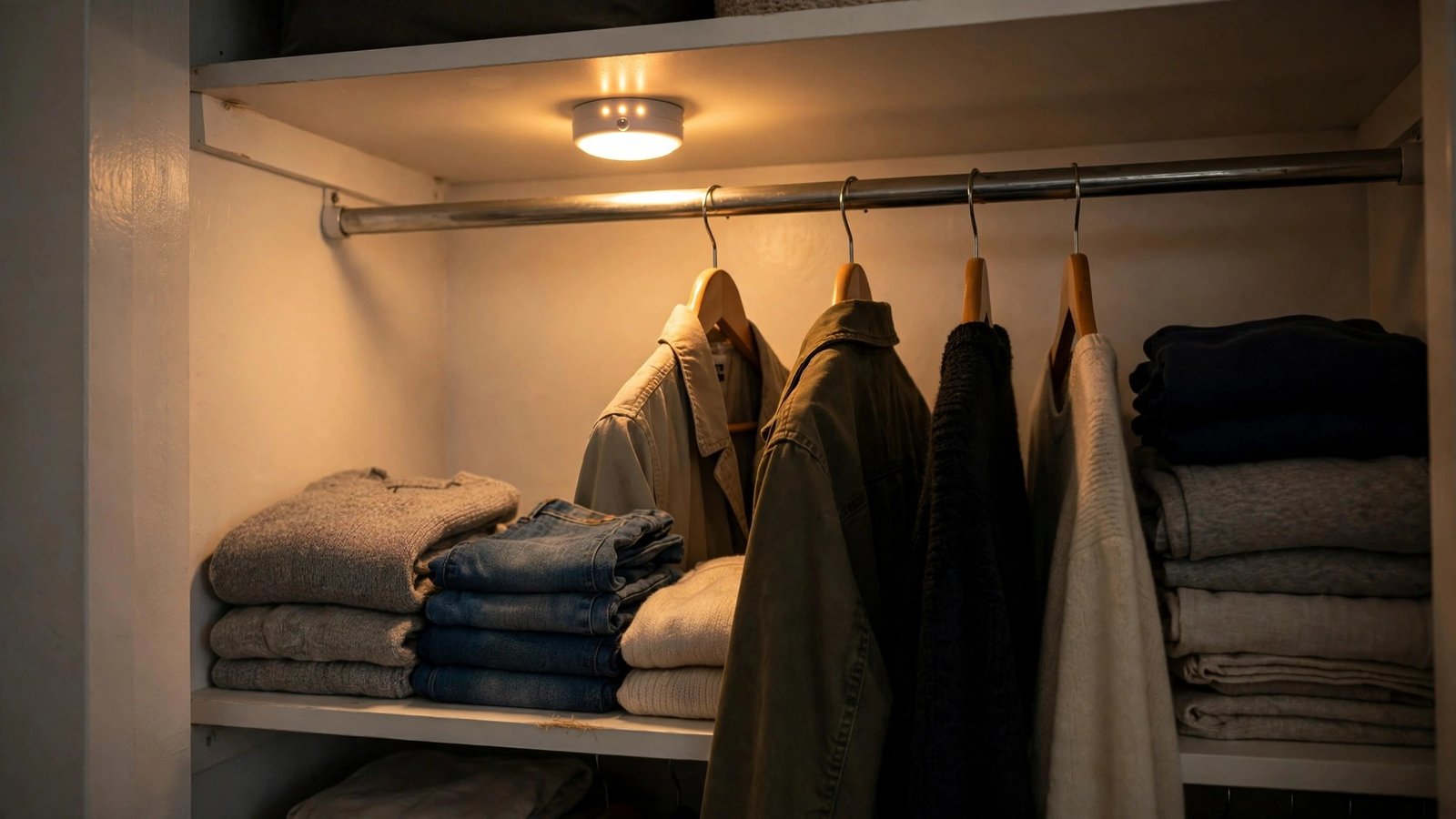
Most rental closets are caves. One dim bulb — if there is a bulb at all — and guests are dressing by phone flashlight. A battery-powered motion-sensor puck light changes that instantly: it sticks on with a magnetic back or removable adhesive, clicks on when the door opens, and turns itself off. No wiring, no electrician, no lease violation.
I’ve added these to rentals where the closet had literally no fixture, and the effect is outsized. Guests can actually see the hangers, find their shoes, and read clothing tags. Because it’s motion-activated, there’s nothing to explain and nothing for guests to forget to turn off. At move-out, it pops off the wall and moves to your next place.
- Buy a battery-powered motion-sensor puck or strip light — the magnetic-back style is easiest to reposition.
- Mount it high inside the closet, angled toward the rod, using its included removable adhesive or magnet.
- Open and close the door a few times to confirm the sensor triggers reliably.
- Keep a spare set of batteries in a nearby drawer so a dead light never surprises a guest mid-visit.
- Pop it off and pack it when you move; it leaves no trace.
Approximate cost: $8–$18 for a one- or two-pack.
10. Freshen the Air the Renter-Safe Way

Closets develop a smell — stale air, old shoes, that faint cardboard aroma of storage. You can’t Febreze your way to hospitality for three days straight, and plug-in fresheners are a non-starter in a closet with no outlet (and many landlords frown on them anyway). The renter-safe answer is passive: scent sachets, dried lavender bundles, and a small open container of baking soda tucked on the shelf.
Passive freshening is perfect for rentals because there’s nothing plugged in, nothing sprayed on walls, and nothing that could stain. I’ve tucked sachets into guest closets for years, and guests always comment on it — “it smells so nice in here” is one of the most common compliments a host can get, and it costs almost nothing. Baking soda quietly absorbs odors while the sachets add the pleasant top note.
- Place two or three scent sachets on the closet shelf — one near the hangers, one near the linens.
- Tie a small bundle of dried lavender or eucalyptus and hang it from a hanger hook or the rod end.
- Set a small open jar or bowl of baking soda on the shelf’s back corner to absorb mustiness.
- Keep scents light and natural — strong fragrance in a small closed closet overwhelms fast.
- Replace sachets each holiday season; they fade after a few months.
Approximate cost: $5–$12.
11. Build a Tiny Wrinkle-Rescue Kit
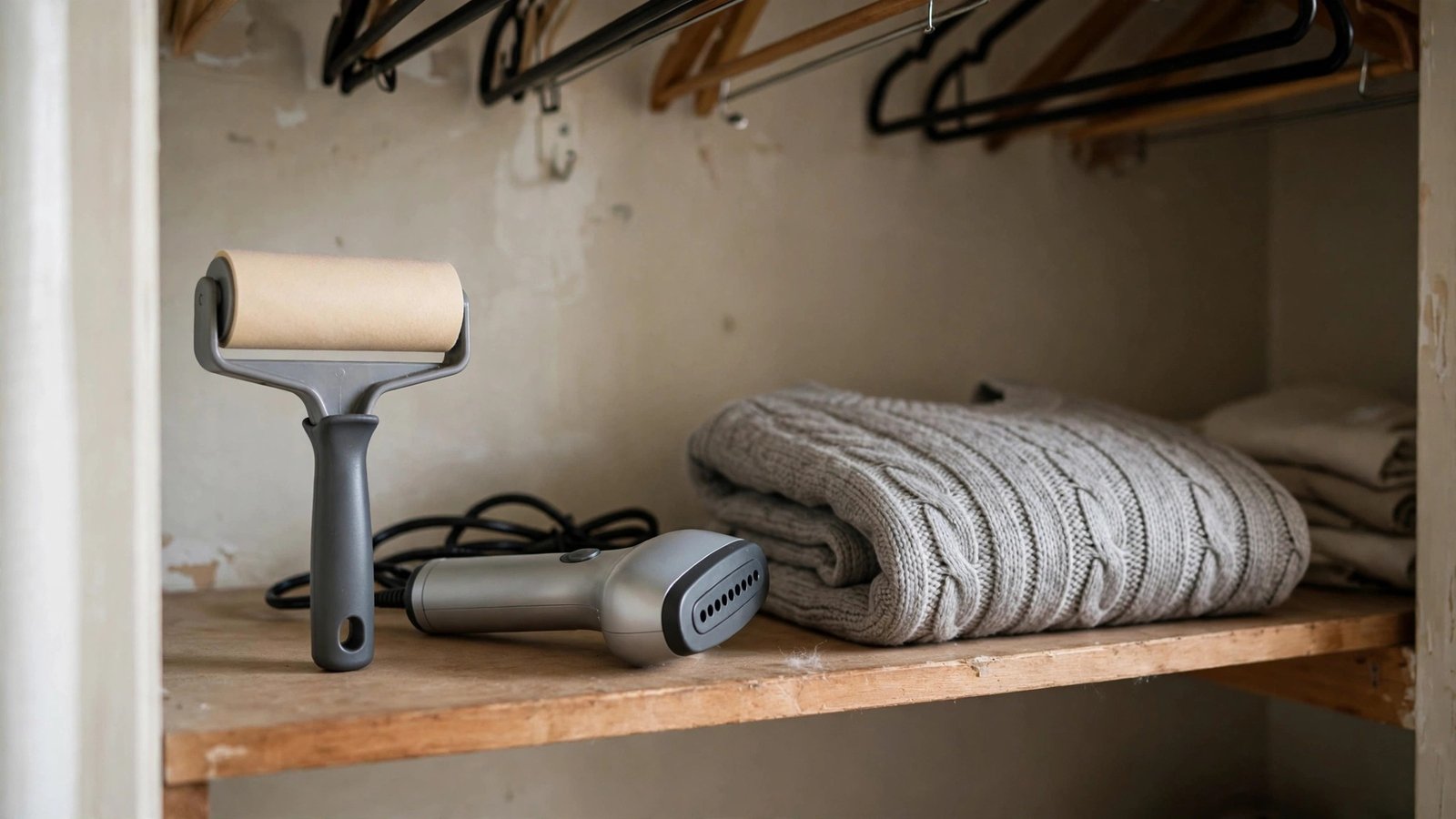
Suitcases wrinkle clothes — it’s physics, not a packing failure. A tiny wrinkle-rescue kit in the guest closet saves your visitors from arriving at holiday dinner looking like they slept in their outfit. All it takes is a lint roller and a small spray bottle of wrinkle-release solution, standing together on the shelf where guests can’t miss them.
This idea earns its place because it solves a problem guests are too polite to mention. I’ve watched visitors try to smooth a wrinkled shirt with damp hands in a bathroom; handing them the tools instead is pure hospitality. Everything sits on the shelf — nothing mounted, nothing plugged in — so it passes the renter test without a second thought. A handheld steamer is a lovely upgrade if you already own one, but the spray-and-roller combo handles most holiday fabrics just fine.
- Stand a lint roller upright on the guest closet shelf — visible, not buried.
- Add a small spray bottle of wrinkle-release solution beside it (decant into a plain bottle if you prefer a clean look).
- If you own a handheld steamer, plug-free storage on the shelf works too; guests can use it in the bathroom.
- Include a small note? Skip the note — the placement says it all. Visible tools get used; hidden ones don’t.
- Check the roller sheet count after each guest wave and refill as needed.
Approximate cost: $6–$12 for the roller and spray.
12. Finish With One Small Welcome Touch
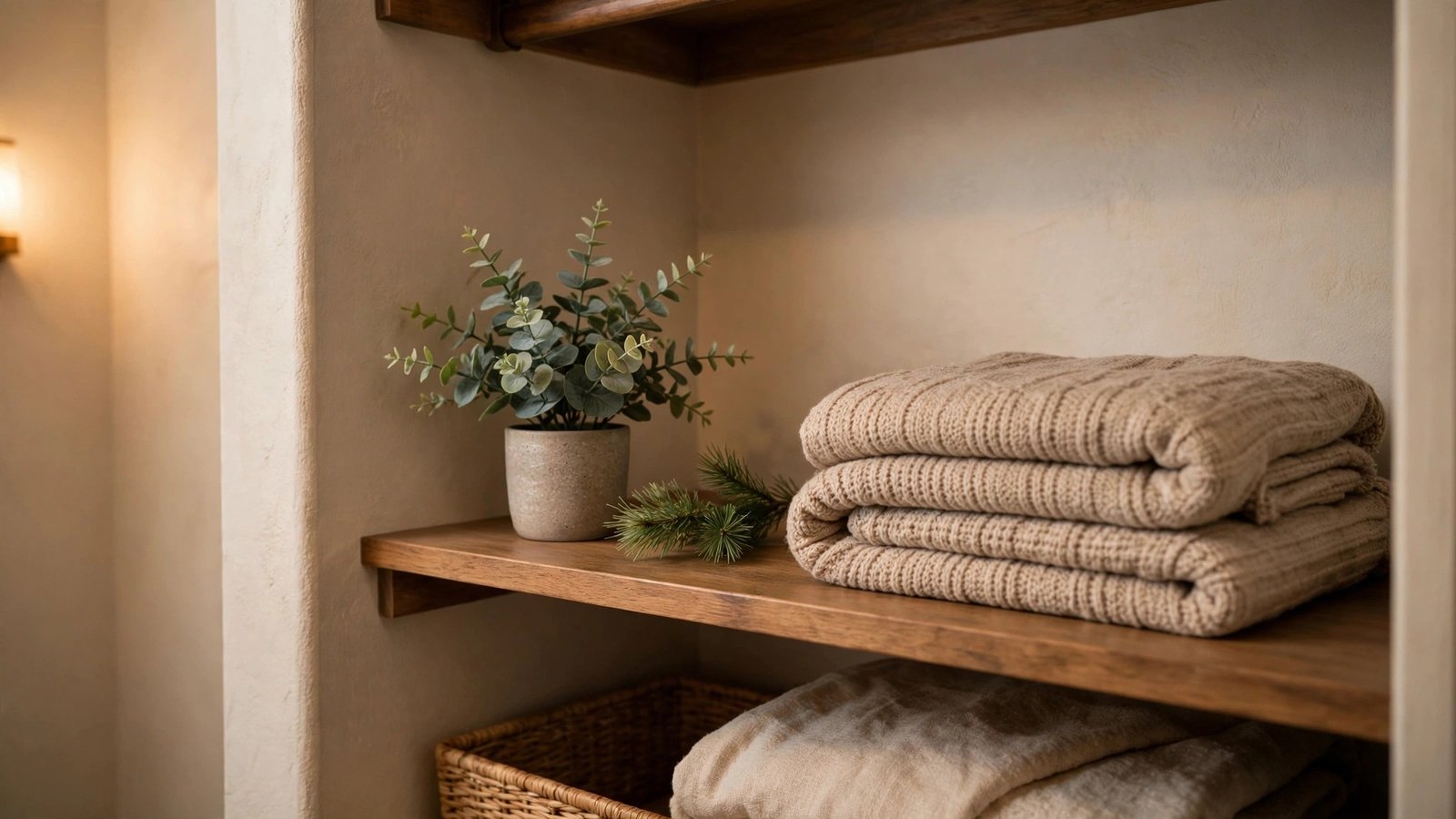
After all the practical work, add one thing that has no function at all: a small potted plant, a pine sprig in a jar, a folded throw blanket in a holiday color, a little dish for jewelry and watches. This is the detail guests photograph and remember. It says the closet wasn’t just cleared — it was styled for them.
Renters sometimes skip this step because it feels extra, but I’ve found it’s the step that makes everything else land. A bare-but-functional closet reads as efficient; the same closet with one living green thing reads as loved. Keep it small and unbreakable — a faux eucalyptus sprig never needs watering and survives being knocked by a suitcase, which a real orchid will not. Everything here sits on a surface and lifts away, so the renter test is a formality.
- Pick one welcome object: a small faux plant, a seasonal sprig in a jar of water, or a folded throw in a festive color.
- Place it on the closet shelf where it’s the first thing seen when the door opens — not hidden behind the linens.
- Add a tiny dish or tray beside it as a catch-all for guests’ rings, watches, and pocket change.
- Keep it low and stable so a swinging suitcase can’t knock it over.
- After the holidays, the plant and dish move into your everyday decor — nothing wasted.
Approximate cost: $0–$15.
A Guest Closet That Says “We Were Waiting for You”
Here’s what I want you to take from all twelve ideas: a welcoming guest closet was never about square footage or built-ins. It’s about the message. Every cleared shelf, every matching hanger, every small light that clicks on when the door opens tells your visitors the same thing — you were expected, you have a place here, and someone thought about you before you arrived.
And the renter’s version of this might be the best version. Because you couldn’t drill, you chose the freestanding rack. Because you couldn’t renovate, you staged instead. Constraints made the welcome more intentional, not less. I’ve seen guest closets in big owned homes that felt colder than a studio closet prepped with these twelve steps, simply because the studio host cared more.
Start this weekend, one idea at a time, and give yourself the full afternoon — you’ll be amazed how far a cleared shelf and ten matching hangers carry you. Your guests will notice, even if they never say a word about the closet itself. They’ll just say the visit felt easy. That’s the whole goal.
Please save this visual guide on Pinterest and share it with every renter friend who hosts the holidays — a little closet prep goes a long way toward a warm welcome.

Amelia leads HavenlyStyle’s editorial vision with a passion for elegant interiors and practical home living. With years of experience in home décor and lifestyle content, she ensures every article is accurate, inspiring, and easy to follow. From timeless decorating ideas to the latest interior design trends, Amelia is committed to helping readers create beautiful, functional spaces while maintaining HavenlyStyle’s trusted and welcoming voice.