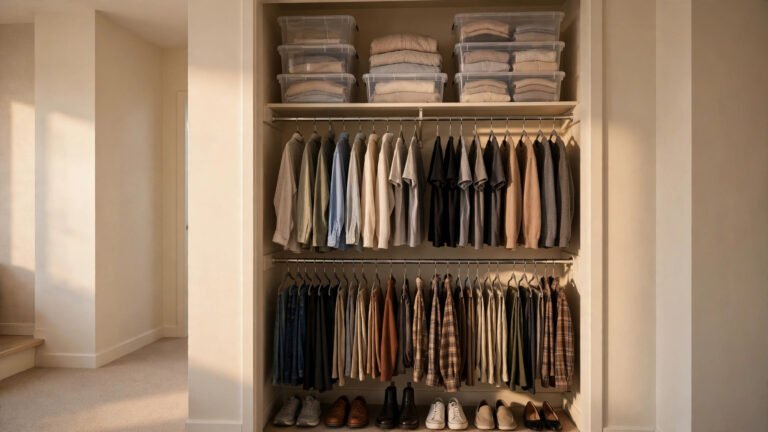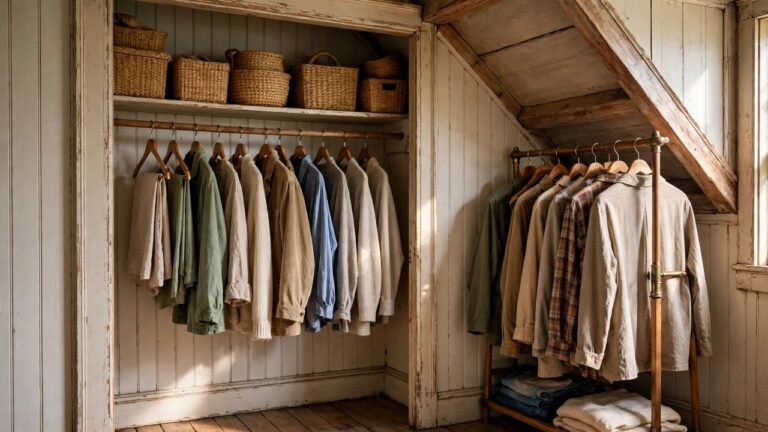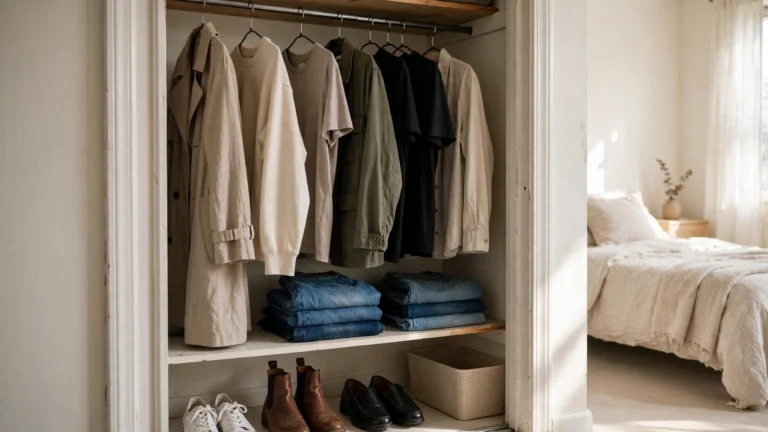
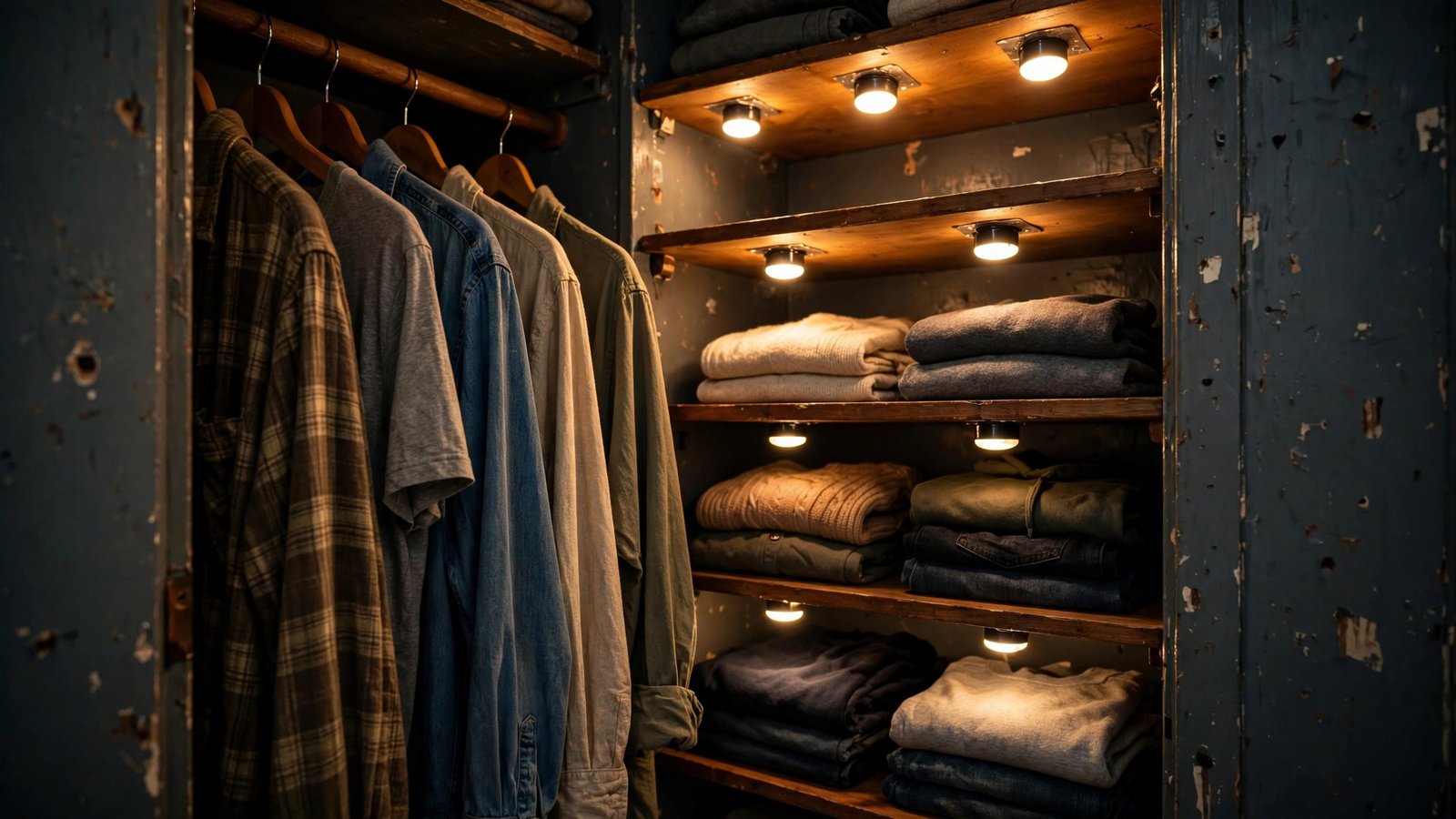
If you’ve ever dug through a rental closet that goes pitch black the second you push the door open, you already know this pain. No fixture, no switch, no way to see which black sweater is actually navy — and the one thing every hardware-store solution assumes is that you own the place and can drill into it. Renters can’t. Most leases forbid hardwiring, drilling into ceilings, or anything an electrician would call “a real installation.”
I’ve helped dozens of renters solve exactly this problem, and the good news is that closet lighting is one of the easiest renter upgrades to pull off. Modern battery and adhesive lighting has gotten genuinely good: warm, bright, motion-activated lights that stick on, peel off, and leave your deposit untouched. No electrician, no landlord permission needed for adhesive and battery options, and nothing you can’t undo in ten minutes on moving day.
These twelve ideas are ordered by impact — start at the top and your dark closet will likely be fixed by idea three. Every one is removable or reversible, and anywhere an option even brushes against your lease, I’ll flag it.
Executive Summary
- Battery-powered motion-sensor puck lights are the single best fix: stick them under shelves and your closet lights itself up.
- Adhesive LED strips and rechargeable magnetic bars give you even, strip-style light with zero drilling — they peel off clean at move-out.
- Motion sensors and door-activated switches mean you never fumble for a switch; the light appears exactly when you need it.
- No outlet needed for 10 of 12 ideas — everything is battery or rechargeable; plug-in options are flagged only where an outlet exists.
- Boosters count too: light-colored shelf liners, a mirror, and a pale back wall bounce the light you add and make every lumen work harder.
1. Stick-On Motion-Sensor Puck Lights Under Shelves

The single highest-impact fix for a dark rental closet. These are small round battery-powered LED discs — about the size of a hockey puck — with an adhesive pad on the back. Stick one or two under each shelf and the closet lights itself up when you reach in. I’ve personally seen a single six-pack of puck lights turn a cave-dark reach-in closet into something that looks like it has a real fixture.
Why it works for renters: nothing is drilled, wired, or screwed in. The adhesive pads come off with a gentle twist or a little dental floss behind the pad, and the batteries are standard AA or AAA, so there is no charging routine to maintain. Because each puck has its own motion sensor, they only turn on when you’re actually in the closet, so batteries typically last months, not weeks.
How to do it:
- Measure your shelf widths and buy enough pucks for one or two per shelf section (a 6- or 12-pack typically covers a reach-in closet).
- Wipe the underside of each shelf with a dry cloth so the adhesive grabs — dust is the main reason pucks fall off.
- Peel the adhesive backing and press each puck firmly under the shelf, toward the front edge, so light washes down over your clothes.
- Test by closing the door and reopening it (or waving a hand) — the motion sensor should trigger in under a second.
- Set a phone reminder every 4–6 months to swap batteries, since dead pucks in a dark closet are easy to ignore.
Approximate cost: roughly $8–$20 for a multi-pack of six or more. Fully renter-safe — adhesive and battery only, no landlord permission needed.
2. Adhesive-Backed Motion-Sensor LED Strips Along Shelf Lips
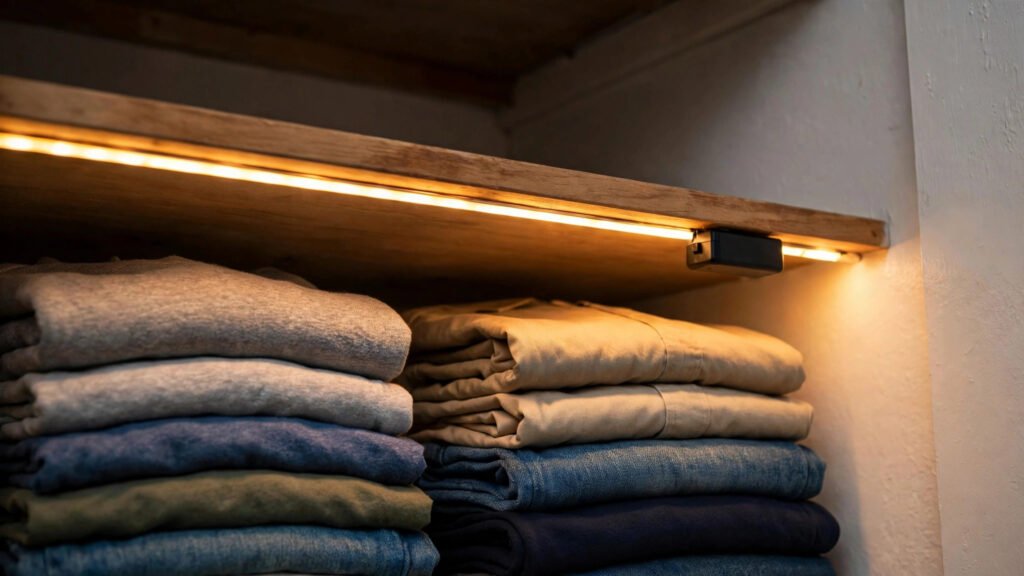
If pucks give you pools of light, adhesive LED strips give you an even wash of light with no dark bands — closer to what a real closet fixture looks like. These flexible strips run on batteries or a rechargeable pack, come with adhesive backing, and include a motion sensor so they switch on when the door opens.
Why it works for renters: the whole strip is peel-and-stick. The good ones use a strong but removable adhesive, and at move-out you can soften the bond with a hair dryer and lift the strip off without damaging paint or laminate. Cut the strips at the marked points to fit narrow shelves — one strip under the top shelf often lights an entire reach-in closet.
How to do it:
- Measure the shelf or vertical frame where the strip will live, and cut the strip only at the printed scissor marks.
- Clean the mounting surface with a dry cloth; for laminated rental shelves, a quick wipe with rubbing alcohol helps adhesion.
- Peel the backing and press the strip along the front lip of the shelf or down a vertical divider, holding it in place for 30 seconds.
- Position the motion sensor end toward the door opening so it catches movement as you step in.
- Test at night with the door closed — if one corner stays dark, add a short second strip rather than repositioning the first.
Approximate cost: roughly $12–$30 per reel or kit. Fully renter-safe — peel-and-stick, battery or rechargeable, no tools, no permission needed.
3. Rechargeable Magnetic LED Bars Under Hanging Sections
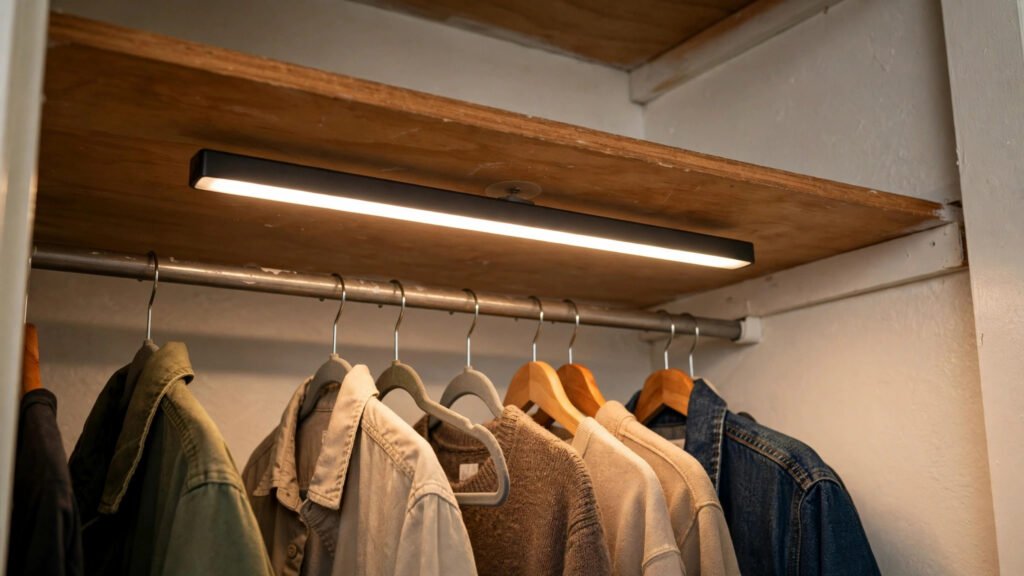
For the long hanging section where shirts and dresses hang in a row, a single slim LED bar beats scattered pucks. These bars mount with a thin adhesive metal plate — the light itself snaps on magnetically — and recharge through a USB cable, so there are no batteries to buy at all.
Why it works for renters: when the bar needs charging, you just pull it off the magnet, charge it at your desk overnight, and snap it back on. Nothing is wired, and the adhesive plate is small and removable. I’ve noticed renters love this one because it feels like the most “finished” option — one clean bar of light, no clutter of discs.
How to do it:
- Stick the adhesive metal plate to the underside of the shelf above your hanging section, centered over the clothes.
- Let the adhesive cure for the time the package recommends (usually a few hours) before attaching the bar.
- Snap the LED bar onto the magnet and test the motion-sensor mode by stepping back and approaching the closet.
- Run the included USB cable to the bar once every 1–3 months, depending on how often the sensor triggers.
- At move-out, peel the metal plate off — warm it with a hair dryer first if it resists, and any residue lifts with rubbing alcohol.
Approximate cost: roughly $15–$35 per bar. Fully renter-safe — adhesive and magnetic, rechargeable, no permission needed.
4. Clip-On Closet-Rod Lights
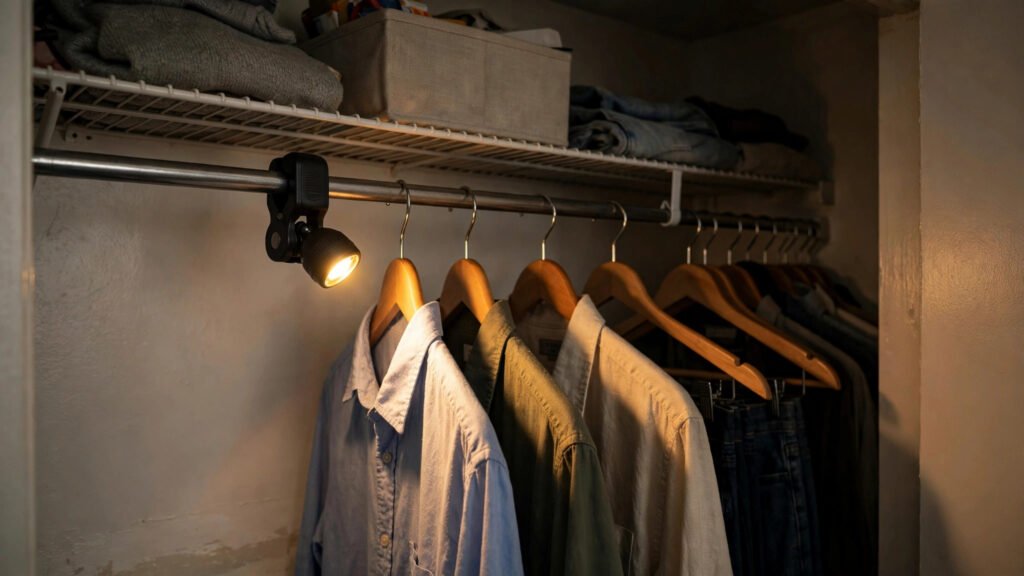
Some closet areas — the rod itself, a high shelf you can’t easily reach, a vertical side panel — just don’t have a flat surface for a puck or strip. Clip-on lights solve that: they clamp directly onto the closet rod or a shelf edge, swivel to aim the light where you want it, and run on batteries.
Why it works for renters: a clamp is the most reversible mount in existence. No adhesive residue, no holes, nothing to explain at move-out. Aim one down at the rod for your hanging clothes and another at the shoe area below, and a walk-in corner that was pure shadow becomes fully visible.
How to do it:
- Open the clamp and clip it onto the closet rod near the section you want lit — position it so the light head can swivel freely.
- Aim the head downward at a slight angle so it washes across the hanging clothes rather than blasting into your eyes.
- If your closet has a second zone (shoes, bins on the floor), clip a second light lower, aimed at that zone.
- Use the light’s motion or touch mode per your preference — motion is better if your hands are full of clothes.
- Swap batteries every few months; keep a spare set in a labeled bin so you don’t put it off.
Approximate cost: roughly $10–$25 for a set of two or more. Fully renter-safe — clamps only, zero surface damage, no permission needed.
5. Door-Activated Sensor Lights That Turn On When the Door Opens

This is the closest you can get to “real” closet lighting behavior without wiring: a small light with a sensor that detects the door opening and closing. Open the door — the light comes on. Close it — the light goes off. It mounts on the door jamb or frame with adhesive, runs on batteries, and needs no electrician or wall switch at all.
Why it works for renters: it behaves exactly like the wired closets in nicer homes, but it’s completely self-contained. The sensor mounts with adhesive pads on the jamb, so there is no contact with the door mechanism itself and nothing to rewire later. Guests honestly can’t tell it isn’t hardwired.
How to do it:
- Choose a battery-powered door-sensor light (some use an infrared beam between two tiny units; others use a single motion sensor aimed at the doorway).
- Mount the sensor unit on the inside of the door jamb with its adhesive pad, roughly at shoulder height.
- Mount the light unit where it can flood the closet interior — under the top shelf or on the back wall with adhesive.
- Open and close the door a few times to calibrate the sensor’s range so it triggers reliably.
- Replace batteries when the light starts lagging or dimming — that’s the sign, not total darkness.
Approximate cost: roughly $10–$25 per unit. Fully renter-safe — adhesive mounting on the jamb, no wiring, no permission needed.
6. A Plug-In Motion-Sensing LED Bar Where an Outlet Exists
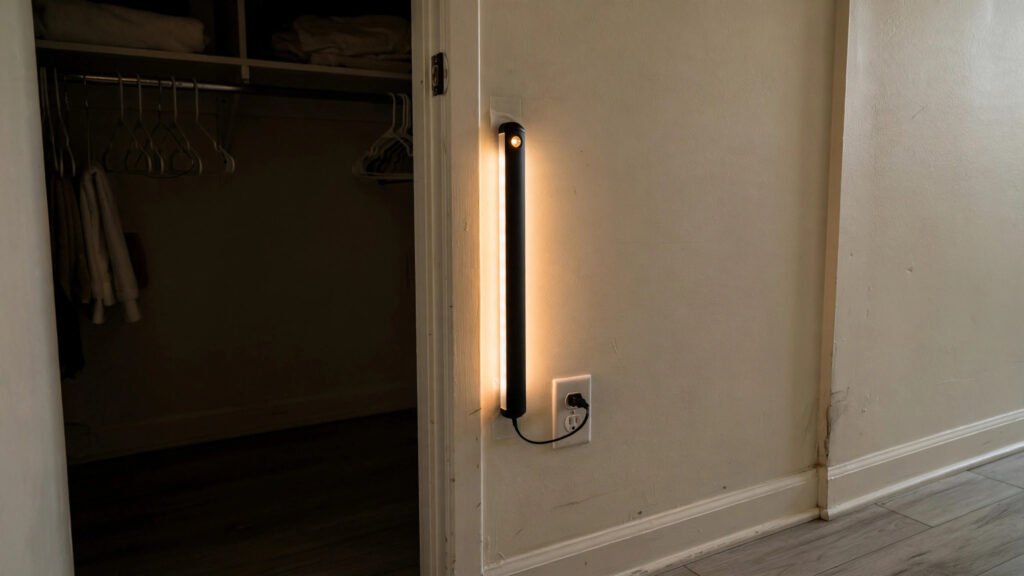
If your closet (or the wall right beside it) happens to have an outlet, a plug-in motion-sensing LED bar is the one true “set it and forget it” option — no batteries, no charging, just constant bright light whenever motion is detected. Some walk-ins have an outlet for a vacuum; some reach-ins share a wall with one.
The honest flag: many rental closets have no outlet at all, which is exactly why this idea sits at number six instead of number one. Where an outlet exists, though, this is the brightest and most maintenance-free option on the list. Never run an extension cord across a doorway or hallway to reach a distant outlet — that’s a tripping and fire hazard, and it looks terrible.
How to do it:
- Check for an outlet inside the closet first, then immediately outside it on either side of the door.
- Choose a plug-in LED bar or motion-sensor nightlight designed for closets — a low-profile design won’t snag clothes.
- Plug it into the outlet closest to the closet interior and mount the bar with its adhesive backing on the nearest shelf or wall.
- Set the sensor to motion mode (most have an always-on option — skip it; it wastes energy and light).
- Keep the outlet accessible — don’t bury it behind a storage tower you can never move.
Approximate cost: roughly $12–$25. Renter-safe since nothing is wired — but only use it where a real outlet already exists; running cords from another room is not a renter-safe move. No permission needed for plugging in a light.
7. A Rechargeable Lantern for Walk-In Closets
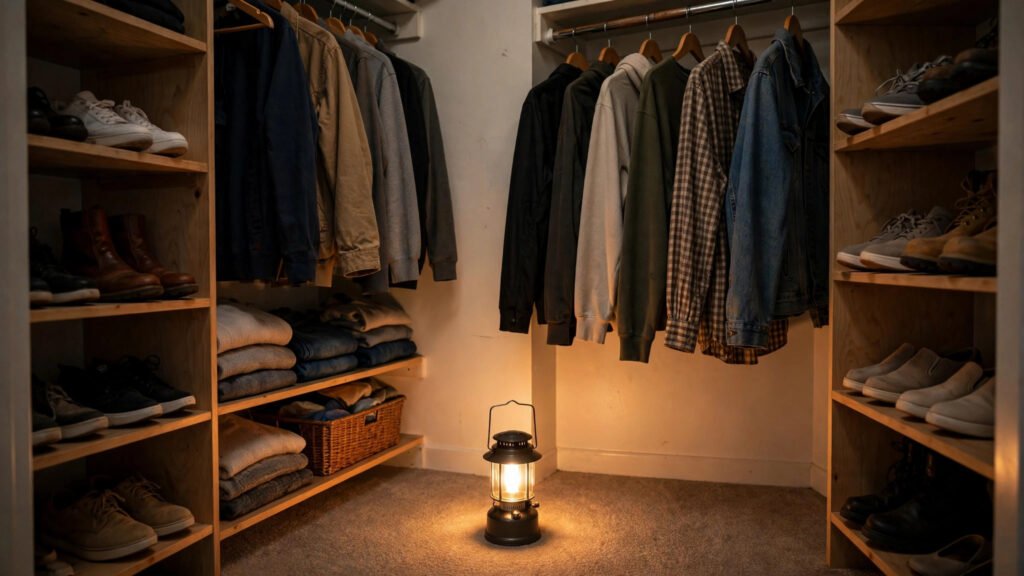
Walk-in closets with no fixture and no flat surfaces can feel unsolvable, but sometimes the simplest answer is the best: a rechargeable LED lantern sitting on the floor or on a low shelf. No mounting at all — just set it down where it can glow outward, and it lights the whole space like a small lamp.
Why it works for renters: there is literally nothing to mount, stick, or peel. A lantern lives in the closet like a piece of furniture, and it doubles as emergency lighting during a power outage. Choose a warm-white lantern rather than cool daylight — warm light makes fabric colors look truer and the closet feel like a boutique instead of a storage unit.
How to do it:
- Pick a rechargeable lantern with a warm-white setting and a stable base (tip-over is the main risk in a closet).
- Place it on the floor in the center of a walk-in, or on a low shelf in a deep reach-in.
- Charge it fully the first time, then top it up every month or two — most hold a charge for weeks.
- If the closet is large, add a small mirror behind the lantern to throw its glow further (see idea 9).
- On moving day, it goes in a box with your lamps — the only “installation” is picking it up.
Approximate cost: roughly $15–$30. Fully renter-safe — no mounting whatsoever, nothing to remove later.
8. Light-Colored Shelf Liners to Bounce the Light You Add

This is a booster idea, not a light source — and it’s the cheapest one on the list. Dark wood-tone rental shelves absorb light; pale shelf liners reflect it. Once you add any light from ideas 1–7, light-colored liners bounce that light around the closet and make every lumen work noticeably harder.
Why it works for renters: non-adhesive shelf liners just lay in place — they’re the most renter-approved product in existence. Even the adhesive versions peel off clean from laminate. Ivory, cream, or pale gray liners brighten the visual feel of the whole closet, and they protect shelves from scuffs, which your landlord will appreciate at move-out.
How to do it:
- Measure each shelf and cut the liner slightly smaller than the shelf surface so edges don’t curl over.
- Choose a light, matte color — glossy white can create glare under LED pucks; matte cream or pale gray is ideal.
- Lay the liner in place, smoothing out bubbles from the center outward.
- For wire shelves, use a thicker liner that spans the wires so small items sit flat and light reflects evenly.
- Pair it with at least one light source above — liners amplify light but can’t create it.
Approximate cost: roughly $8–$18 for a roll that covers several shelves. Fully renter-safe — removable liners, no permission needed.
9. A Mirror Inside the Door to Multiply the Glow
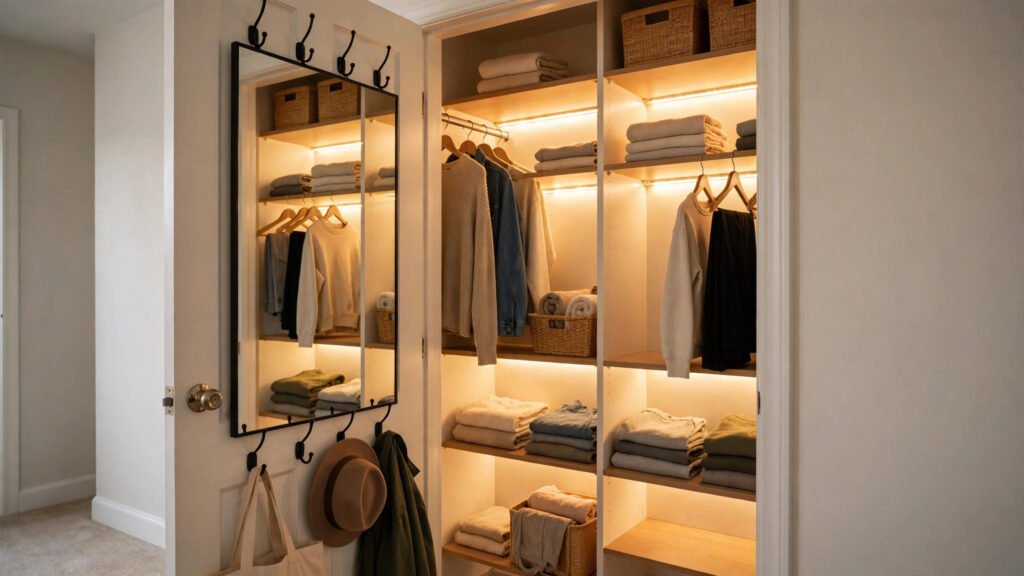
A mirror doesn’t produce light, but it doubles the light you have. Mount a full-length mirror on the inside of the closet door and the glow from your puck lights or LED bar reflects back into the space — brightening the interior and giving you a place to check outfits, which is the whole point of a well-lit closet.
Why it works for renters: over-the-door hook mirrors hang without a single screw or adhesive pad — pure gravity. Adhesive-mounted mirrors work too, as long as you use the removable mounting strips designed for them and follow the weight rating. When paired with motion-sensor lights, the mirror makes a small closet feel dramatically larger and brighter.
How to do it:
- Choose an over-the-door-hook mirror if your closet door has clearance, or a lightweight adhesive mirror with removable mounting strips.
- Hang it centered on the inside of the door so it faces your light sources when the door is open.
- If using adhesive strips, press and hold for the full recommended time and wait the full cure period before hanging the mirror.
- Angle any swivel lights (ideas 3 and 4) slightly toward the mirror to bounce extra light into dark corners.
- At move-out, lift an over-door mirror straight off; for adhesive strips, pull the tabs slowly straight down as directed.
Approximate cost: roughly $15–$35 depending on size. Fully renter-safe — over-door hooks or removable strips only, no drilling, no permission needed.
10. Removable Light-Colored Peel-and-Stick Panels on the Back Wall
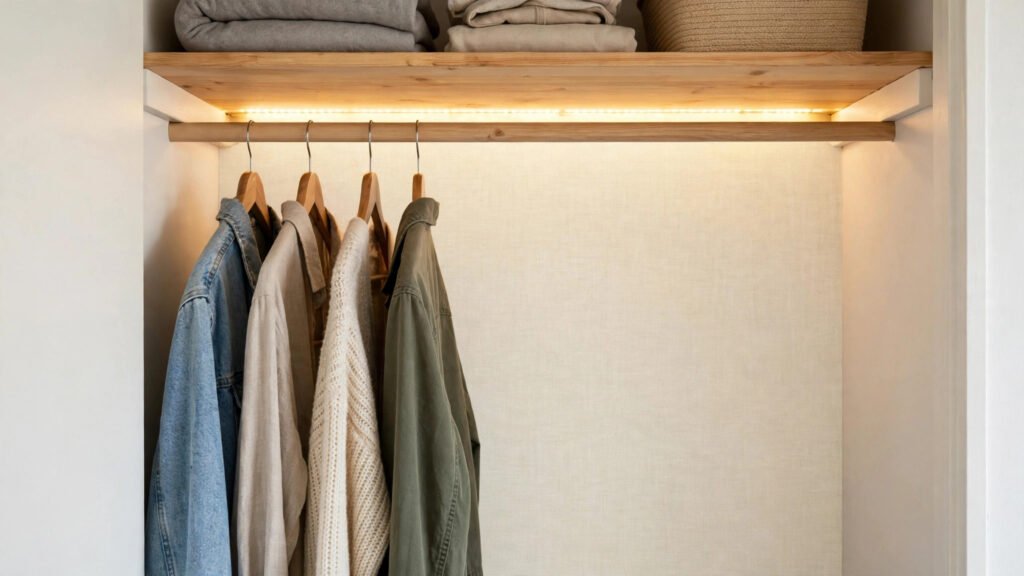
The back wall of a rental closet is usually a dingy off-white or a landlord-special beige that swallows light. A light-colored peel-and-stick wallpaper or a set of peel-and-stick wall panels on that one wall acts like a giant reflector — bouncing light forward onto your clothes — and it makes the closet look intentionally designed rather than accidentally beige.
Why it works for renters: modern peel-and-stick wallpaper is genuinely removable — it’s designed to come off in full sheets without damaging paint underneath. Keep the pattern pale and simple (a soft white, warm ivory, or light linen texture) since the goal is reflection, not distraction. One wall is enough; wrapping the whole closet is overkill and costs more.
How to do it:
- Measure just the back wall of the closet — height and width — and buy peel-and-stick wallpaper or panels to cover it.
- Pick a pale, matte finish in white, ivory, or light gray for maximum light reflection.
- Start at one corner and smooth the wallpaper down slowly, using a credit card wrapped in a cloth to push out bubbles.
- Trim around shelves with a utility knife, cutting conservatively — you can always trim more.
- At move-out, peel from a bottom corner slowly and steadily; if a spot resists, warm it with a hair dryer.
Approximate cost: roughly $20–$40 for enough to cover one closet wall. Renter-safe by design — peel-and-stick is made for rentals — but if your lease specifically restricts adhesive products on walls, check with your landlord first; this is the one idea on the list worth a quick ask if you’re unsure.
11. Mini Tap Lights Inside Storage Bins and Drawers
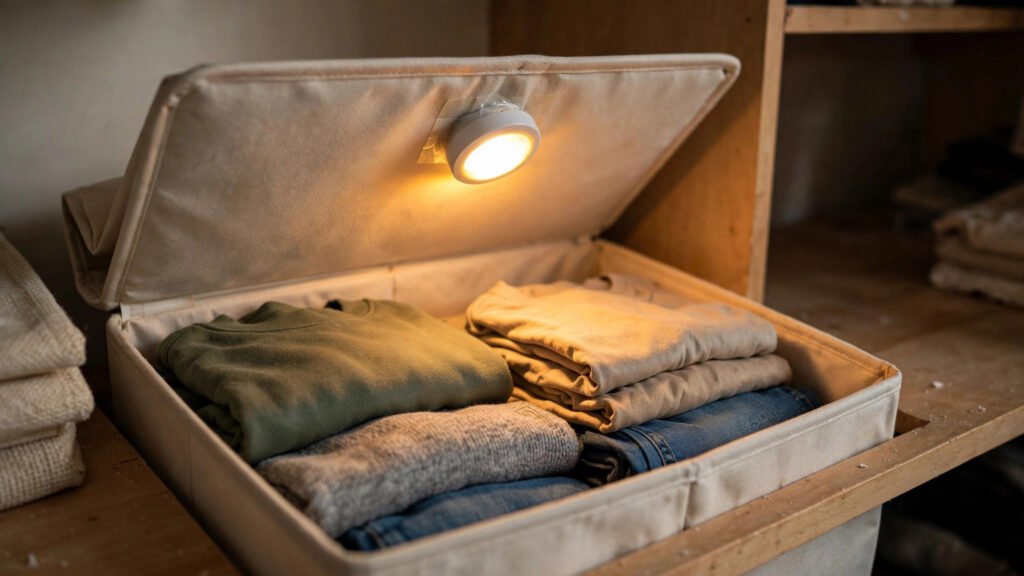
Closet darkness isn’t only about the big space — it’s about the bins, fabric drawers, and storage boxes stacked on closet shelves. You open a lidded bin in a dim closet and you’re guessing at what’s inside. Tiny battery-powered tap lights — small round lights you press to switch on — stick to the inside lid of a bin and solve that specific darkness.
Why it works for renters: these are the same adhesive-and-battery DNA as the puck lights, just smaller and manual. They add no wiring and leave no trace. I recommend them specifically for the bins you use most — seasonal clothes, accessories, linens — so you’re not fumbling with a flashlight while holding a door open.
How to do it:
- Identify the 3–5 bins or drawers you open most often in the closet.
- Stick one mini tap light to the inside of each bin’s lid with its adhesive pad — lid placement means light shines down onto contents.
- Press to test; the click mechanism should feel firm, not mushy.
- Replace the small coin batteries about once a year — they’re tiny and last a long time with occasional use.
- For fabric drawers without lids, stick the tap light to the inside front panel so it lights the contents when you pull the drawer open.
Approximate cost: roughly $8–$18 for a pack of six or more. Fully renter-safe — adhesive and battery only, no permission needed.
12. Swap the Closet Door for a Light Curtain to Let Room Light In
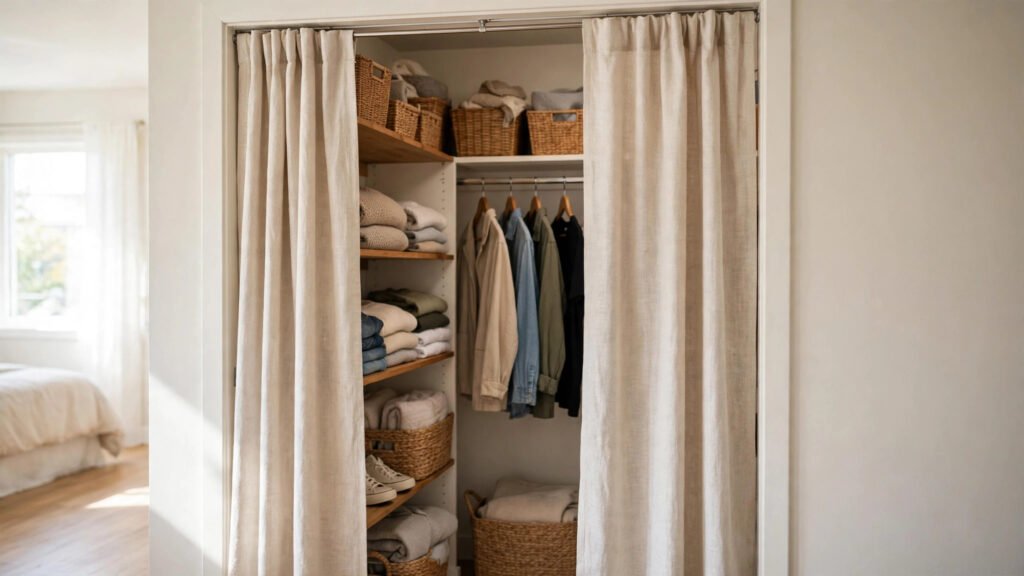
The boldest idea on the list, saved for last: many dark closets are dark mostly because a solid door seals them off from the room’s light. If you remove the closet door, store it carefully, and hang a light-colored curtain on a tension rod instead, your bedroom’s ambient light floods the closet all day — no batteries, no charging, ever.
The honest flag: removing a door is reversible (the hinges go right back on), but doors are heavy and awkward, and a dinged door at move-out is a real deposit risk. Check your lease or ask your landlord first — some leases prohibit removing doors. If you get the okay, store the door flat under a bed or behind furniture, never leaning where it can warp or fall.
How to do it:
- Confirm with your landlord that temporarily removing the closet door is acceptable.
- Have someone help you lift the door off its hinges — label the hinge screws in a baggie taped to the door so nothing gets lost.
- Store the door flat in a safe spot where it won’t warp, warp being the enemy of a clean rehang.
- Mount a tension rod inside the door frame and hang a light-colored, light-filtering curtain (linen-look or sheer panels work well).
- Enjoy a closet that borrows your room’s light all day — then rehang the door at move-out exactly as it was.
Approximate cost: roughly $15–$30 for a tension rod and curtain panels. Reversible — but this is the one idea that needs landlord permission, so get the okay first.
Conclusion
A dark rental closet is one of those problems that feels permanent until you fix it in an afternoon. You don’t need an electrician, a drill, or your landlord’s blessing for eleven of these twelve ideas — a handful of battery-powered pucks or one adhesive LED strip will take most closets from cave-dark to fully usable, and the boosters (pale liners, a mirror, a lighter back wall) make the light you add go further.
Start with idea one, add a second light if the corners are still shadowy, and layer in a booster or two. The next time you open that closet door, the light will already be waiting for you — and when moving day comes, everything peels off, unclips, or lifts out in minutes, deposit intact. That’s the renter way: make it beautiful, keep it reversible.
Please save this visual guide on Pinterest and follow along for more renter-friendly organization ideas that respect your lease and your deposit.

Amelia leads HavenlyStyle’s editorial vision with a passion for elegant interiors and practical home living. With years of experience in home décor and lifestyle content, she ensures every article is accurate, inspiring, and easy to follow. From timeless decorating ideas to the latest interior design trends, Amelia is committed to helping readers create beautiful, functional spaces while maintaining HavenlyStyle’s trusted and welcoming voice.