A windowless living room can feel like a design dead end. You walk in, there’s no daylight, no view, no natural focal point — just four walls and a ceiling light that makes everything look flat and a little tired. If you’re renting, it feels even more unfair, because the usual fixes (knock out a wall, add a skylight, repaint everything white) are exactly the things your lease forbids.
I’ve helped dozens of renters turn windowless living rooms into rooms people actually want to spend time in, and I’ve learned that the absence of windows is a lighting and layering problem, not a square-footage problem. A room with no windows doesn’t need more stuff — it needs light at the right heights, reflective surfaces that bounce that light around, and one strong focal point to replace the view you don’t have. Get those three things right, and guests will stop noticing the missing windows entirely.
Every idea below is deposit-safe and renter-friendly. Nothing requires paint, drilling, or wiring, and everything comes down or moves out when your lease ends. Pick the three or four ideas that fit your room and your budget — a windowless room rewards restraint, because a few well-lit layers beat a room stuffed with decor every time.
Executive Summary
- A windowless room is a lighting problem first: layer light at three heights (overhead, eye level, and low) instead of relying on one harsh ceiling fixture.
- Mirrors and glass furniture bounce your existing light around the room, doubling its effect without a single new bulb.
- A faux window — curtains framing a backlit print or a light panel — gives your eye the “view” it expects and becomes an instant focal point.
- Light colors on big surfaces (slipcovers, rugs, wallpaper) lift the whole room, while dark, heavy pieces make a windowless space feel smaller.
- Tall plants, open shelving, and a ceiling pendant add life, airiness, and a sense of height that flat walls can’t provide on their own.
- Every idea below is removable: Command hooks, tension rods, peel-and-stick products, and freestanding pieces only — no paint, no drilling, no landlord permission needed.
1. Build a Three-Layer Lighting Plan
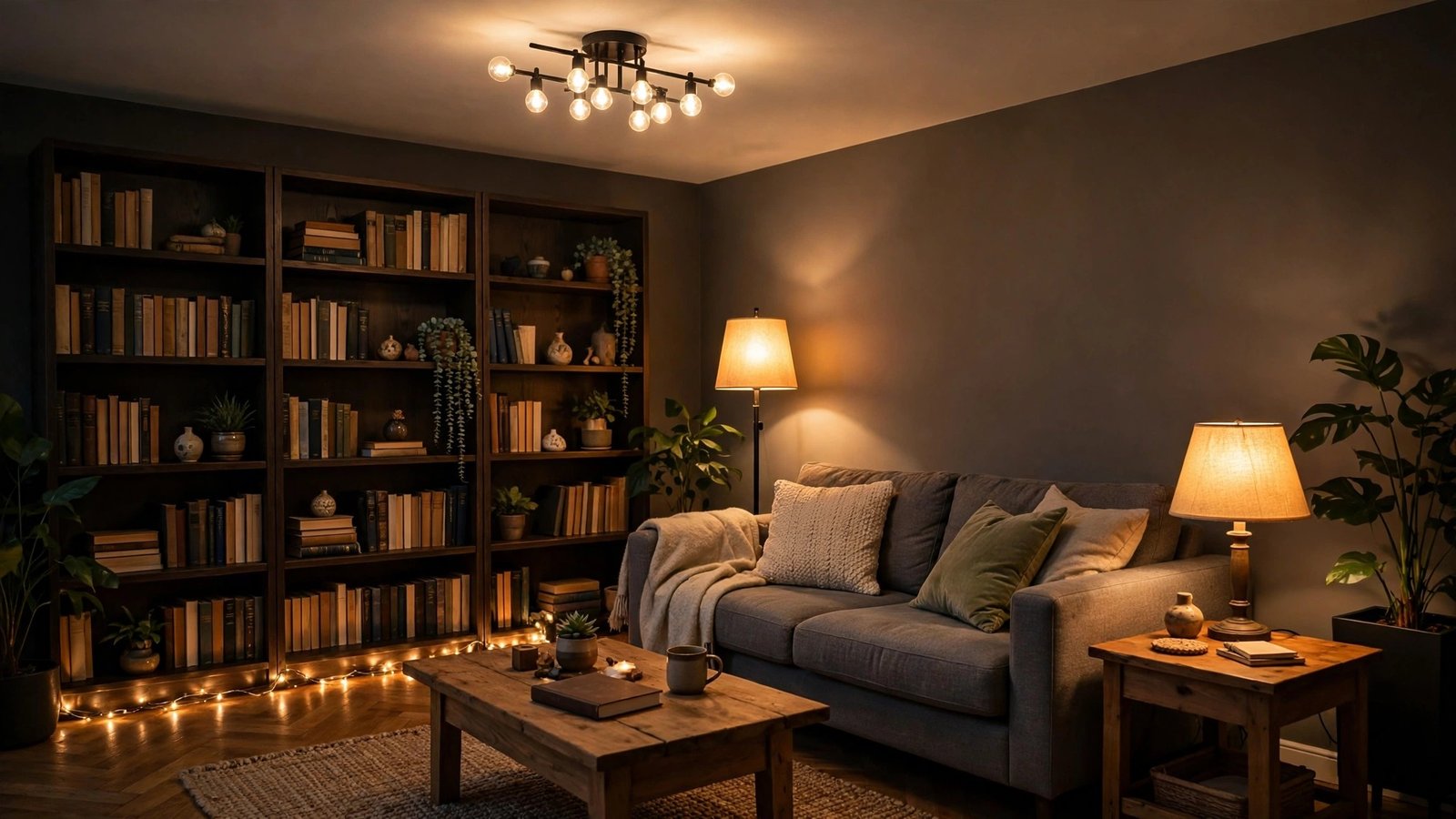
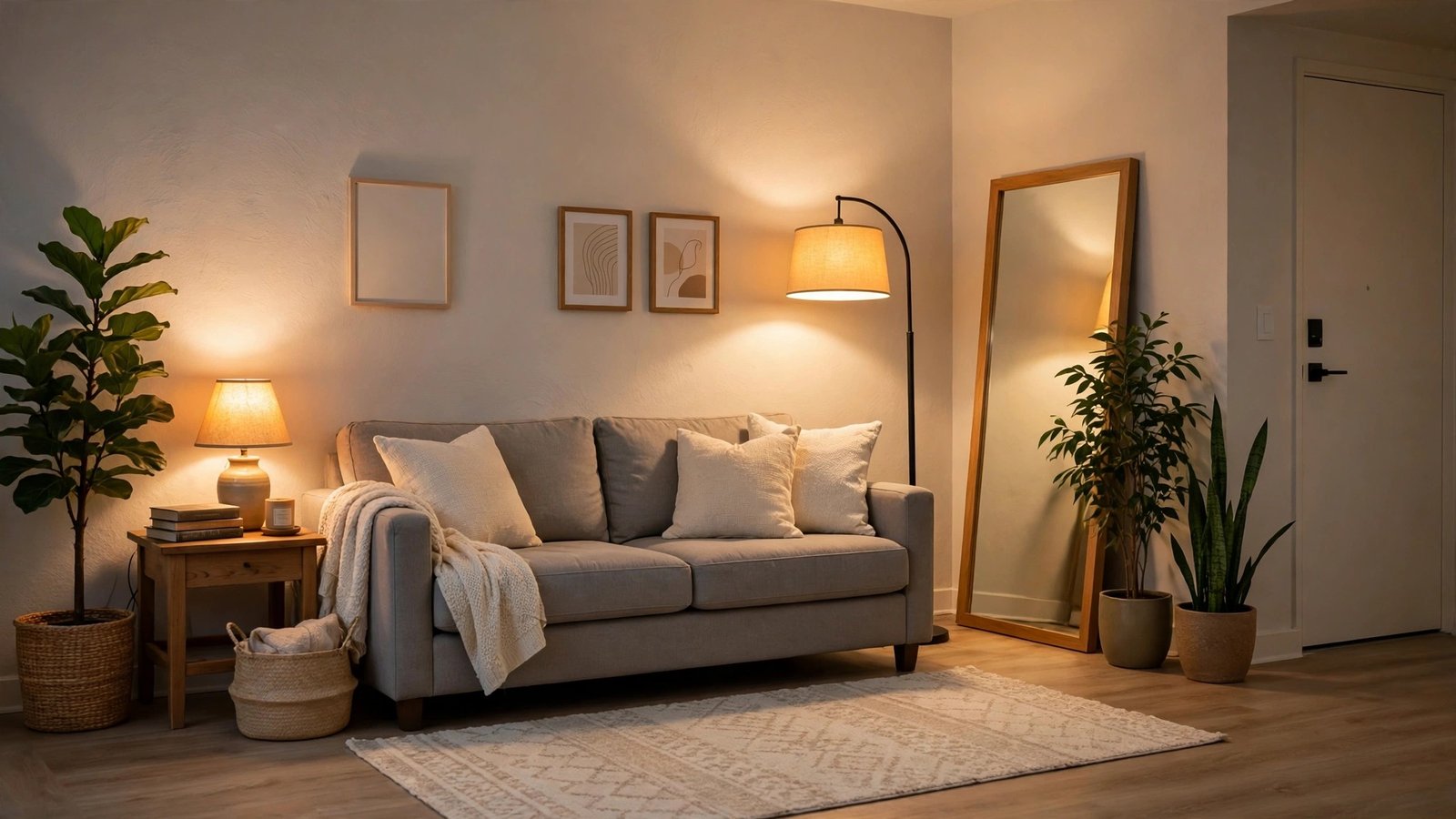
A three-layer lighting plan means lighting your room at three heights instead of one: an overhead source, lamps at eye level, and a low glow near the floor. Most windowless rooms fail because they rely on a single ceiling fixture, which flattens everything and casts hard shadows. Layered light mimics the way daylight fills a room from different directions, and it instantly makes the space feel bigger and warmer.
Why it works for renters: every layer is a lamp or a plug-in light you already own or can buy cheaply. Nothing is wired in, nothing is attached to the walls, and the whole plan moves with you to your next apartment. It’s also the single highest-impact change on this list for the lowest cost.
How to do it:
- Start overhead: keep your existing ceiling fixture, but swap in warm-white bulbs (around 2700K) and add a dimmer-style smart bulb if your fixture allows it, so the top layer can go soft in the evening.
- Add eye-level light: place a floor lamp beside your sofa and a table lamp on a side table or console, so light falls where people actually sit and talk.
- Add a low glow: tuck a small plug-in light, a battery candle cluster, or a short string of warm fairy lights along a bookshelf base or behind a chair.
- Put the three layers on separate switches or smart plugs so you can run just one or two in the evening for a cozy feel, or all three when you need the room bright.
My renter tip: match your bulb color temperature across all three layers — mixing cool white overhead with warm lamps is the fastest way to make a room feel off. Stick with warm white everywhere and the layers will blend into one soft, even glow.
Approximate cost: $40–$90 for two lamps and bulbs if you’re starting from scratch.
2. Hang an Oversized Mirror
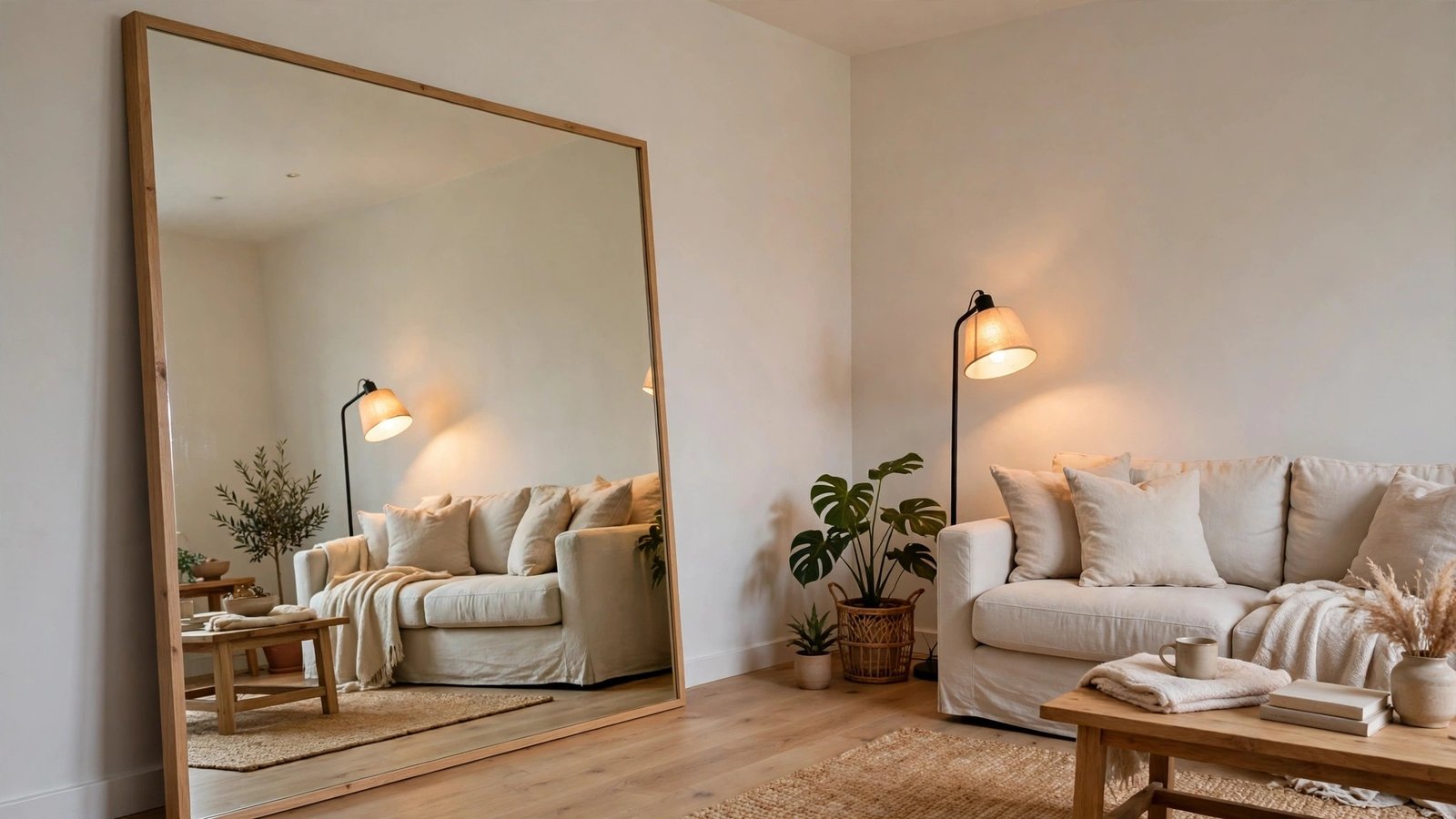
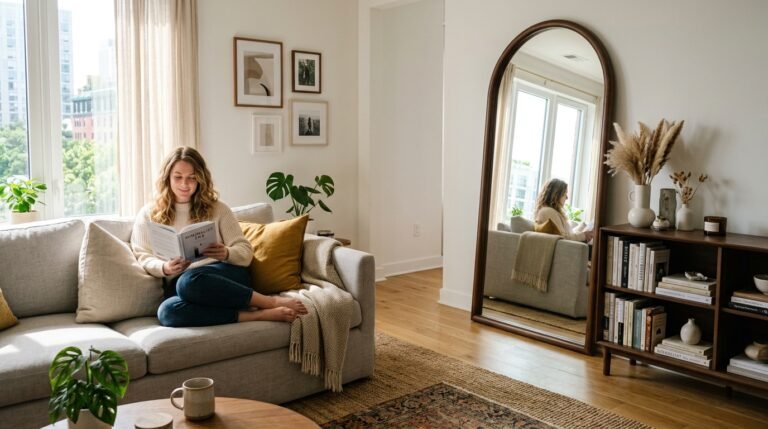
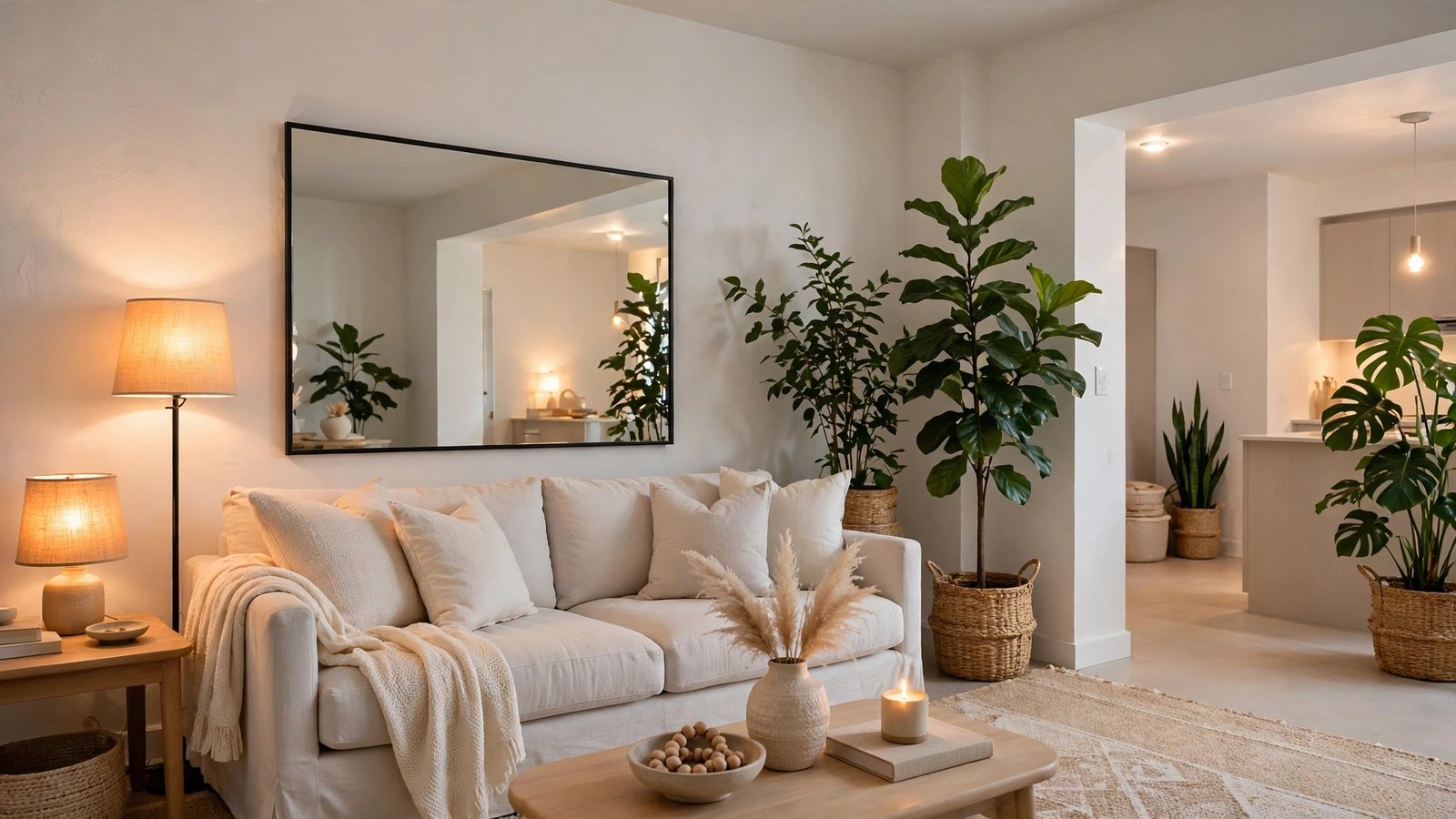
An oversized mirror is the closest thing to adding a window without touching a wall. A big mirror reflects your lamps, your light-colored furniture, and even the far side of the room, so your eye reads depth and brightness where there was only a flat wall before. In a windowless room, it’s the one piece that genuinely makes the space feel larger.
Why it works for renters: a leaning mirror needs no wall mounting at all — it stands on the floor against the wall — and a hung mirror can go up with a single heavy-duty Command hook rated for its weight. Either way, there’s no drilling and nothing to patch when you move out.
How to do it:
- Choose the biggest mirror your wall and budget allow; a full-length leaning mirror or a 30-by-40-inch framed mirror both work beautifully.
- Lean it against the wall opposite your main light source (a lamp or a bright piece of art) so it catches and throws that light back into the room.
- Angle a leaning mirror very slightly forward at the top so it reflects the room rather than the ceiling.
- Keep the wall area around the mirror simple — a bare stretch of wall makes the mirror read as a feature, not as clutter.
- Clean it weekly; in a windowless room, a dusty mirror dulls the one reflection doing all the work.
My renter tip: if your lease forbids hanging anything heavy, go with a leaning mirror — it needs zero wall contact, and you can slide it to a new spot in seconds. Just anchor the top with a small adhesive bumper if you have pets or kids who might bump it.
Approximate cost: $50–$150 for a large leaning or framed mirror.
3. Create a Faux Window With Curtains and a Backlit Print
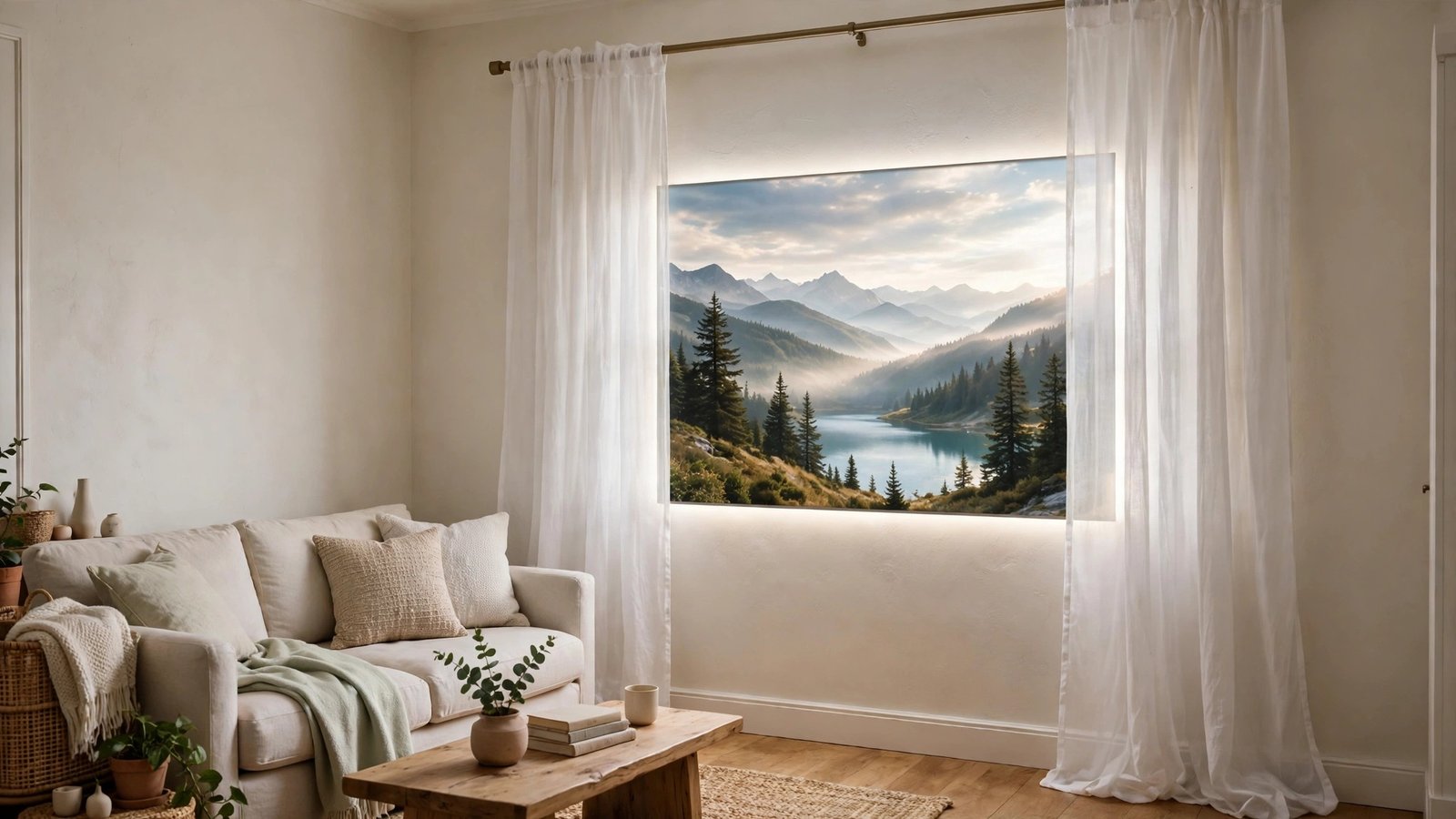
A faux window is a framed landscape print or a backlit light panel, dressed with real curtain panels on a tension rod or Command-hook rod, so your eye gets the shape and glow of a window where there is none. It sounds like a trick, but it works because our brains are wired to look for a bright rectangle on a wall — give it one, and the whole room relaxes.
Why it works for renters: the curtains hang from a tension rod inside a simple frame or from adhesive hooks, and the print hangs with a Command strip. Nothing is cut into the wall, and the whole “window” lifts off in minutes at move-out.
How to do it:
- Pick a wall that faces your main seating area — that’s where a real window would naturally sit.
- Choose a large landscape or garden print in a simple frame, or a slim LED light panel with a nature image for a softly glowing effect.
- Hang the print at eye level, roughly where a window’s center would be, using Command strips rated for its weight.
- Mount a curtain rod above and slightly wider than the frame using adhesive hooks or a tension rod, and hang two light, sheer or linen-look panels.
- Let the panels fall to the floor and puddle slightly at the bottom, the way real window curtains would, to sell the illusion.
My renter tip: keep the curtains light and airy — heavy drapes on a faux window make the wall feel heavier, not brighter. Sheer white or pale linen panels let the “view” stay the star and keep the whole wall feeling open.
Approximate cost: $60–$140 for a framed print, rod, and curtain panels.
4. Add a Peel-and-Stick Wallpaper Accent Wall
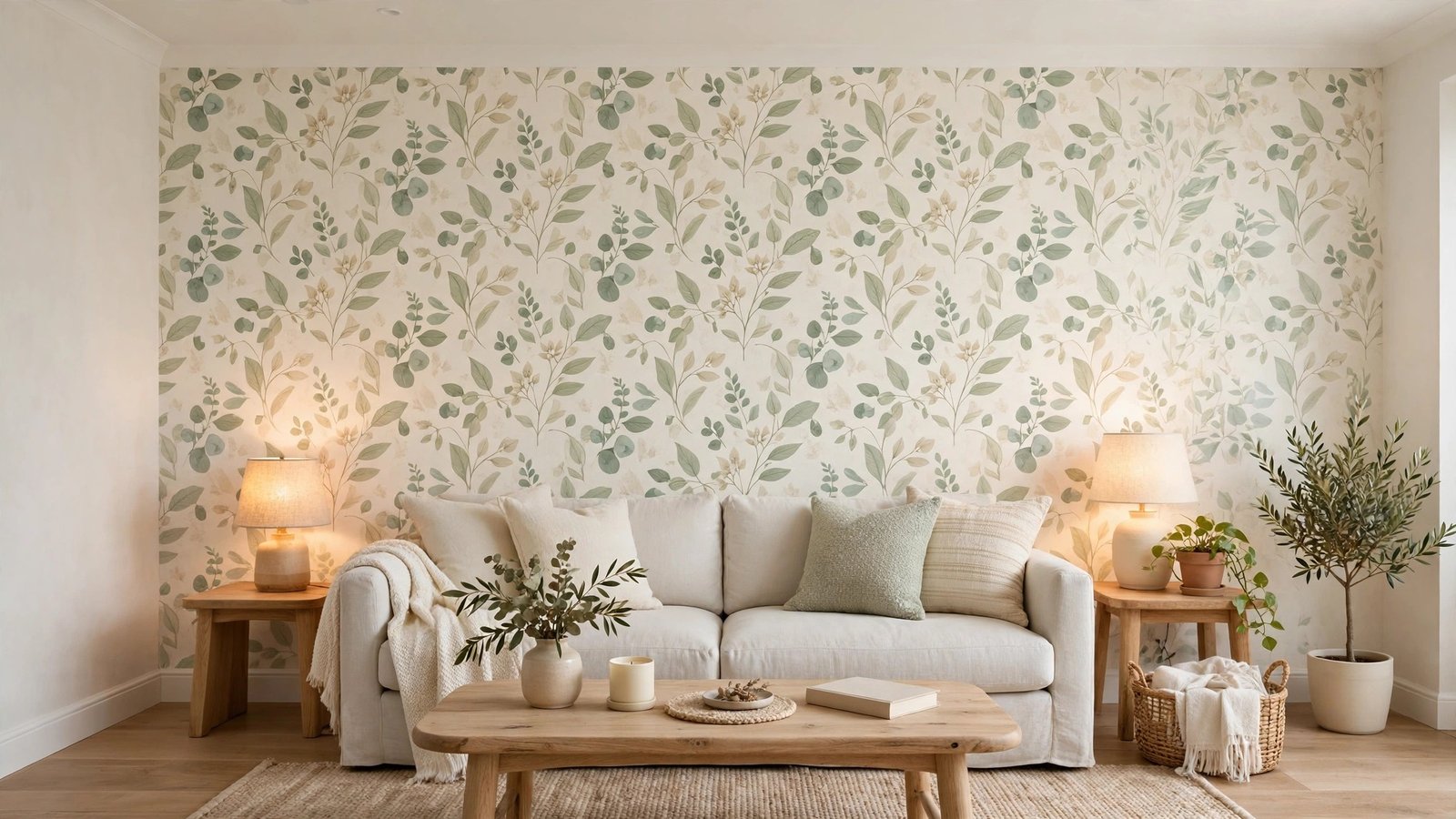
Peel-and-stick wallpaper is the renter’s answer to a feature wall: a light, airy pattern — soft botanicals, pale geometrics, subtle linen texture — on one wall gives a windowless room the visual interest that a view normally provides. It breaks up the flatness of four blank walls and makes the room feel designed rather than default.
Why it works for renters: peel-and-stick wallpaper is made to come off cleanly. It adheres without paste, peels away in sheets, and leaves no residue on most painted walls. One accent wall also means a small amount of product and a weekend-afternoon project, not a whole-room commitment.
How to do it:
- Choose one wall — the one behind your sofa or the wall you face when you walk in — and leave the other walls plain so the pattern stays a feature, not a takeover.
- Pick a light background with a small-to-medium pattern; large dark patterns shrink a windowless room instead of opening it.
- Clean the wall and let it dry completely before you start, so the adhesive grips evenly.
- Apply from the top down, smoothing with a plastic card as you go, and trim the excess at the baseboard with a sharp utility knife.
- When you move out, peel from a bottom corner slowly at a low angle, and use a hair dryer on low heat for any stubborn section.
My renter tip: order one extra roll beyond what the calculator says — pattern matching eats more paper than you expect, and running short mid-wall is the classic peel-and-stick regret. And test a small piece behind furniture first if your walls are older or matte-painted, since adhesion varies.
Approximate cost: $40–$100 for enough rolls for one accent wall.
5. Dress the Room in Light Slipcovers and Pale Textiles

Light slipcovers and pale textiles are the fastest way to lift a dark room: a cream or light-gray slipcover over a dark sofa, pale throw pillows, and a light throw blanket turn your biggest furniture piece from a dark block into a bright anchor. In a room with no daylight, every dark surface absorbs the light you worked hard to add — pale textiles give that light something to bounce off.
Why it works for renters: slipcovers slide on and off, throws fold into a closet, and nothing is permanent. It’s also the most forgiving idea on this list — if you hate the color, you swap a pillow, not a paint job.
How to do it:
- Start with the sofa: a stretch slipcover in cream, light gray, or pale sage covers a dark or dated sofa in about fifteen minutes.
- Layer two or three pale throw pillows in different textures — linen, knit, velvet — so the light color reads as cozy, not clinical.
- Drape a light throw over one arm of the sofa and one over a chair, so the pale color repeats around the room.
- Swap any dark curtains, table runners, or chair cushions for lighter versions in the same family of tones.
- Keep one or two deeper accent pieces (a terracotta pillow, a navy throw) so the room doesn’t wash out entirely.
My renter tip: choose machine-washable fabrics for everything — slipcovers and throws in a windowless room pick up everyday living fast, and being able to toss them in the wash keeps the pale palette actually looking pale instead of gradually going gray.
Approximate cost: $60–$150 for a slipcover, pillows, and a throw.
6. Bring In Tall, Low-Light Plants
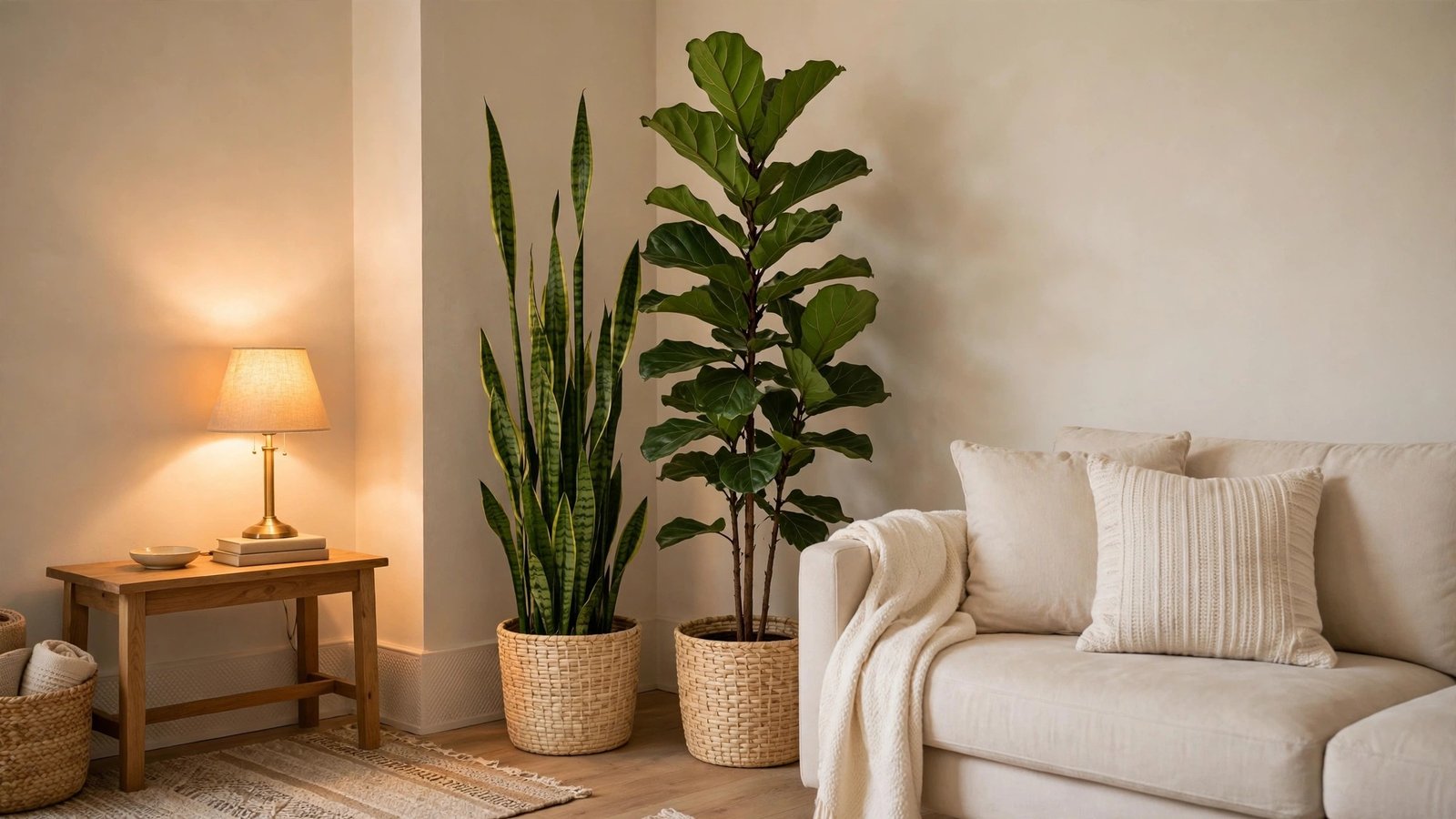
Tall plants do two jobs in a windowless room: they add living green height that draws the eye upward, and they break up flat walls the way a window view would. Snake plants, ZZ plants, and pothos all tolerate low light, and realistic faux plants work just as well if your room gets truly no natural light at all.
Why it works for renters: plants live in pots, not in walls. They move with you, they need no installation, and a tall plant in a corner is the easiest way to make an empty stretch of wall feel intentional instead of forgotten.
How to do it:
- Pick one tall plant for a corner — a snake plant or a faux fiddle-leaf fig in a 5- to 6-foot range — and one or two smaller plants for shelves or a side table.
- Choose light-colored or woven pots so the planters add brightness rather than another dark mass.
- Place the tall plant where a real window’s light would have fallen — beside the sofa or in the corner you see first when you walk in.
- If you go live, pick genuinely low-light varieties and water sparingly; low light means slow growth and slow drying, so overwatering is the real killer.
- If you go faux, dust the leaves monthly and bend a few stems slightly off-perfect, since perfectly symmetrical faux plants are what give the game away.
My renter tip: mix one real low-light plant with one good faux plant rather than going all one way — the real one adds authenticity and the faux one guarantees greenery in the darkest corner, and guests genuinely can’t tell which is which at a glance.
Approximate cost: $40–$120 for plants and pots.
7. Choose Glass and Acrylic Furniture
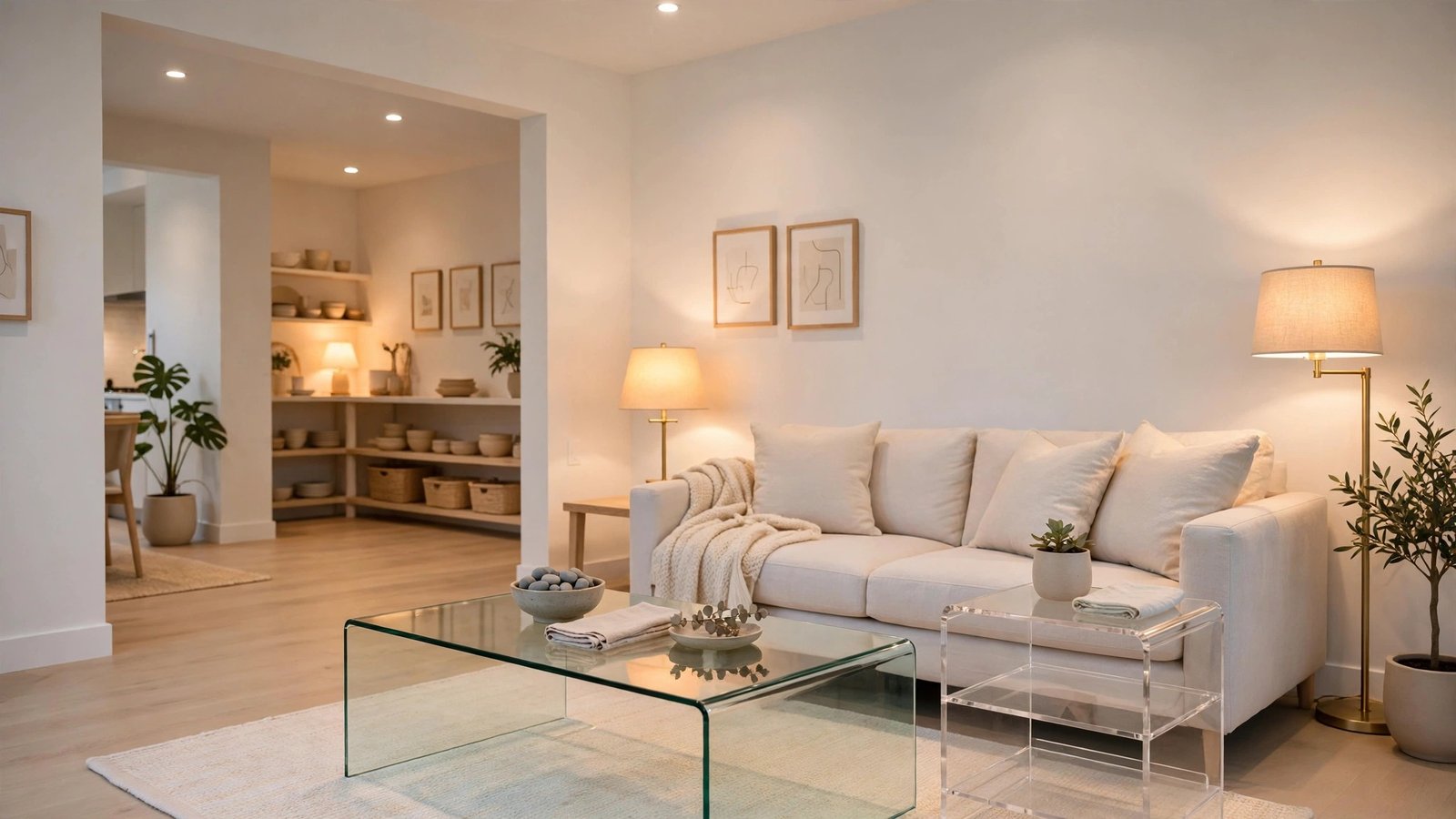
Glass and acrylic furniture keeps sightlines open in a room that already feels enclosed. A glass coffee table, an acrylic side table, or a console with a glass top lets your eye travel through the piece instead of stopping at it, so the room reads as more open and less crowded — the opposite of what heavy wood furniture does in a windowless space.
Why it works for renters: it’s furniture, not a fixture. It arrives, it sits there, and it leaves with you. There’s no installation, no wall contact, and no deposit risk whatsoever.
How to do it:
- Swap your coffee table first — it’s the centerpiece of the room and the piece your eye crosses most often.
- Add one acrylic side table or a glass-top console where a solid piece currently blocks a walkway or a view across the room.
- Keep the styling on glass surfaces light: one book, one small plant, one candle — a cluttered glass table just becomes a visible pile.
- Pair glass with one warm material (wood legs, a woven basket underneath) so the room doesn’t feel cold or showroom-like.
- Wipe glass weekly; in a windowless room, fingerprints and dust show up fast under lamplight.
My renter tip: if a full glass table feels too fragile for daily life, try a glass top over your existing table or a single acrylic side table first — you get most of the visual openness for a fraction of the cost and commitment.
Approximate cost: $50–$180 for a glass coffee table or a pair of acrylic side tables.
8. Add LED Cove and Backlighting Behind Furniture
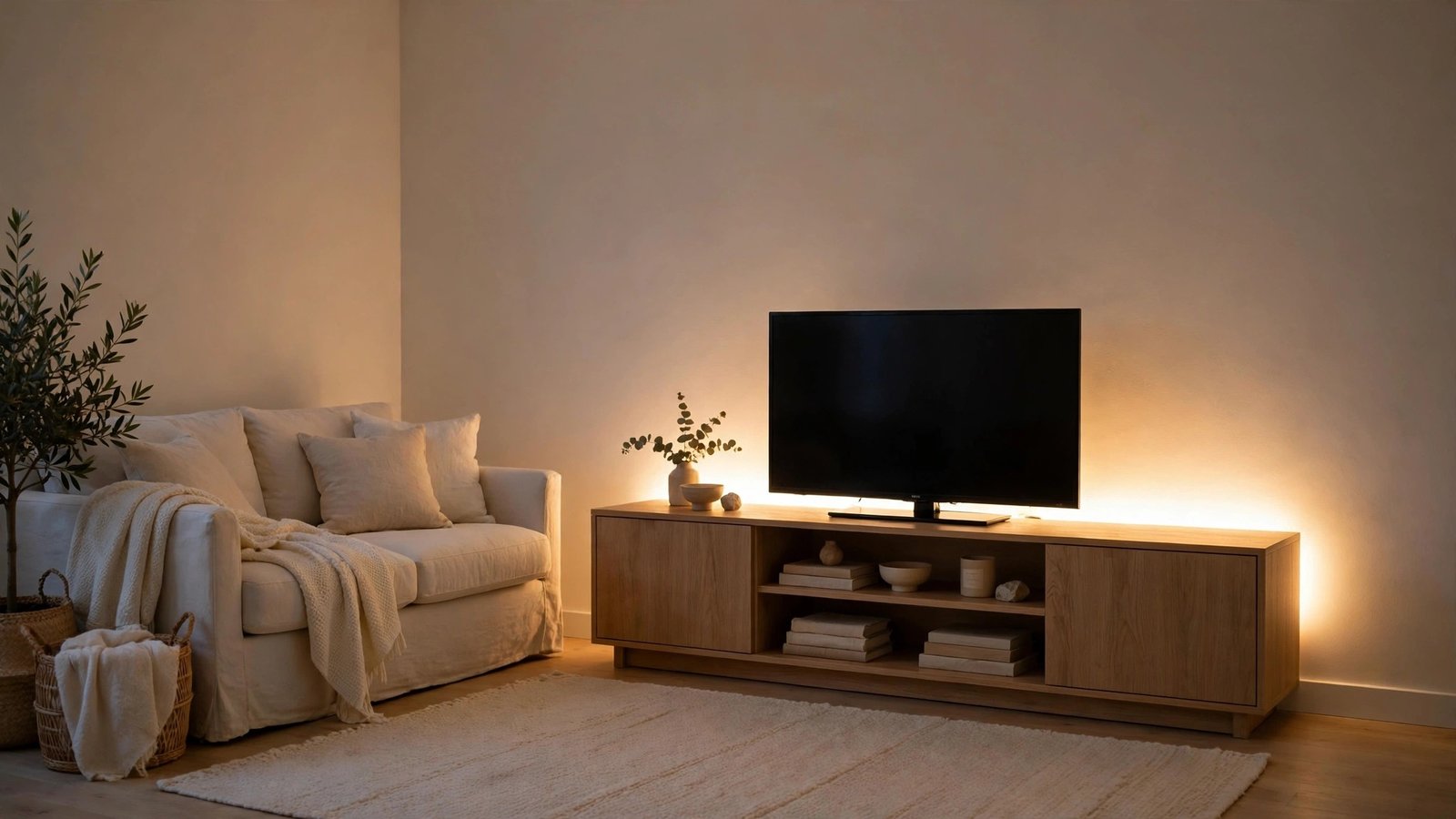
LED strip lighting tucked behind furniture creates a soft halo of light that makes walls glow and furniture look like it’s floating. Run a strip behind your TV console, under a floating shelf, or behind the sofa, and the room gains a warm, indirect light source that feels like daylight spilling in from somewhere just out of sight.
Why it works for renters: LED strips stick on with their own adhesive backing, plug into a normal outlet, and peel off cleanly. They draw very little power, they come with a remote or an app for dimming and color temperature, and they leave no trace when you remove them.
How to do it:
- Measure the back edge of your TV console, shelf, or sofa, and buy a strip slightly shorter than that length.
- Choose warm white (2700K–3000K) — cool or colored light behind furniture looks like a gaming setup, not a living room.
- Stick the strip along the back edge, facing the wall, so the light washes the wall rather than shining into the room.
- Plug it into a smart plug or use the included remote so you can dim it separately from your lamps.
- Add a second strip under a shelf or behind a headboard-height console if one halo isn’t enough to lift the whole room.
My renter tip: test the adhesive on a hidden spot for a day before committing the full strip — on some finishes the backing can be stronger than expected, and a quick test saves you a sticky cleanup later. When you remove it, peel slowly and roll the strip off rather than yanking.
Approximate cost: $15–$40 per strip, remote included.
9. Make Oversized Art Your Focal Point

A windowless room has no natural focal point, so you have to build one — and oversized art is the simplest way to do it. One large canvas or a tight gallery wall gives the eye somewhere to land the moment you walk in, which is exactly the job a window normally does. Without a focal point, a windowless room just feels like four walls; with one, it feels like a room with a purpose.
Why it works for renters: large canvases are light for their size and hang with a couple of Command strips, and a gallery wall uses the same adhesive hooks. Nothing is drilled, and the art moves with you to the next apartment.
How to do it:
- Choose one wall — ideally the one your sofa faces — and commit to making it the art wall.
- Pick one oversized piece (at least 30 by 40 inches) or a set of three to five coordinating prints in simple frames.
- Hang the center of the piece at eye level, about 57 inches from the floor to the center, which is gallery standard.
- If you go the gallery route, lay the arrangement on the floor first and photograph it, so you hang it once instead of three times.
- Light it: aim a small picture light, a clip light, or a nearby lamp at the art so it glows softly in the evening.
My renter tip: go bigger than you think you need — a too-small piece on a big blank wall makes the wall look even emptier. If oversized original art is out of budget, a large framed print or a stretched canvas print gives you the same scale for a fraction of the price.
Approximate cost: $40–$150 for a large framed print or a small gallery set.
10. Brighten the Floor With Light, Layered Rugs
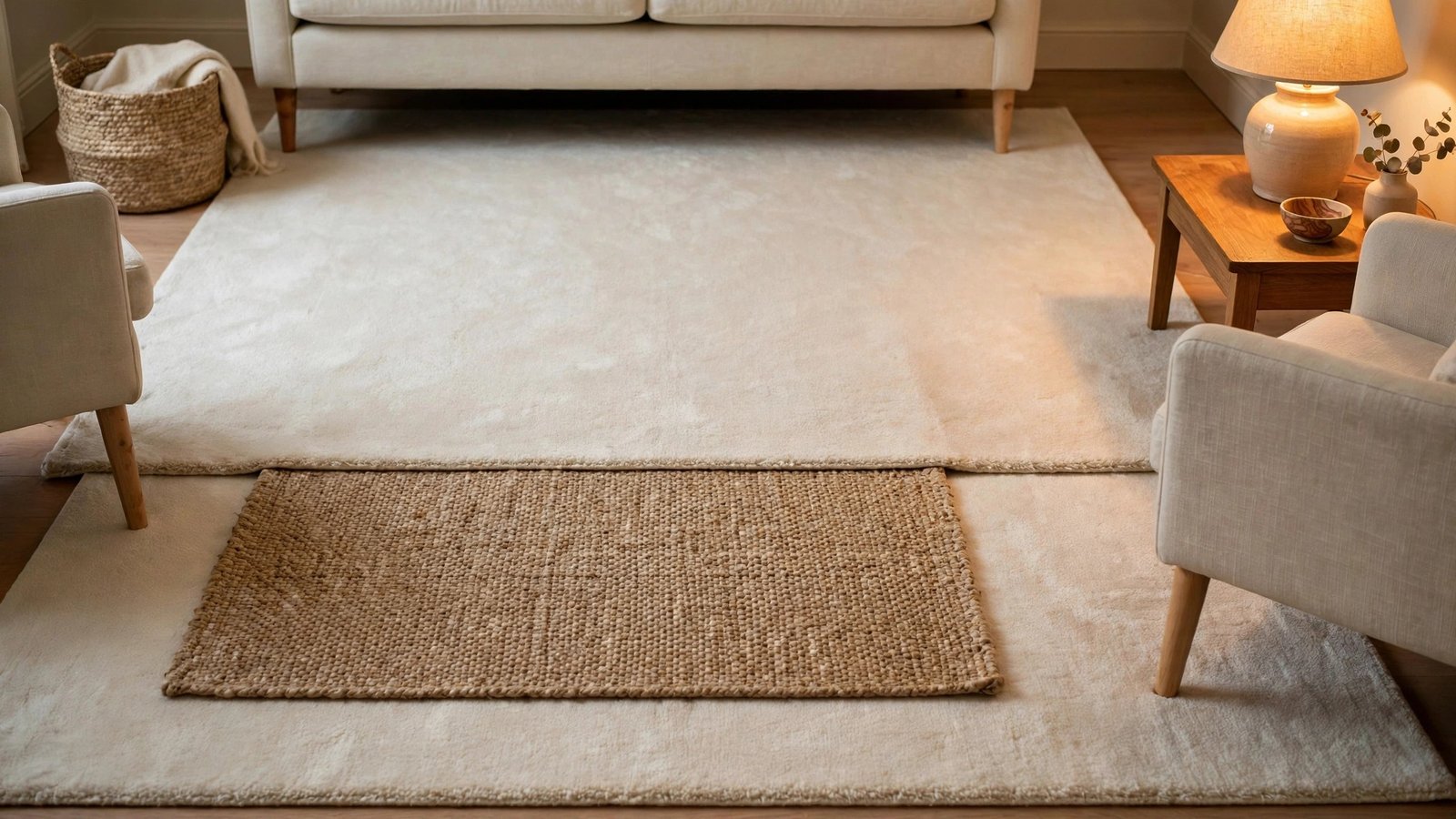
The floor is the largest surface in your living room, and in a windowless room a dark floor swallows light from below. A light-colored rug — layered over a larger neutral one if you want texture — bounces your lamps’ glow back up into the room and defines the seating area as a bright island in the middle of the space.
Why it works for renters: rugs are the ultimate deposit-safe decor. They roll out, they roll up, they go with you, and a rug pad underneath protects both the rug and the floor you’re responsible for.
How to do it:
- Measure your seating area and choose a rug large enough that the front legs of your sofa and chairs sit on it — a too-small rug chops the room up.
- Start with a light neutral base: cream, pale gray, or a soft natural jute tone.
- Layer a smaller, slightly patterned or textured rug on top at an angle if you want depth without darkness.
- Add a non-slip rug pad underneath so the layers stay put and your floor stays scuff-free.
- Vacuum weekly and spot-clean spills quickly, since light rugs in a lamp-lit room show everything.
My renter tip: if your existing rug is dark and you don’t want to replace it, layer a light flatweave rug right on top — you get the brightness without the cost of a new base rug, and the layered look is genuinely stylish, not a cover-up.
Approximate cost: $60–$180 for a large light rug and pad.
11. Style Open Shelving With Light Objects and Battery Candles
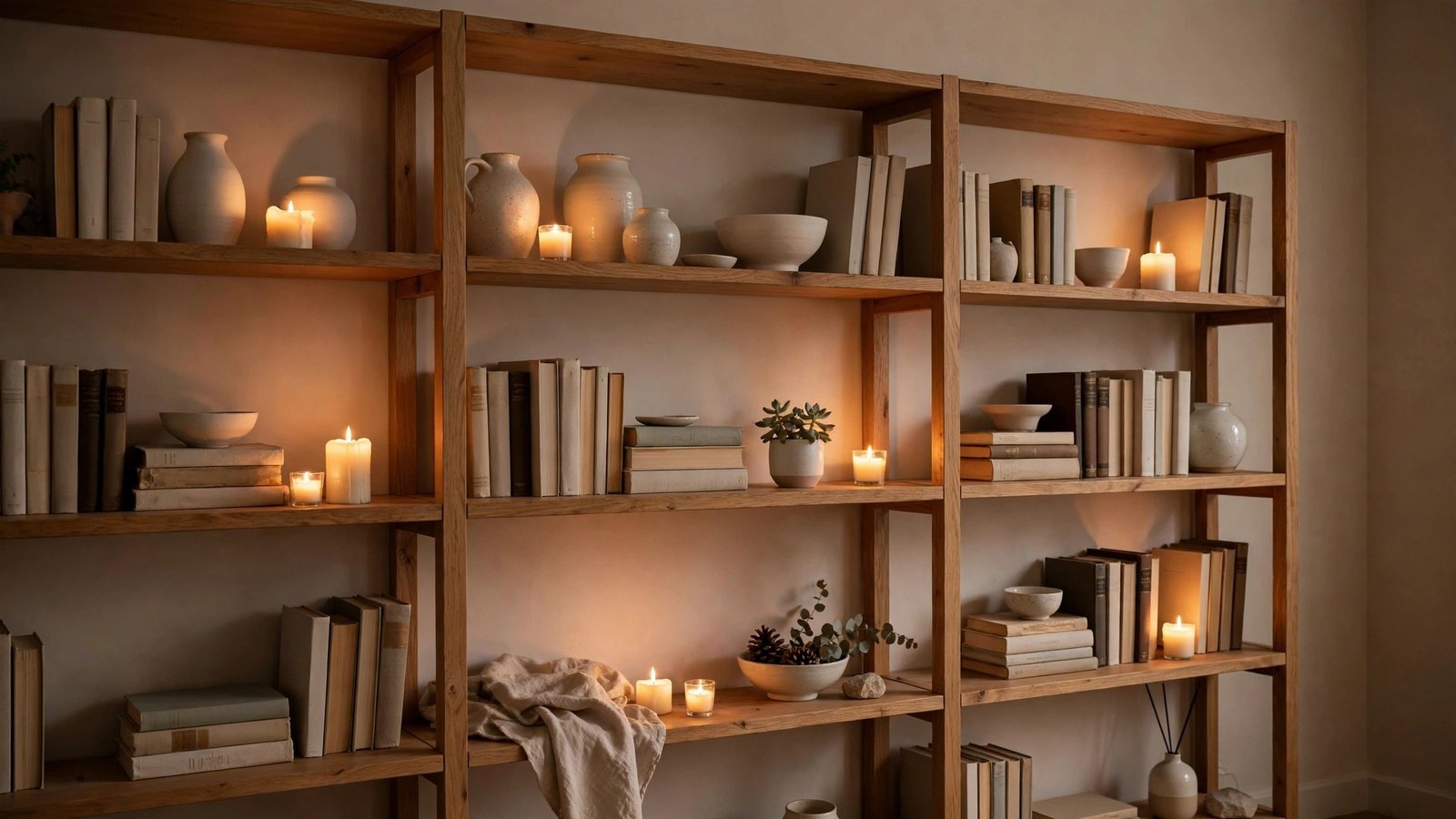
Open shelving styled with light-colored objects and battery candles turns a blank wall into a glowing display. Books with pale spines facing out, white or cream ceramics, a small plant, and a few flickering battery candles give the wall warmth and depth — and the candlelight does real work in a room with no daylight, adding the kind of soft, moving glow that flat lamplight can’t.
Why it works for renters: freestanding bookshelves need no wall contact at all, and floating shelves hang with adhesive strips. Battery candles mean real flame is never involved, so there’s no fire risk, no soot on your walls, and no lease clause to worry about.
How to do it:
- Use a freestanding bookshelf or two adhesive-mounted floating shelves on the wall that needs the most life.
- Style from the top down: taller, lighter objects up high, heavier pieces lower, so the display reads as airy rather than top-heavy.
- Mix pale ceramics, a few books, one small plant, and one or two battery candles per shelf — leave breathing room between objects.
- Set the battery candles on a timer so they flicker on automatically in the evening, when the room needs them most.
- Edit ruthlessly: a half-empty shelf looks styled, while a crammed shelf looks like storage, and storage is the opposite of what a windowless room needs.
My renter tip: buy battery candles with a remote and a timer — candles you have to switch on one by one get used twice and then forgotten, while timed ones turn your shelf into an evening ritual you actually enjoy.
Approximate cost: $50–$140 for shelves, candles, and a few light accessories.
12. Dress the Ceiling With a Swag Pendant and Medallion
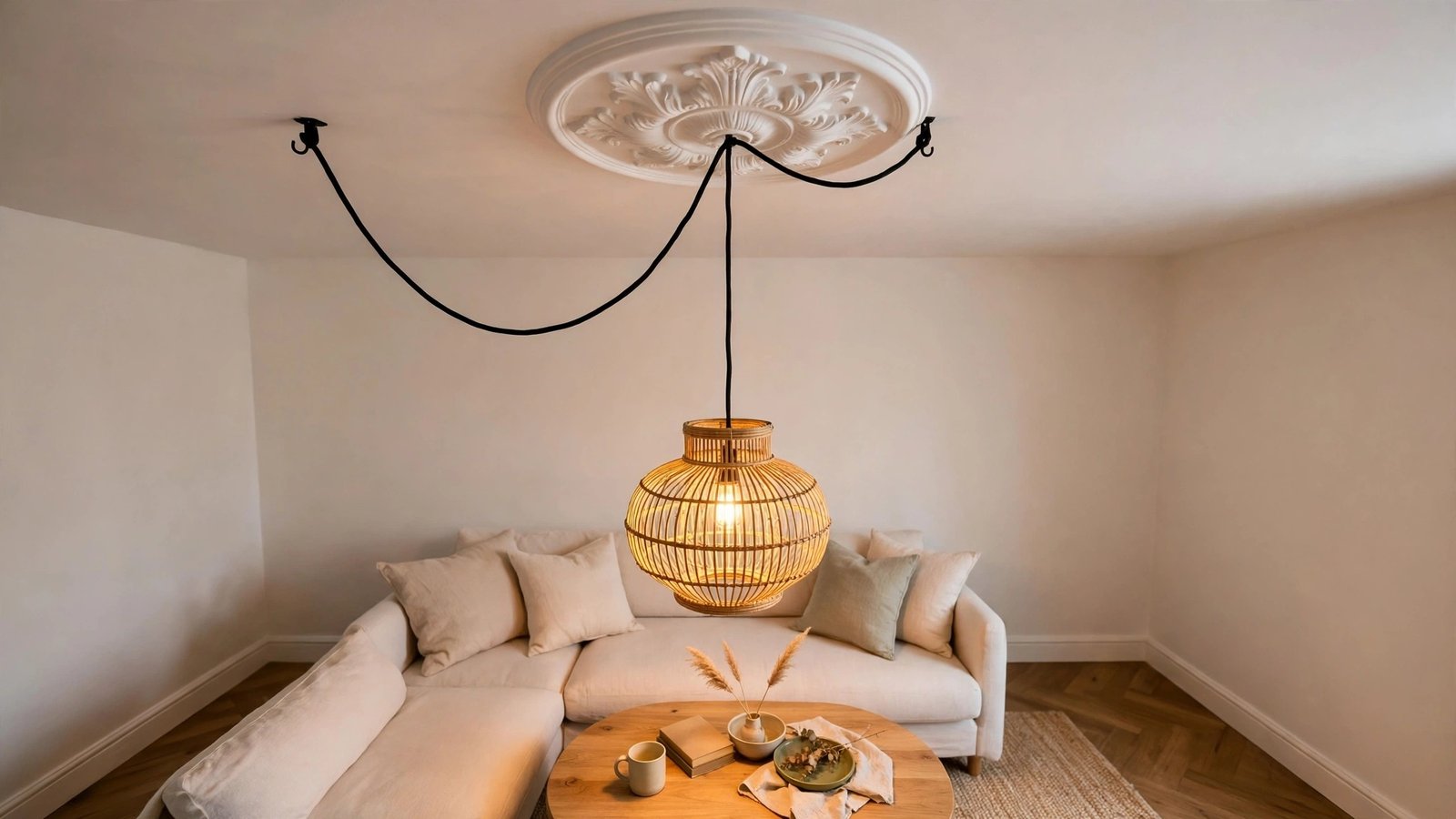
In a windowless room, the ceiling is the one surface everyone forgets — and it’s the one surface that can make the room feel taller. A peel-and-stick ceiling medallion plus a plug-in swag pendant (a pendant light that hangs from a ceiling hook and plugs into a wall outlet, with the cord draped decoratively) draws the eye upward, adds a beautiful light source at exactly the right height, and gives the room a finished, intentional feel.
Why it works for renters: the medallion sticks on and peels off, the pendant hangs from a single adhesive ceiling hook, and the cord plugs into a normal outlet — no electrician, no wiring, no holes. It’s the closest thing to installing a real ceiling fixture without touching the electrics.
How to do it:
- Pick a lightweight pendant — paper, rattan-look, or fabric shades are all light enough for an adhesive ceiling hook.
- Center a peel-and-stick ceiling medallion on the ceiling above your coffee table or seating area, pressing it firmly into place.
- Hang the pendant from an adhesive ceiling hook at the medallion’s center, adjusting the cord so the shade hangs about 30 inches above your coffee table.
- Swag the cord to the nearest wall with a second adhesive hook, then run it down to the outlet, clipping it neatly along the wall.
- Put the pendant on a dimmer plug or smart plug so it can be your soft evening light as well as your statement piece.
My renter tip: check your adhesive hook’s weight rating before you hang anything overhead — a pendant plus a shade weighs more than you’d guess, and you want a hook rated for at least double the pendant’s weight. And keep the cord run tidy with small adhesive clips, since a dangling cord ruins the whole polished effect.
Approximate cost: $45–$120 for a pendant, medallion, hooks, and cord clips.
Conclusion
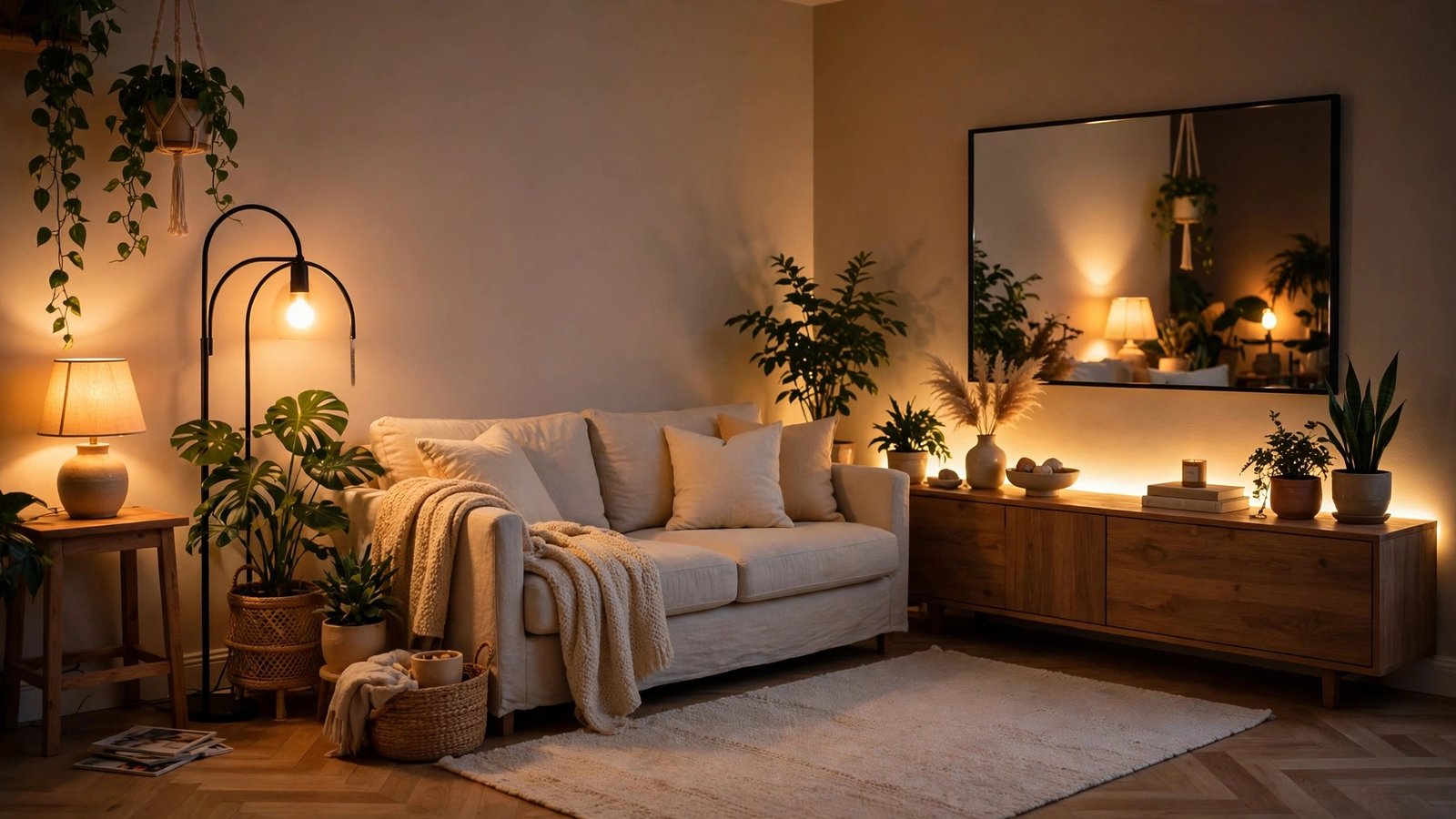
A room with no windows doesn’t have to feel like a room with no hope. Layer your light at three heights, bounce it around with a mirror and glass furniture, give your eye a focal point with a faux window or oversized art, and lift the whole space with pale textiles, a light rug, and a little greenery. Each of these ideas is small on its own, but together they do what a window does: they make the room feel bright, open, and alive.
I’ve watched renters walk into a windowless living room they were embarrassed by and, a weekend later, host friends in that same room without a single comment about the missing windows — because nobody was looking for them anymore. They were looking at the glow behind the sofa, the art on the wall, the plant in the corner. That’s the real trick: you don’t replace a window, you give people better things to look at.
Start with the lighting and the mirror this weekend, then add one idea a week until the room feels like yours. And when it does, take a photo of it — you earned that before-and-after.
Please save this visual guide on Pinterest and share it with any renter friend stuck with a windowless living room — the next person staring at four blank walls will thank you for it.

Amelia leads HavenlyStyle’s editorial vision with a passion for elegant interiors and practical home living. With years of experience in home décor and lifestyle content, she ensures every article is accurate, inspiring, and easy to follow. From timeless decorating ideas to the latest interior design trends, Amelia is committed to helping readers create beautiful, functional spaces while maintaining HavenlyStyle’s trusted and welcoming voice.