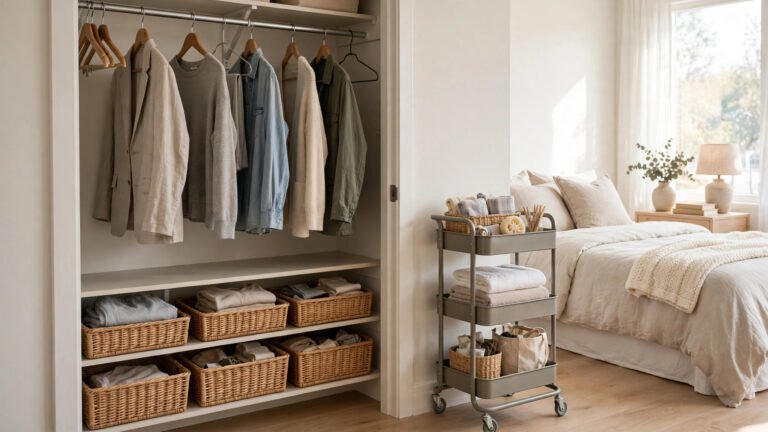
I've helped dozens of renters open the same disappointing door: the linen closet. You know the one. It's either a narrow sliver of shelving crammed between the hallway and the bathroom, or a cavernous dark box of deep shelves where towels go in and never come back out. The shelves are too tall, so your folded towels slump into a sad leaning tower. The sheets are a folded avalanche waiting to happen — you pull one fitted sheet and four others cascade onto your feet. And because it's a rental, the real fixes are off the table: no built-in pull-out shelves, no mounted organizers, nothing screwed into walls you don't own.
Here's what I've learned after organizing rental linen closets in apartment after apartment: the linen closet is the hardest-working storage space in a small home, and it gets the least respect. Bedding, bath towels, hand towels, washcloths, spare blankets, seasonal quilts, guest sheets — one small closet holds the textiles for your entire household. Generic organizing advice assumes you can install custom systems, but renters need something better: storage that lifts off, slides out, unhooks, and moves with you.
The twelve ideas below are built for real rental linen closets — tall shelves, deep boxes, narrow hall closets, and awkward corners alike. Every single one is renter-safe: removable, reversible, and deposit-friendly, with honest approximate cost ranges. No drilling, no mounting, no landlord negotiations. Just a linen closet that finally behaves.
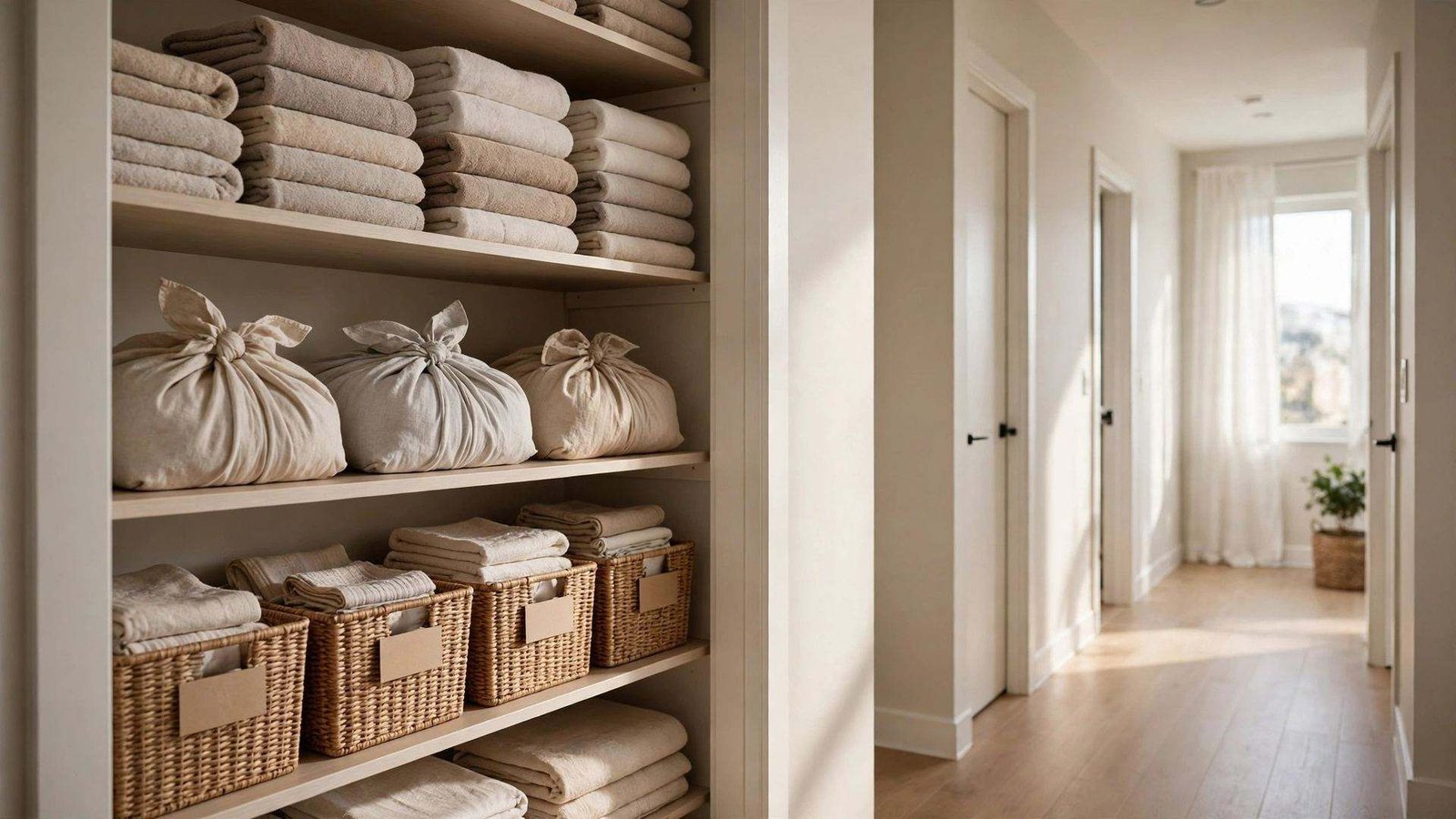
Executive Summary
- Tall shelves are the enemy, not the storage. Add dividers and stacking risers to break one tall void into two or three usable tiers — no hardware needed.
- Fold for the shelf, not the drawer. File-folding and retail-style folds turn linen stacks into self-supporting rows that don't avalanche.
- Bundling beats stacking. Fold each sheet set inside its own pillowcase and the fitted-sheet hunt disappears forever.
- Bins are drawers you don't have to install. Handled totes and open bins turn deep, unreachable shelves into pull-out drawers that slide to you.
- Label everything. In a shared closet or a deep one, labels are the difference between "organized" and "looked organized for a week."
- Nothing here is permanent. Every idea is removable or reversible — most lift out in minutes on move-out day.
1. Add Shelf Dividers to Tame Tall Shelves
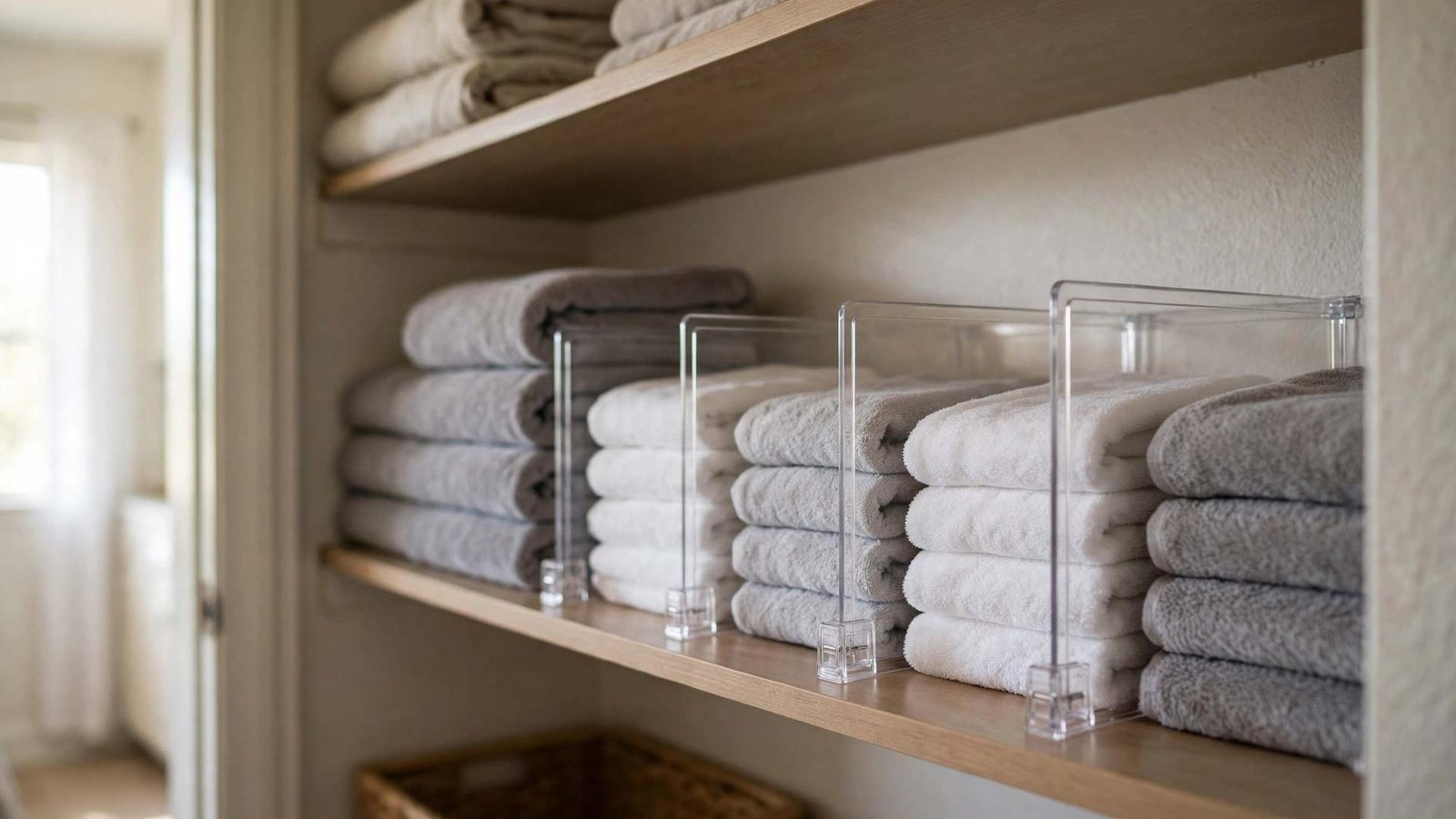
Rental linen closets almost always have shelves spaced a foot or more apart — tall enough for stacked towels to slump and slide. Shelf dividers fix this without a single screw. They clip, wedge, or stand between shelves and create vertical walls, so each stack of towels has its own lane. Think of it like library shelving: upright divisions keep every pile standing on its own instead of leaning on its neighbor.
I reach for these first in any linen closet because they're the fastest visual win. Ten minutes after clipping in dividers, the top shelf goes from "towel landslide" to neat labeled rows. They also stop the classic rental problem where you pull one towel from the middle of a tall stack and the whole thing slowly tilts sideways over the next week.
Why it's renter-safe: Most dividers are tension-clip or free-standing — they grip the shelf edge or stand on the shelf surface with no hardware at all. When you move, they lift off in seconds and leave no marks.
How to do it:
- Measure your shelf depth and height before buying — linen closet shelves are often 14–18 inches deep, and you want dividers that reach most of that depth.
- Sort towels by type (bath towels, hand towels, washcloths) and give each type its own lane between dividers.
- Space dividers about 8–10 inches apart so folded stacks have a snug wall on both sides.
- Put the most-used lane closest to the door or at hand height.
- Approximate cost: $10–$25 for a pack of four to six dividers.
2. File-Fold Your Towels Instead of Stacking Them
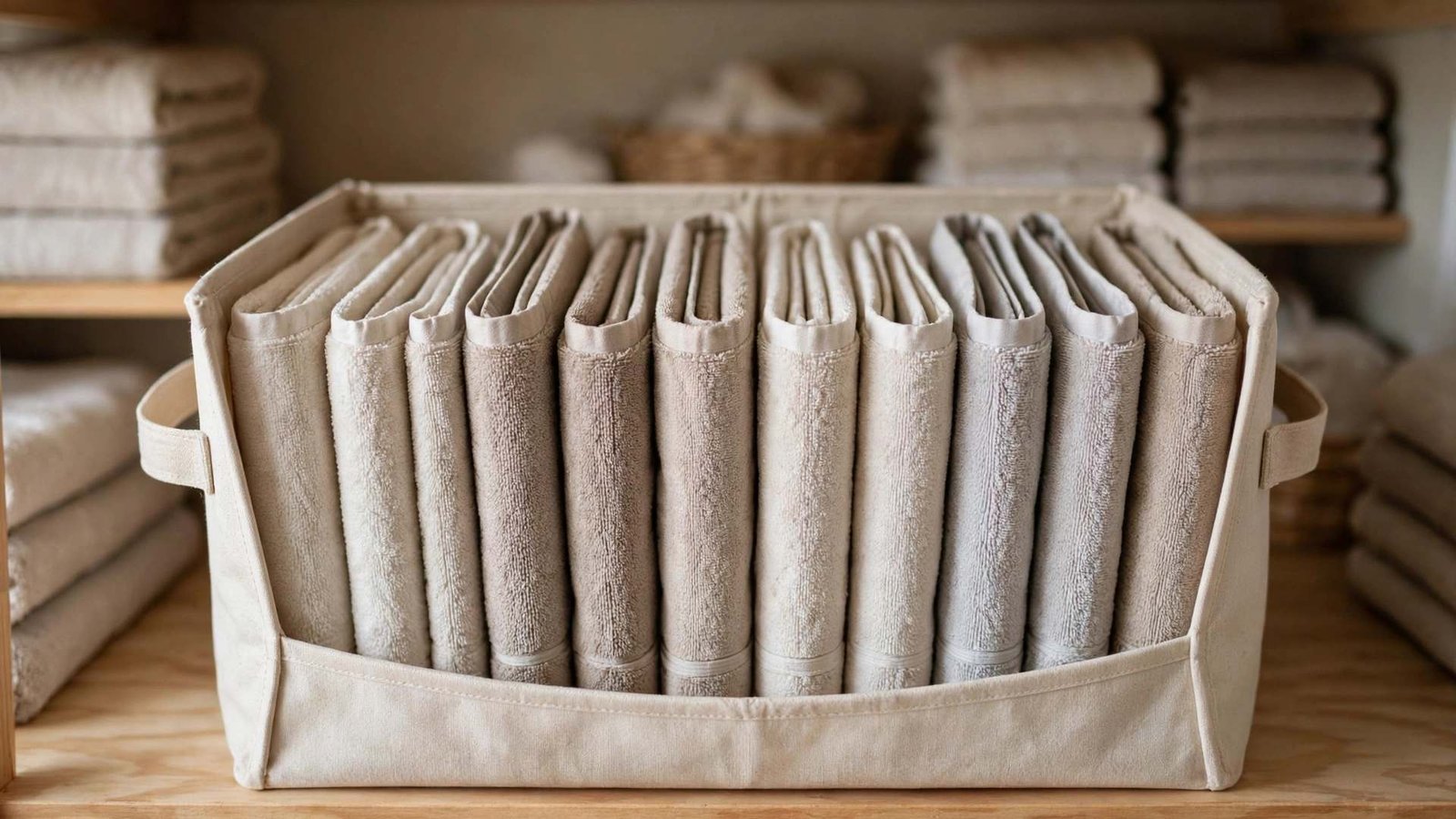
Stacked towels are a gravity problem: every towel you remove destabilizes the ones above it. File-folding — the method where each towel is folded into a rectangle and stood upright in a row, like files in a drawer — solves it completely. You see every towel at once, you remove one without touching the rest, and the row never collapses.
This technique comes from small-space organizing, and linen closets are its perfect home. A file-folded row of bath towels in a bin or on a divided shelf takes up the same footprint as a stack but behaves ten times better. Guests can find their own towel without interrogating you, and the closet stays neat because the system resists mess instead of inviting it.
Why it's renter-safe: It's a technique, not a product. Zero cost, zero installation, zero changes to the apartment — and the fold works on any shelf in any future home.
How to do it:
- Lay each towel flat, fold it in thirds lengthwise, then fold into a rectangle sized to your bin or shelf lane.
- Stand the folded towels upright in a row inside a bin or between shelf dividers, folded edge up.
- Arrange by color or household member so everyone can grab their own towel at a glance.
- Keep a "front row" of two or three everyday towels and put backups behind them.
- Approximate cost: $0. Refolding what you own is the entire project.
3. Bundle Each Sheet Set Inside Its Own Pillowcase
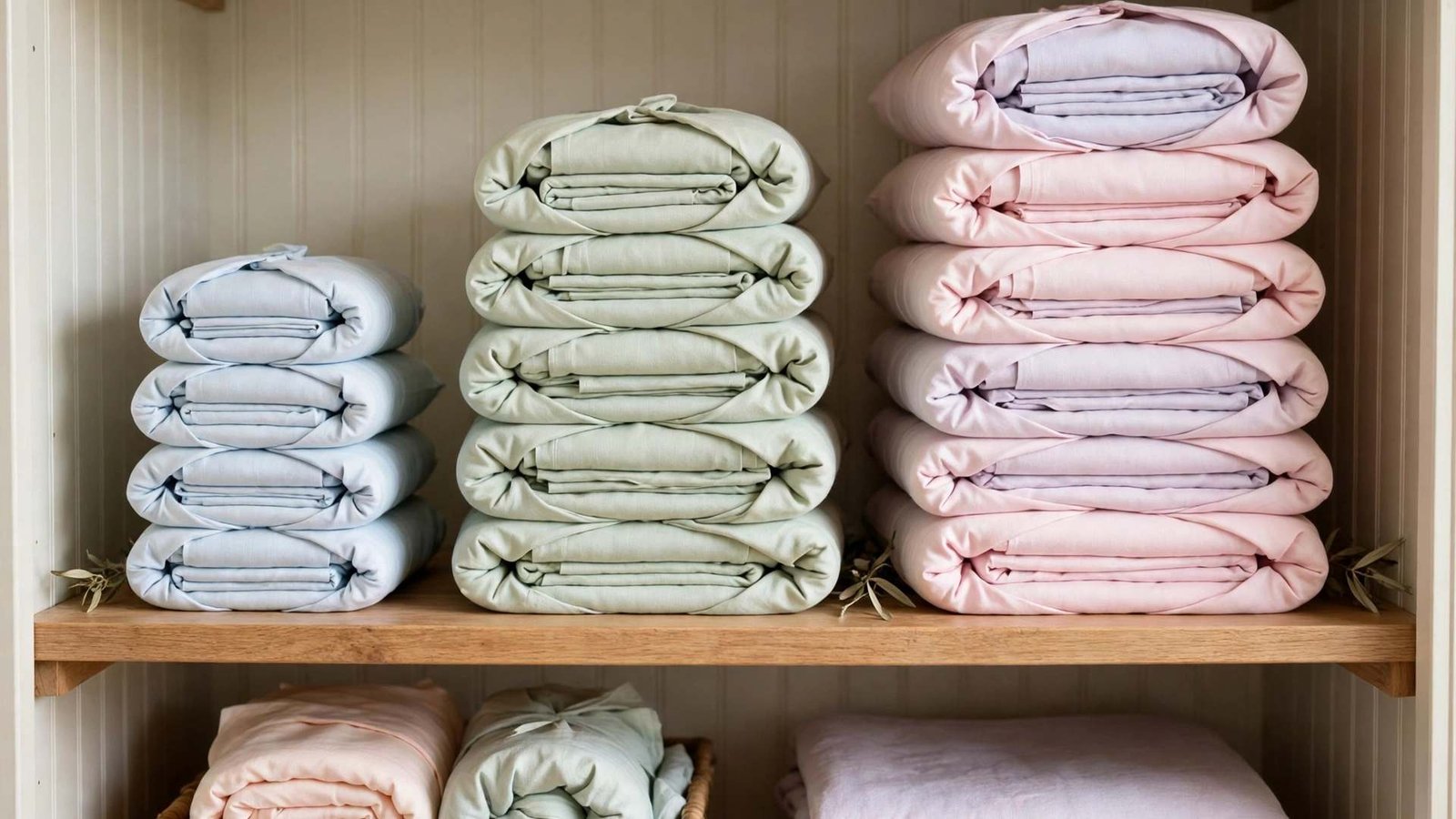
The fitted sheet is the linen closet's greatest villain. Folded on its own, it's a lumpy bundle that unravels and swallows the shelf. The pillowcase method — folding the fitted sheet, flat sheet, and second pillowcase, then tucking the whole set inside one pillowcase — turns every bed's bedding into a single tidy package.
I've watched this one idea change more linen closets than any organizer I've ever bought. Suddenly "find the queen sheets" means grabbing one neat bundle instead of spelunking through a wobbly stack of elastic-edged fabric. Stack the bundles by bed size, label the pillowcase edge, and the sheets section becomes self-managing. It also makes guest bedding a one-grab operation instead of a three-shelf hunt.
Why it's renter-safe: Pure folding technique. Nothing is attached, installed, or purchased — the system travels in your moving boxes and works in any closet anywhere.
How to do it:
- Fold the fitted sheet into a flat rectangle (the "envelope fold" works, or just smooth and fold — precision isn't the point).
- Fold the flat sheet and the matching pillowcase into the same footprint.
- Slide the folded set into the second pillowcase and fold the open edge under for a clean finish.
- Stack bundles by bed size (twin, full, queen, king), largest at the bottom of the stack.
- Approximate cost: $0. You already own the pillowcases.
4. Use Stacking Shelf Risers to Double the Tiers
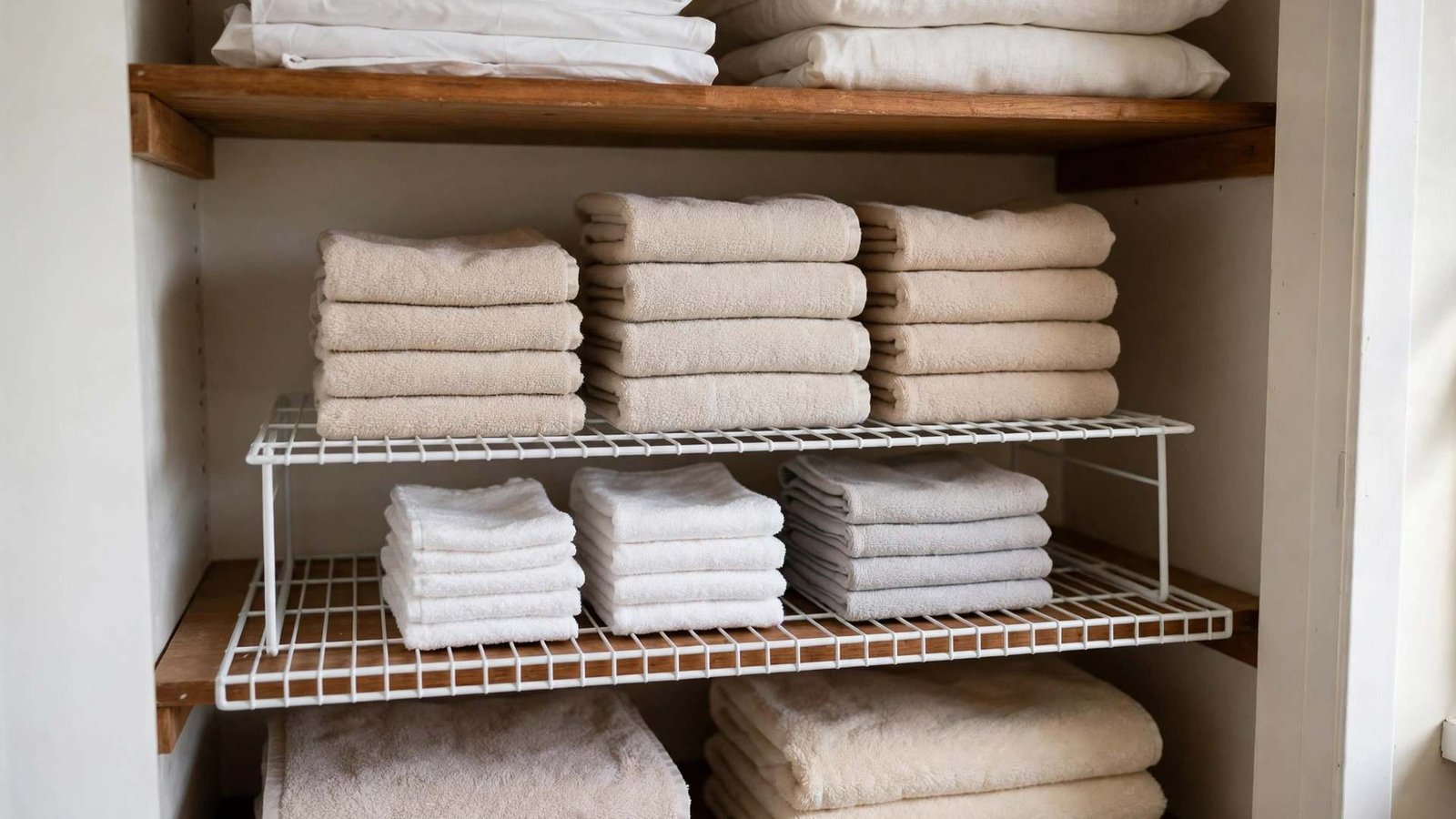
That 12-to-14-inch gap between linen closet shelves is the whole problem: too tall for one neat stack, too short for two. Stacking shelf risers — freestanding wire or plastic platforms that sit on the shelf surface — split the gap into two usable tiers without any hardware. Your washcloths live under the riser, your hand towels live on top of it, and the dead air between them disappears.
This is the single best answer for rental shelves you can't move or adjust. Closet shelves in apartments are almost never adjustable, and risers effectively make them adjustable without touching them. They're also forgiving: slide them around until the layout feels right, restack when seasons change, lift them out entirely if you move to a closet with better spacing.
Why it's renter-safe: Risers stand on the shelf by gravity alone. No brackets, no clips, no holes — they lift straight off and leave the shelf exactly as you found it.
How to do it:
- Measure the gap between shelves, then choose a riser height that leaves clearance for what goes underneath (washcloths need less, bath towels need more).
- Place risers toward the back or sides so the shelf's front edge stays open for grab-and-go items.
- Put high-turnover items (washcloths, hand towels) on the riser tier and lower-turnover items (guest towels, backup sets) beneath.
- Use two narrow risers side by side instead of one wide one if you want sortable zones.
- Approximate cost: $10–$30 for a set of two stacking risers.
5. Turn Deep Shelves into Pull-Out Drawers with Handled Bins
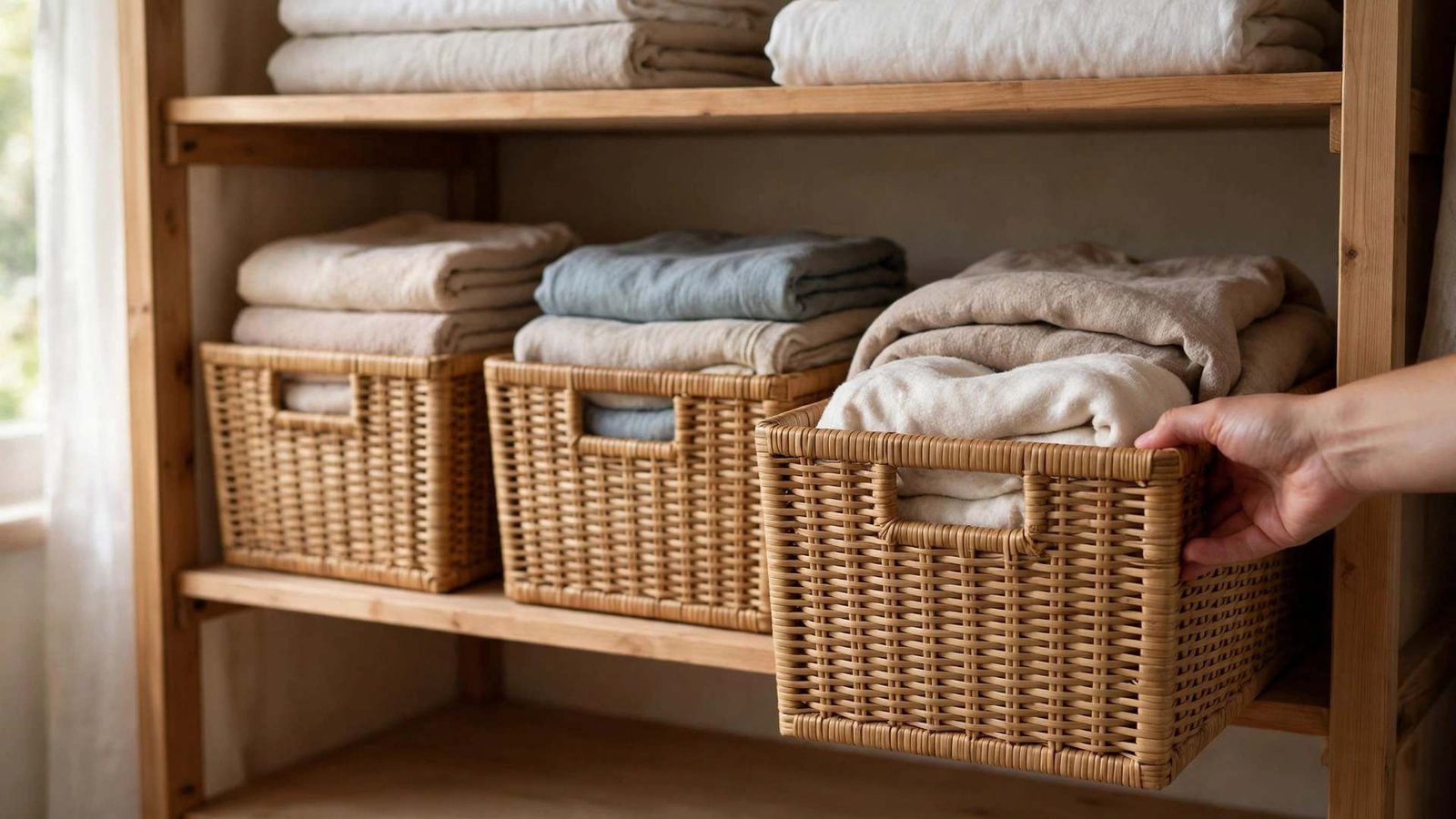
Deep rental shelves — the kind where the back half is a dark void — are where linens go to disappear. The renter-safe fix is handled bins used as pull-out drawers: set an open-top bin or handled tote on each deep shelf, fill it with a category (all spare blankets, all guest bedding, all cleaning rags), and pull the whole bin toward you when you need something.
This works because it changes the geometry of access. Without the bin, you reach blindly into a 24-inch-deep shelf and disturb everything. With the bin, the shelf contents come to you. The handle is what makes it work — bins without handles get shoved back and become just as inaccessible as the open shelf was, so handles (built-in or add-on) are non-negotiable.
Why it's renter-safe: Bins sit on the shelf surface and touch nothing else. No mounting, no tracks, no hardware — you get 80 percent of a built-in pull-out drawer with zero installation.
How to do it:
- Measure shelf depth and buy bins one to two inches shallower so they slide easily without catching the door.
- Assign one bin per category: spare blankets, guest sheet sets, cleaning rags, beach towels — never mix categories in one bin.
- Choose bins with built-in handles or attach adhesive-free handle straps; front handles matter most.
- Put heavy items (quilts, blankets) in lower bins and light items (washcloths, hand towels) in upper ones.
- Approximate cost: $8–$40 depending on bin count and size.
6. Go Vertical: Stack in Labeled Bins Instead of Shelves
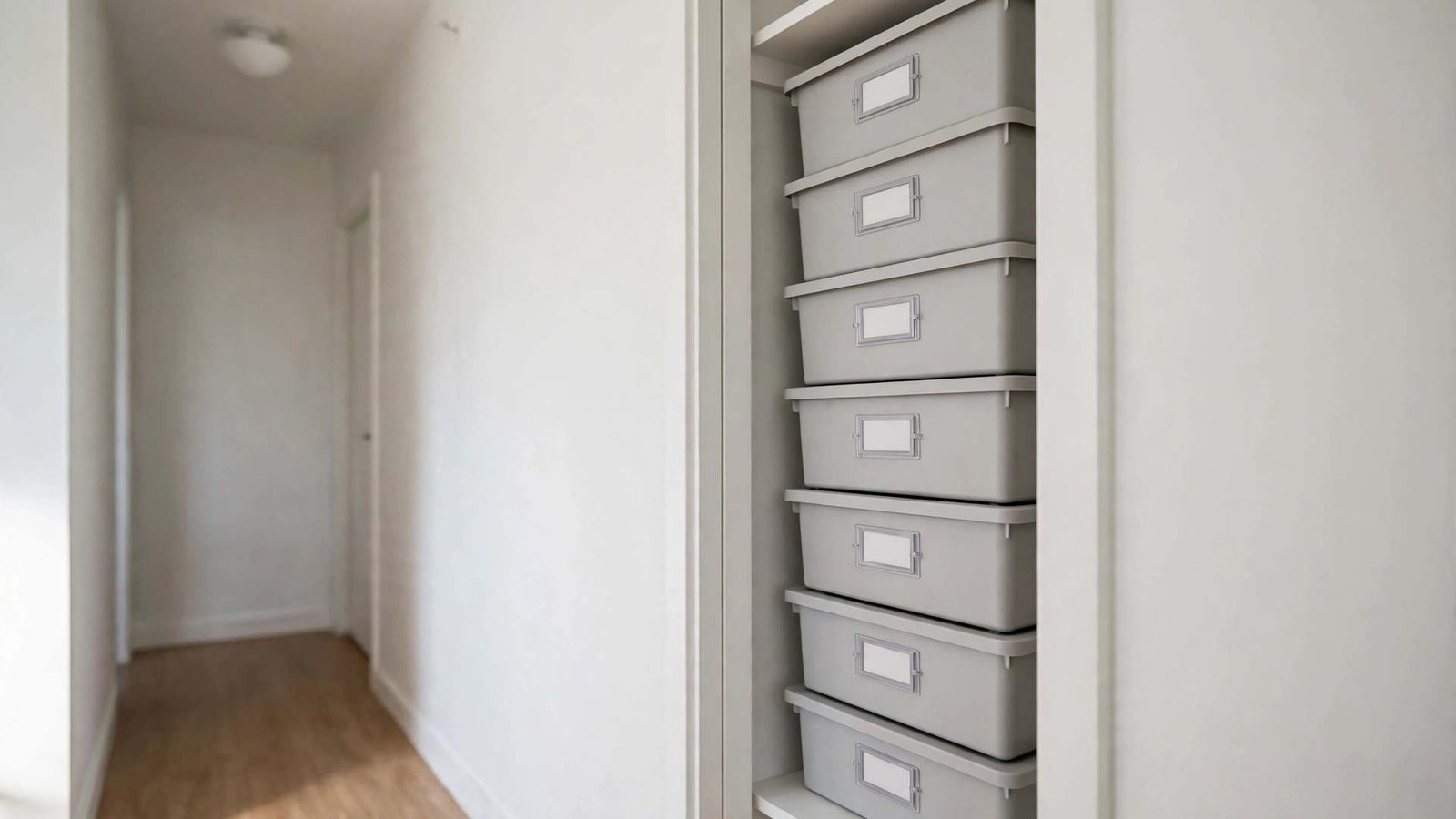
When a linen closet has few shelves — or shelves in all the wrong places — stop organizing shelf-by-shelf and go vertical. Stackable bins or labeled totes piled floor-to-ceiling turn a two-shelf closet into a six-tier system. Each bin is one category, the labels face the door, and the whole closet becomes a tidy tower of purpose.
This approach shines in narrow hall closets and awkward corner closets where the shelves are shallow, irregular, or missing entirely. A stack of uniform bins also looks intentional in a way that mismatched linen piles never do — the closet reads as "organized system" even when it's holding the same stuff. And because the bins are portable, you can reconfigure the tower the day your bedding inventory changes.
Why it's renter-safe: Freestanding stacks touch the walls and floor with nothing more than gravity. Unstack, carry out, and the closet is back to exactly how the landlord left it.
How to do it:
- Choose bins that are stackable by design (lipped or interlocking edges) so the tower can't slide apart.
- Put the heaviest bin (blankets, quilts) on the bottom and the lightest (washcloths, spare pillowcases) on top.
- Label every bin on the side that faces the door — categories should be readable without touching anything.
- Keep the stack at or below eye level for daily items; seasonal or rarely used bedding goes in the top bin.
- Approximate cost: $15–$45 for three to five stackable bins.
7. Roll Your Towels Like a Spa Display
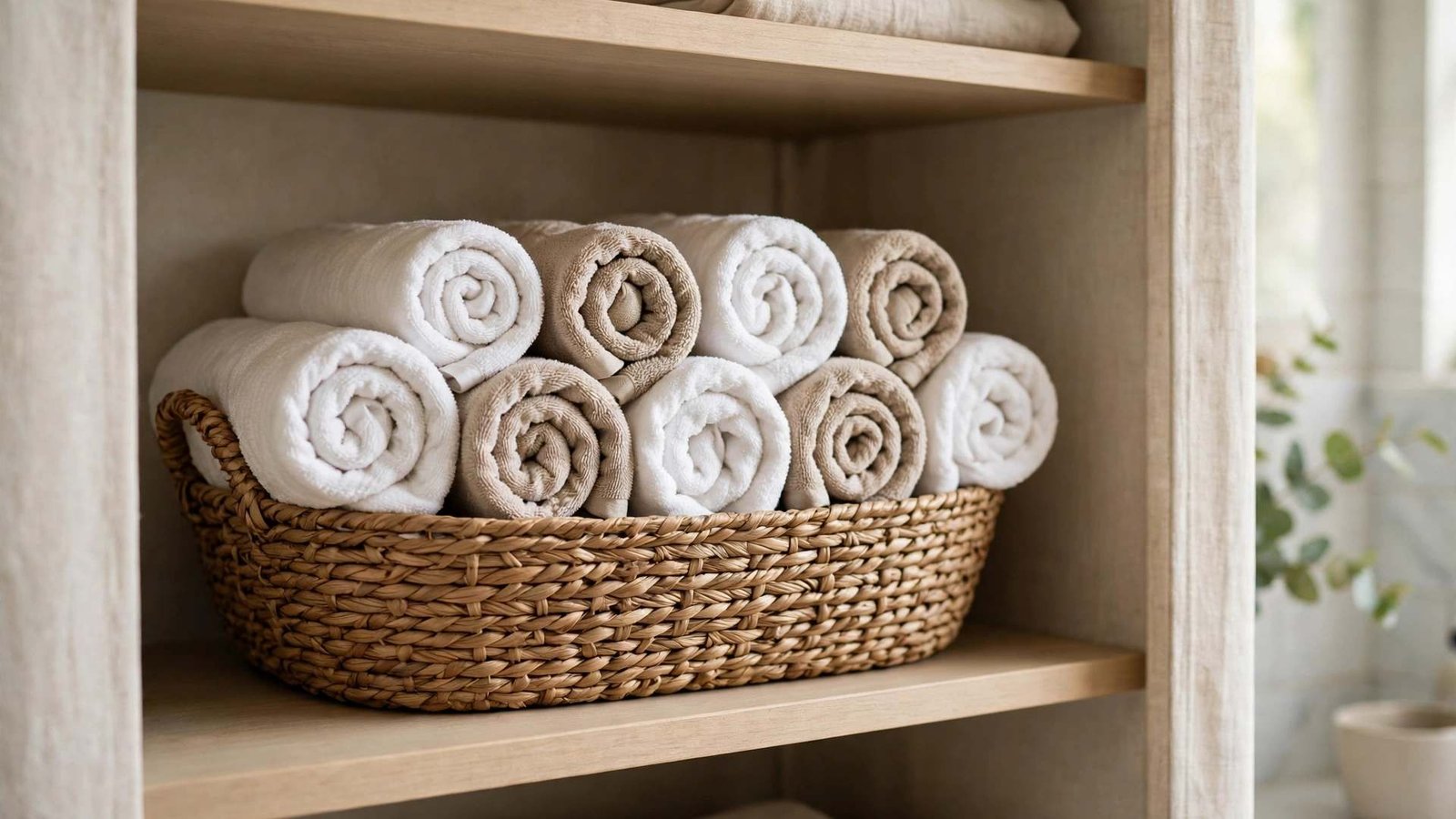
Spa-style rolling — rolling bath towels into tight cylinders and standing or stacking them — is the most space-efficient way to store towels in a small linen closet. A rolled towel has a smaller footprint than a folded one, rolls wedge together so they can't slump, and the whole shelf takes on that calm spa look that makes a rental bathroom feel intentional.
Rolling also solves the visibility problem that folded stacks create. When towels are stacked flat, you can only see the top one; when they're rolled and facing you, you can see every single towel, which means you stop pulling from the top and disrupting the whole pile. In a narrow closet where you can only reach the front row anyway, rolls make the front row the entire collection.
Why it's renter-safe: Another pure technique — no products, no installation, no changes to anything the landlord owns. The skill lives in your hands and works in every closet you'll ever rent.
How to do it:
- Fold each towel in half lengthwise, smooth it flat, then roll tightly from one short end to the other.
- Tuck the loose end under the roll to keep it from unspooling on the shelf.
- Stand rolls upright in a bin or basket, or stack them pyramid-style on a shelf, seam-side down.
- Sort by color so the display looks deliberate and everyone can find their shade.
- Approximate cost: $0. Refolding what you already own is the whole project.
8. Conquer the Door with an Over-the-Door Organizer
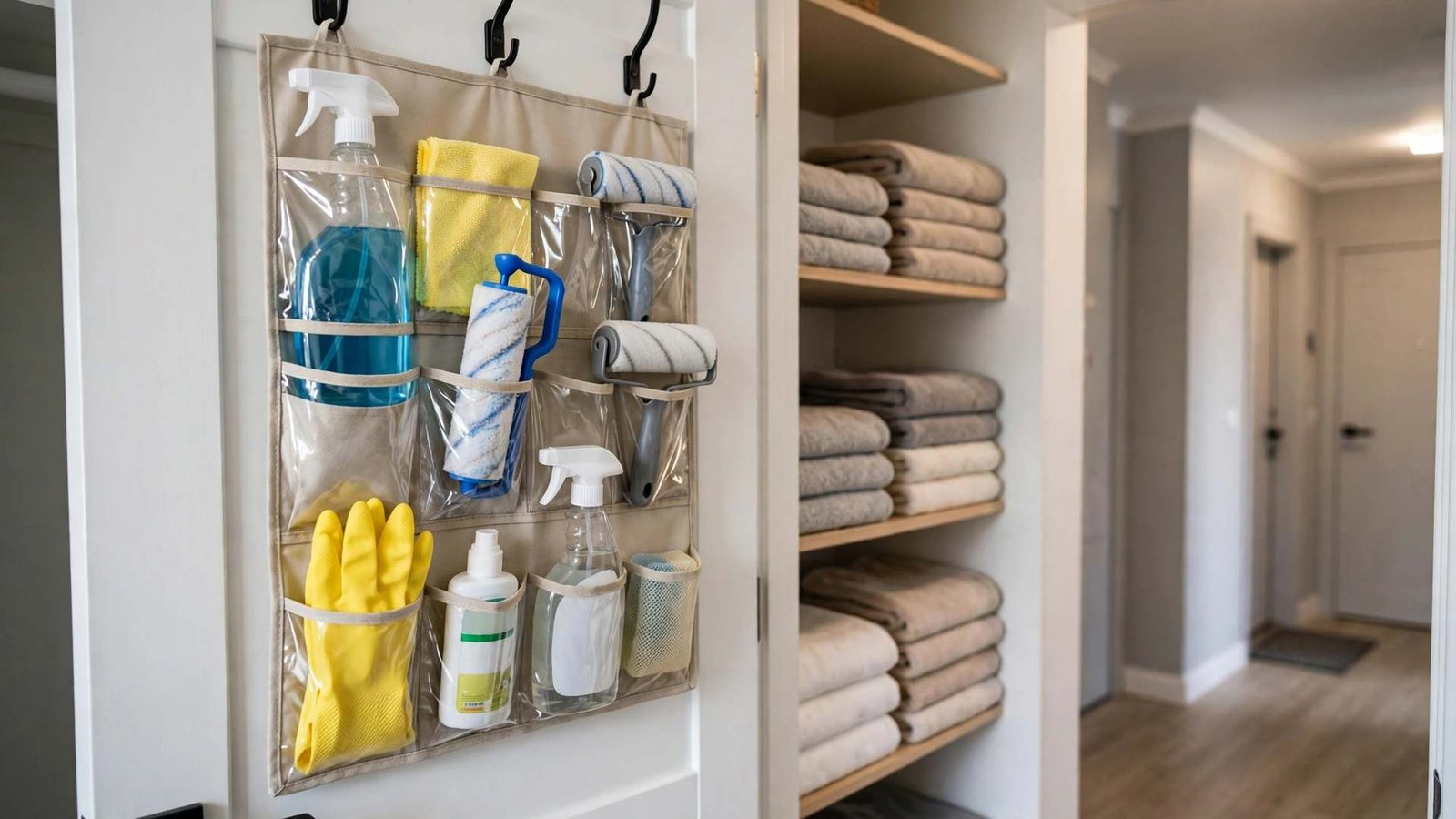
The inside of the linen closet door is free real estate that most renters ignore — and in a small closet, it can add an entire extra shelf's worth of storage. An over-the-door organizer (hooks that hang from the top of the door, no screws) holds the small, annoying items that clutter shelves: stain remover, lint rollers, spare light bulbs, sewing kits, travel toiletries, cleaning cloths.
The catch is door clearance — the organizer adds thickness, so it only works on doors that don't swing into shelves or a tight hallway wall. Measure the gap between the open door and anything behind it before you buy. When it fits, though, it's transformative: all the small supplies leave the shelves, the shelves hold only linens, and the closet finally feels sorted by purpose instead of crammed by necessity.
Why it's renter-safe: Over-the-door hooks hang from the door's top edge and lift off without a trace. Nothing is screwed, stuck, or nailed into the door or frame — a move-out wipe-down erases all evidence.
How to do it:
- Confirm your door has at least two inches of swing clearance behind it so the organizer doesn't bang shelves or walls.
- Choose a flat pocket organizer or row of hooks sized to the door (measure the door width first — closet doors run narrow).
- Assign the organizer to non-linen supplies only: cleaning sprays, stain treatments, spare bulbs, first-aid basics.
- Keep heavy bottles on the lowest pockets so the weight sits near the door's hinge side and the door swings freely.
- Approximate cost: $12–$30 for an over-the-door hook row or pocket organizer.
9. Add a Turntable for the Back Half of Deep Shelves
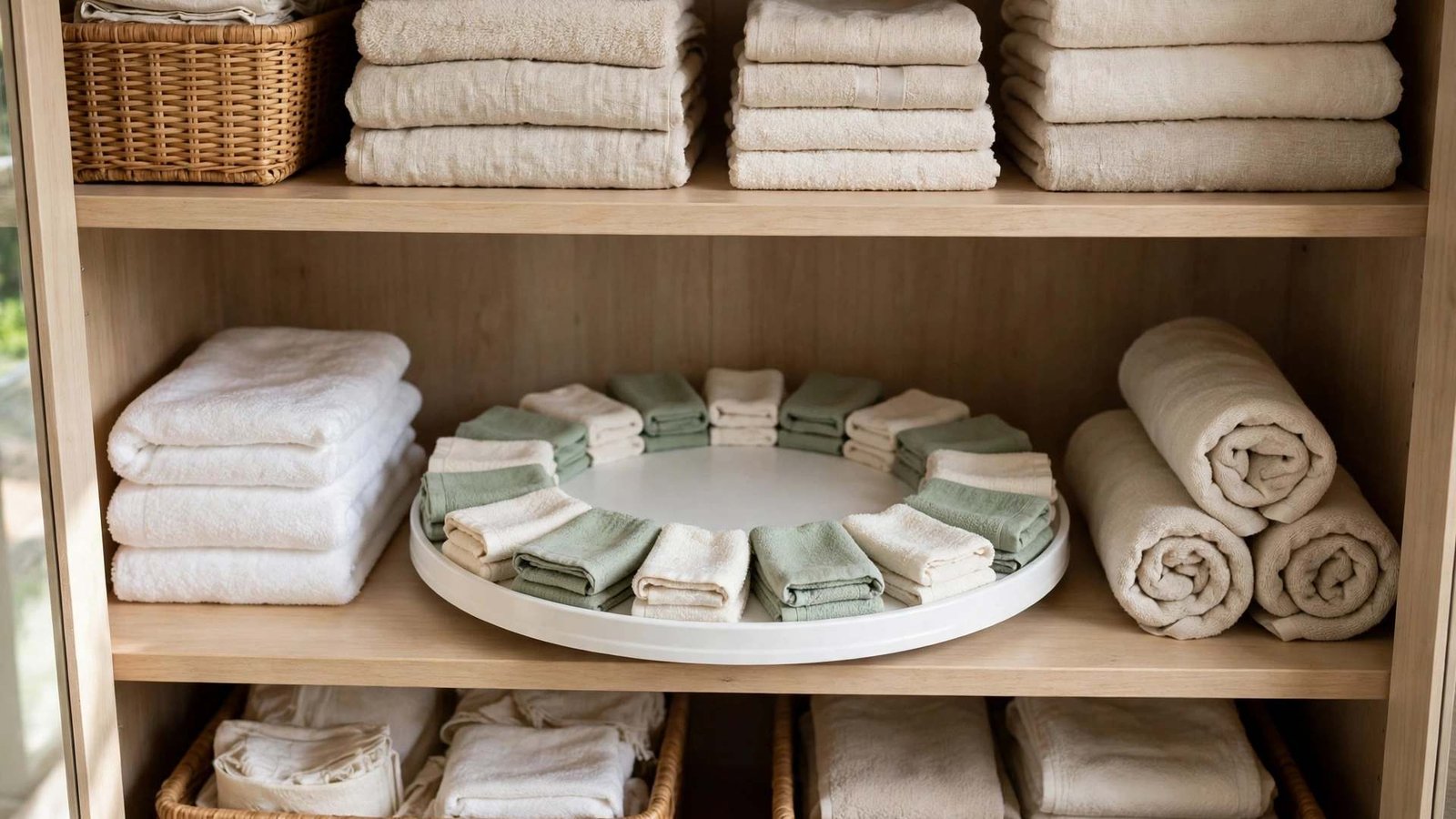
The back half of a deep linen shelf is where folded items get lost — you can't see what's back there, so you shove and hope. A turntable (a round rotating tray that sits on the shelf surface) turns that dead zone into accessible storage: small folded washcloths, hand towels, guest soaps, and spare toiletries ride the turntable, and one spin brings the back to the front.
This is the same principle as a kitchen lazy Susan, applied to textiles. It works especially well for the narrow, deep linen closets in older apartments where the shelves were built for a different era's folding standards. Because the turntable rotates freely, even the items stored at the very back of a 20-inch shelf are one spin away — no more pulling out three stacks to reach the one washcloth you wanted.
Why it's renter-safe: A turntable rests on the shelf by gravity. No mounting, no adhesive, no modifications — lift it off and the shelf is untouched.
How to do it:
- Measure the shelf depth and choose a turntable diameter that leaves an inch of clearance on each side.
- Group small items on the turntable: washcloths, hand towels, guest toiletries, spare sponges — things that get lost in deep space.
- Keep the turntable's load balanced and low so it spins smoothly when full.
- Reserve the turntable for high-turnover small items; bulky bedding stays on the open shelf where it belongs.
- Approximate cost: $10–$25 per turntable.
10. Label Everything with Removable Labels
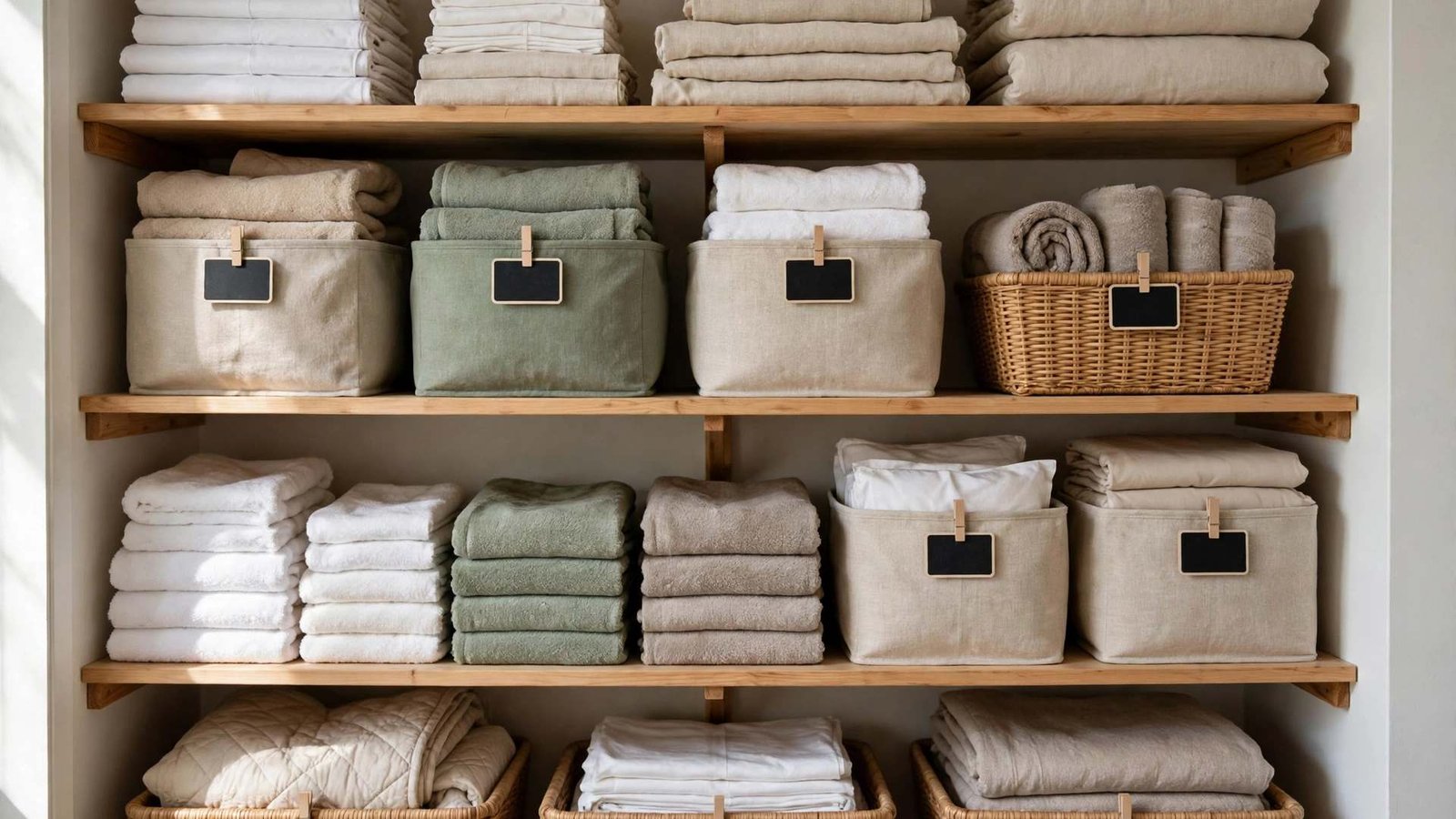
An unlabeled linen closet is a mystery box. You know the guest sheets are "somewhere on the second shelf," but so is everything else, and labels are the cheapest way to end the guessing. Removable labels — chalkboard-style clip labels, adhesive labels rated for easy removal, or simple tags on bin handles — tell every household member (and every guest) exactly where things live and where they go back.
Labels also do something subtler: they make the system stick. When a bin says "queen sheet sets" on the front, nobody stuffs bath towels into it. The closet stays organized not because everyone is disciplined, but because the system communicates. In shared rentals and family households, this single habit prevents more re-cluttering than any folding method ever will.
Why it's renter-safe: Use labels designed to remove cleanly — chalkboard clip labels on bins, adhesive labels rated "removable," or tied tags. Nothing permanent touches the landlord's shelves.
How to do it:
- Label every bin, basket, and divided lane with its category in plain words ("bath towels," "queen sheets," "cleaning rags").
- Put labels on the side that faces the door at eye level, so categories are readable without touching anything.
- Use a label maker or neat handwriting on removable labels — faded or peeling labels get ignored.
- Re-label the moment a bin's purpose changes; an outdated label is worse than no label.
- Approximate cost: $5–$15 for removable labels or a pack of chalkboard clip labels.
11. Shrink Bulky Bedding with Vacuum Storage Bags
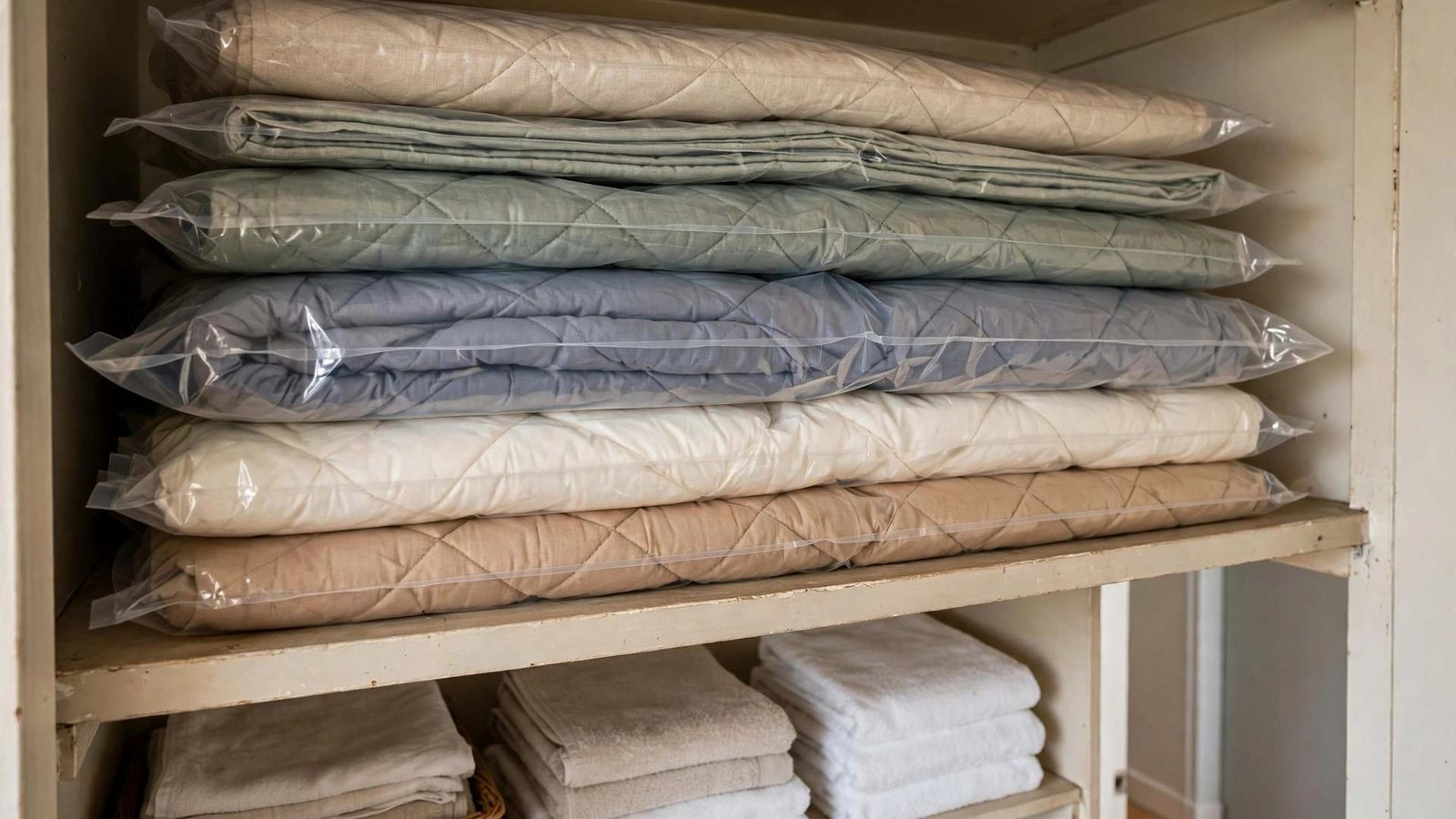
Quilts, comforters, and seasonal blankets are the linen closet's space hogs — three or four bulky pieces can eat an entire shelf. Vacuum storage bags compress them to a fraction of their size: seal the bag, squeeze or vacuum out the air, and a comforter that filled a shelf now slides into the space behind your towels.
This is especially powerful in rentals because bulky bedding is seasonal, not daily. Winter quilts in October don't need to be accessible in July — they need to be stored, and compressed flat they're easy to slide under a bed, onto a high closet shelf, or behind the daily linens. Just remember the re-fluff rule: natural down and feather fills should spend a few hours aired out before use after long compression.
Why it's renter-safe: Bags sit on the shelf or slide under the bed — they touch nothing structural and change nothing about the apartment. When you move, the bags compress again and travel with you.
How to do it:
- Sort bedding by season and bag only the off-season pieces — keep current-season blankets accessible and uncompressed.
- Fold each quilt or comforter flat before bagging so it compresses evenly instead of balling up.
- Seal the bag fully, then press or vacuum the air out until the bag stops shrinking (don't over-compress down fills).
- Label each bag with its contents and season ("winter quilts," "guest comforter") so you can find it months later.
- Approximate cost: $10–$30 for a multi-pack of vacuum storage bags.
12. Corral the Awkward Bottom Shelf with Low Rolling Baskets
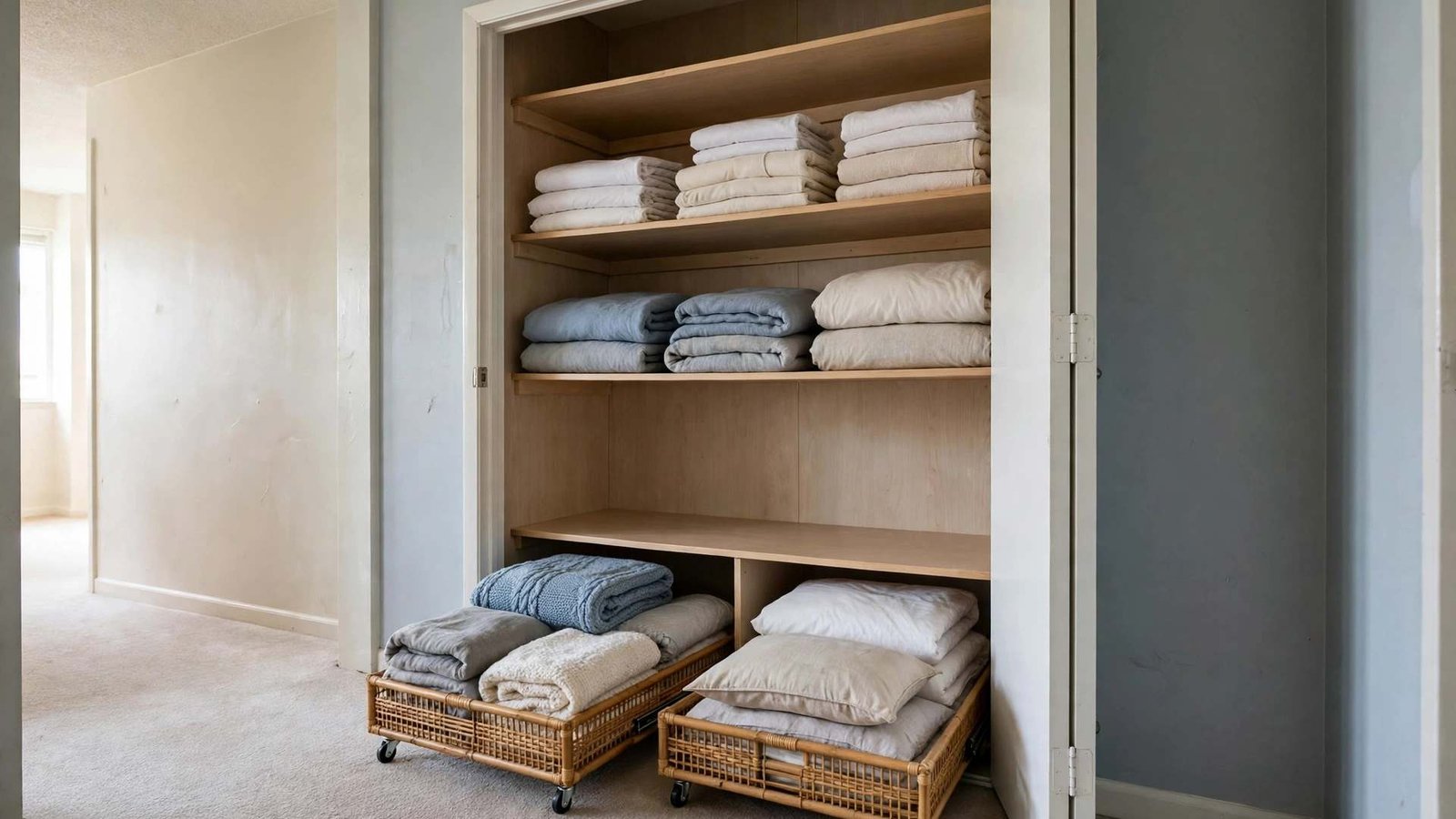
The floor-level shelf of a linen closet is the awkward zone — hard to reach, easy to ignore, and the first place clutter migrates. Low rolling baskets (shallow baskets or under-bed-style bins on casters) turn that dead zone into the closet's most functional tier. Slide-out baskets hold the bulky, low-turnover stuff — spare comforters, seasonal bedding, beach towels — and roll toward you in one motion when you need them.
Renters often waste this bottom space entirely or fill it with a random pile that becomes a permanent mystery. Rolling baskets fix both problems: they give the lowest shelf a defined purpose, they make its contents reachable without kneeling and digging, and the casters mean even a heavy load of blankets glides out easily. On move-out day, the baskets roll straight out of the closet and into the moving truck.
Why it works for renters: Rolling baskets rest on the floor or the lowest shelf and touch nothing else. No installation, no hardware, no marks — they roll out and the space is exactly as you found it.
How to do it:
- Measure the clearance under the lowest shelf and choose baskets low enough to slide in and out freely.
- Assign the bottom zone to low-turnover bulky items: spare comforters, seasonal bedding, beach and pool towels.
- Choose baskets with built-in casters or add stick-on furniture glides (removable ones) so they slide smoothly.
- Keep one basket per category and label the front edge so the "mystery pile" never reforms.
- Approximate cost: $15–$40 for two to three low rolling baskets.
Conclusion
Your rental linen closet doesn't need built-ins, a bigger footprint, or your landlord's permission to finally work. It needs the right strategies for the space it actually is: dividers and risers to fix shelves that are too tall, file-folding and rolling to fix stacks that collapse, pillowcase bundles to end the fitted-sheet hunt, and pull-out bins, turntables, and rolling baskets to make deep and awkward zones reachable. Every idea in this post shares one trait that matters more than any organizer: it's removable. Nothing here asks you to drill, mount, or modify a single thing you don't own.
Start with the free wins this weekend: file-fold the towels, bundle the sheet sets, and roll what's left. Those three techniques cost nothing and transform the shelves instantly. Then add the dividers, risers, and labeled bins — the hardware that makes the good habits stick. Within an afternoon, the closet you used to avoid will be the one you show people. Your rental linen closet was never too small. It was just waiting for a system that respects the rules. Please save this visual guide on Pinterest and pin the idea you're trying first — your future self, reaching into a perfectly organized closet on laundry day, will thank you.

Amelia leads HavenlyStyle’s editorial vision with a passion for elegant interiors and practical home living. With years of experience in home décor and lifestyle content, she ensures every article is accurate, inspiring, and easy to follow. From timeless decorating ideas to the latest interior design trends, Amelia is committed to helping readers create beautiful, functional spaces while maintaining HavenlyStyle’s trusted and welcoming voice.