Intro
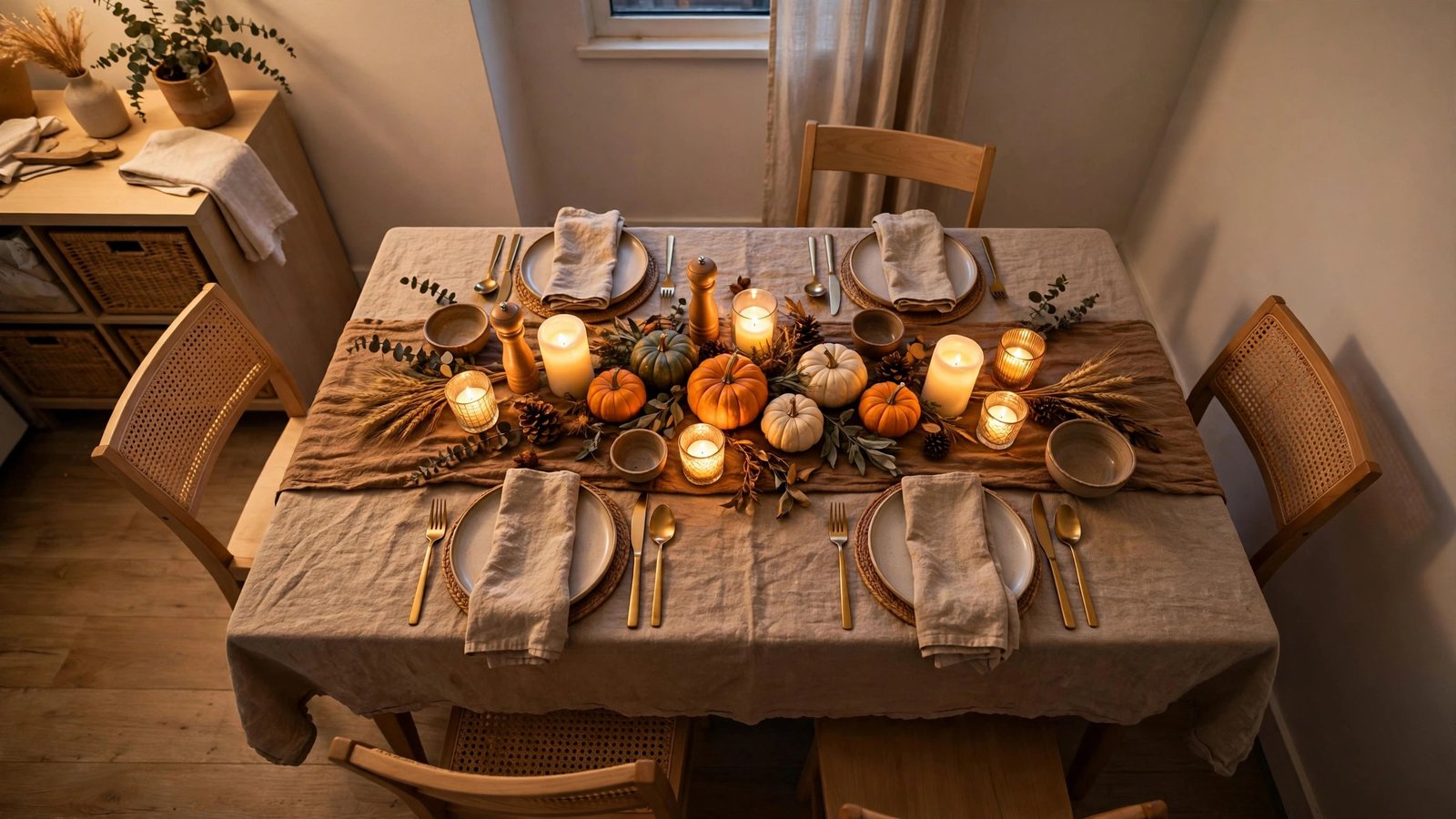
You don’t need a farmhouse table to host a beautiful Thanksgiving — you need a beautiful plan for the table you already have. That’s the renter’s reality, and I’ve watched it play out in dozens of small dining spaces: a hand-me-down table, four mismatched chairs, a landlord who would notice a single scratch, and a holiday that somehow still has to feel like the movies. Here’s the secret I tell every renter I help: on Thanksgiving, nobody remembers the table — they remember what was ON the table.
Every idea in this guide lives entirely on the table surface. Nothing gets nailed, glued, or permanently changed, and your landlord’s furniture actually ends up more protected than it was before you started. I’ve personally seen folding card tables, scratched hand-me-downs, and wobbly dining sets all vanish under the right styling. These fifteen ideas are ordered by impact, so start with number one and keep going until your table looks like the gathering spot it deserves to be.
Executive Summary
- Your table surface is the whole canvas: runners, layers, and centerpieces do all the work — the furniture underneath doesn’t matter.
- Protect the landlord’s table while you decorate: runners, felt pads, and trivets are non-negotiable in a rental.
- A write-on kraft paper runner doubles as an activity and shields the wood at the same time.
- Battery candles give you the full holiday glow without the open flame most leases ban.
- Everything here lifts off in under fifteen minutes — your deposit stays intact.
1. Roll Out a Kraft-Paper Runner You Can Write On
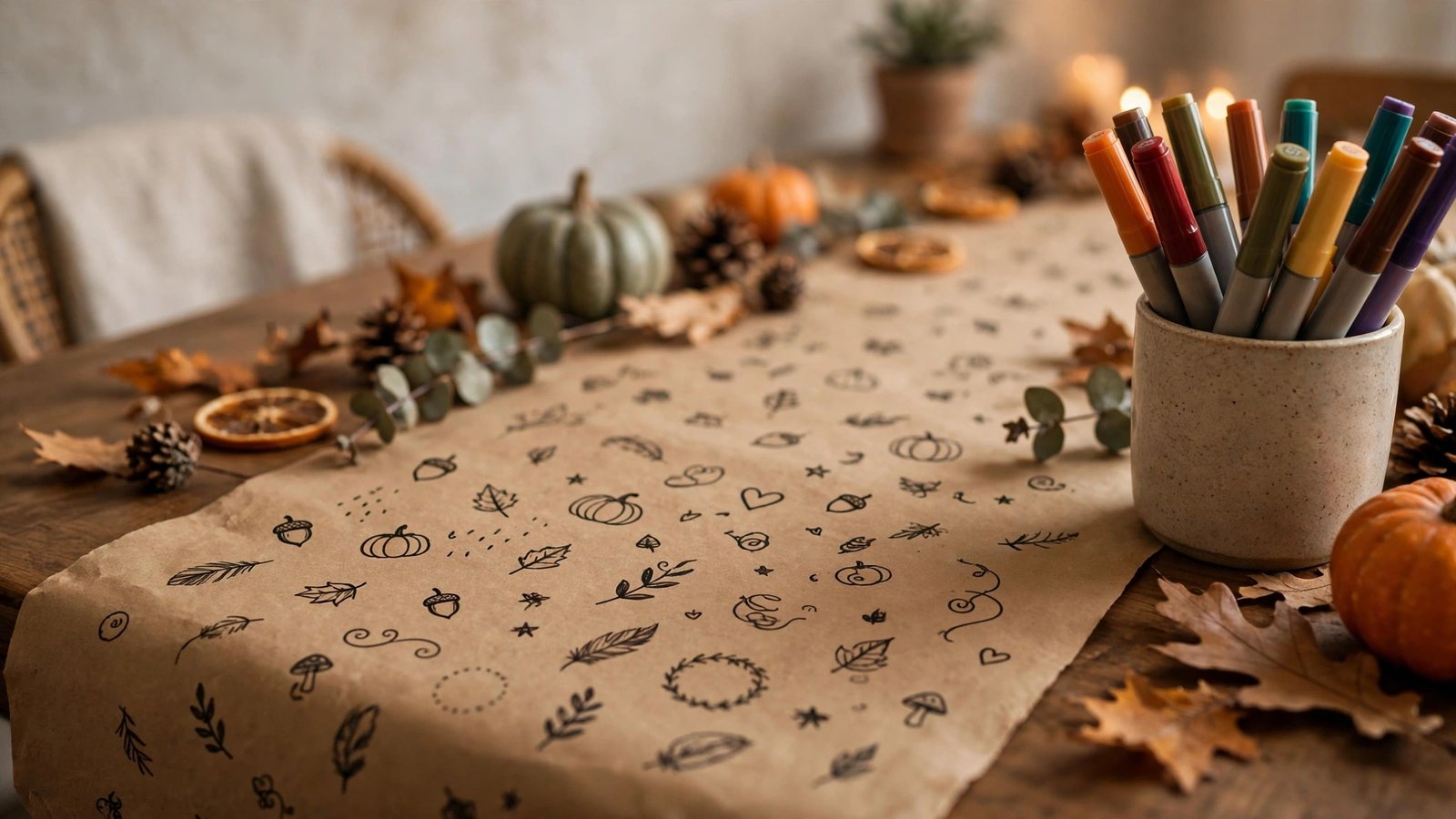
What it is: A roll of brown kraft paper, cut to run the length of your table, that guests write on all evening — names, doodles, things they’re thankful for.
Why it works for renters: It covers the entire center of the table in one move, which means it hides scratches, water rings, and dated finishes while protecting the wood from new ones. Zero adhesive, zero residue — you just roll it up and recycle it.
How to do it:
- Measure your table’s length and add about a foot of overhang on each end; cut the paper with scissors or a craft knife.
- Secure it with small loops of painter’s tape on the underside of the table edge — painter’s tape releases cleanly from wood and laminate.
- Set out a cup of washable markers or colored pencils in the middle so guests know it’s meant to be written on.
- Write the first entry yourself before anyone arrives — “Thankful for this table” breaks the ice and gives permission.
- After dinner, roll the paper up as a keepsake or recycle it; the table underneath is untouched.
Approximate cost: $8–$12 for a large roll of kraft paper and a pack of markers.
Renter tip: Write the date and year at the top — future you will love finding this paper in a memory box.
2. Line the Table with Mini Pumpkins
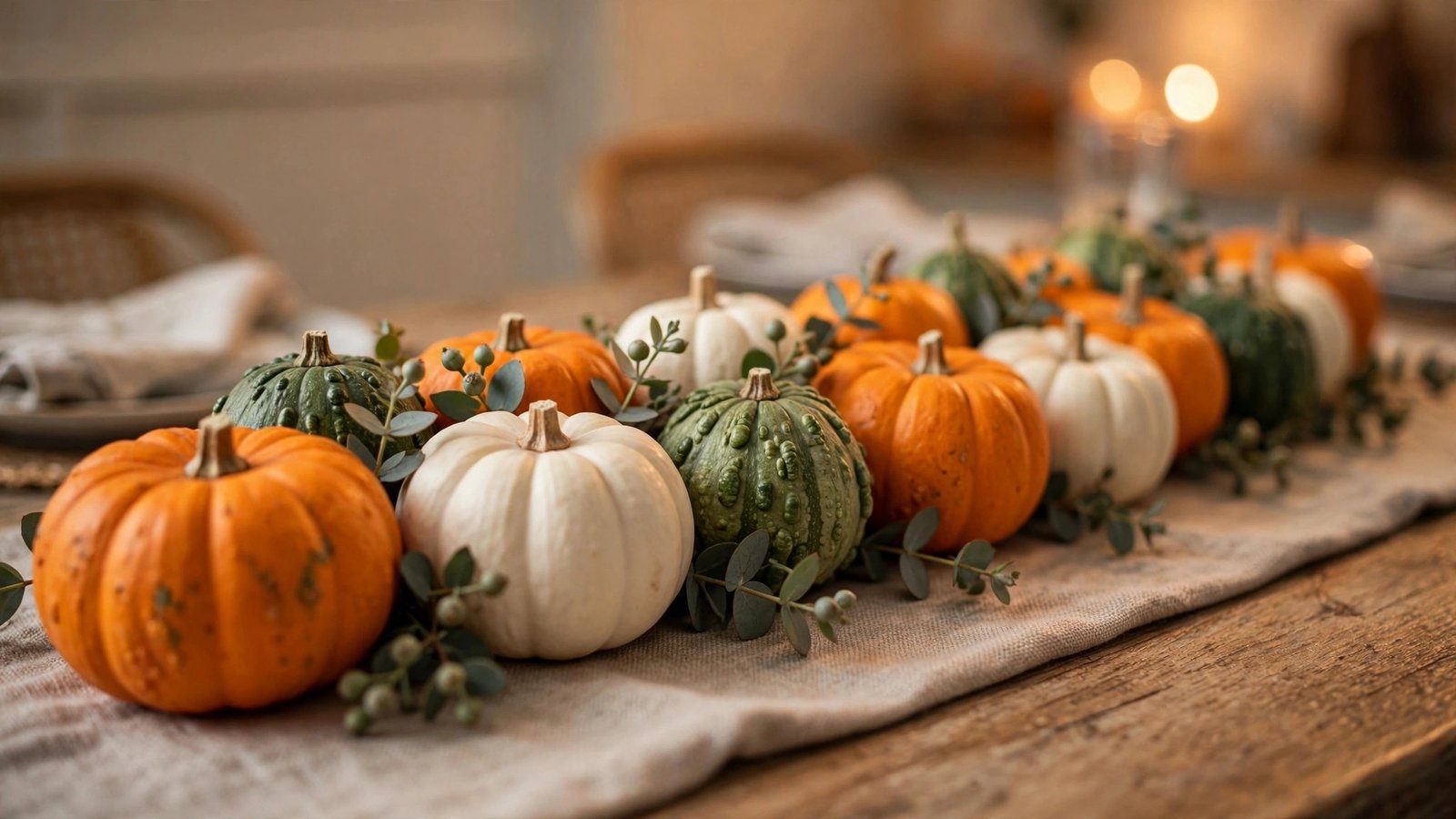
What it is: A simple line of mini pumpkins and gourds down the center of the table — different sizes, mixed colors, nothing else required.
Why it works for renters: Pumpkins are nature’s no-damage decor. They sit on any runner or tabletop, leave no marks, roll off into a bag at the end of the night, and cost less than almost any other centerpiece. I’ve seen a $10 bag of minis transform a folding table completely.
How to do it:
- Buy 8–12 mini pumpkins in mixed colors — orange, white, green-striped — from a grocery store or pumpkin patch; odd numbers look more natural.
- Place the largest ones first, spaced down the center line, then fill gaps with the smaller ones.
- Tuck a few sprigs of eucalyptus or rosemary between them for greenery and scent.
- If your table is narrow, use a single straight line; on wider tables, cluster them in small groups of three.
- After the holiday, roast the edible ones or compost the rest — nothing to store.
Approximate cost: $10–$20 for a bag of assorted minis.
Renter tip: Buy one extra bag; kids always pocket a mini pumpkin, and you’ll want spares.
3. Use Battery Candles at Low Heights for Lease-Safe Glow
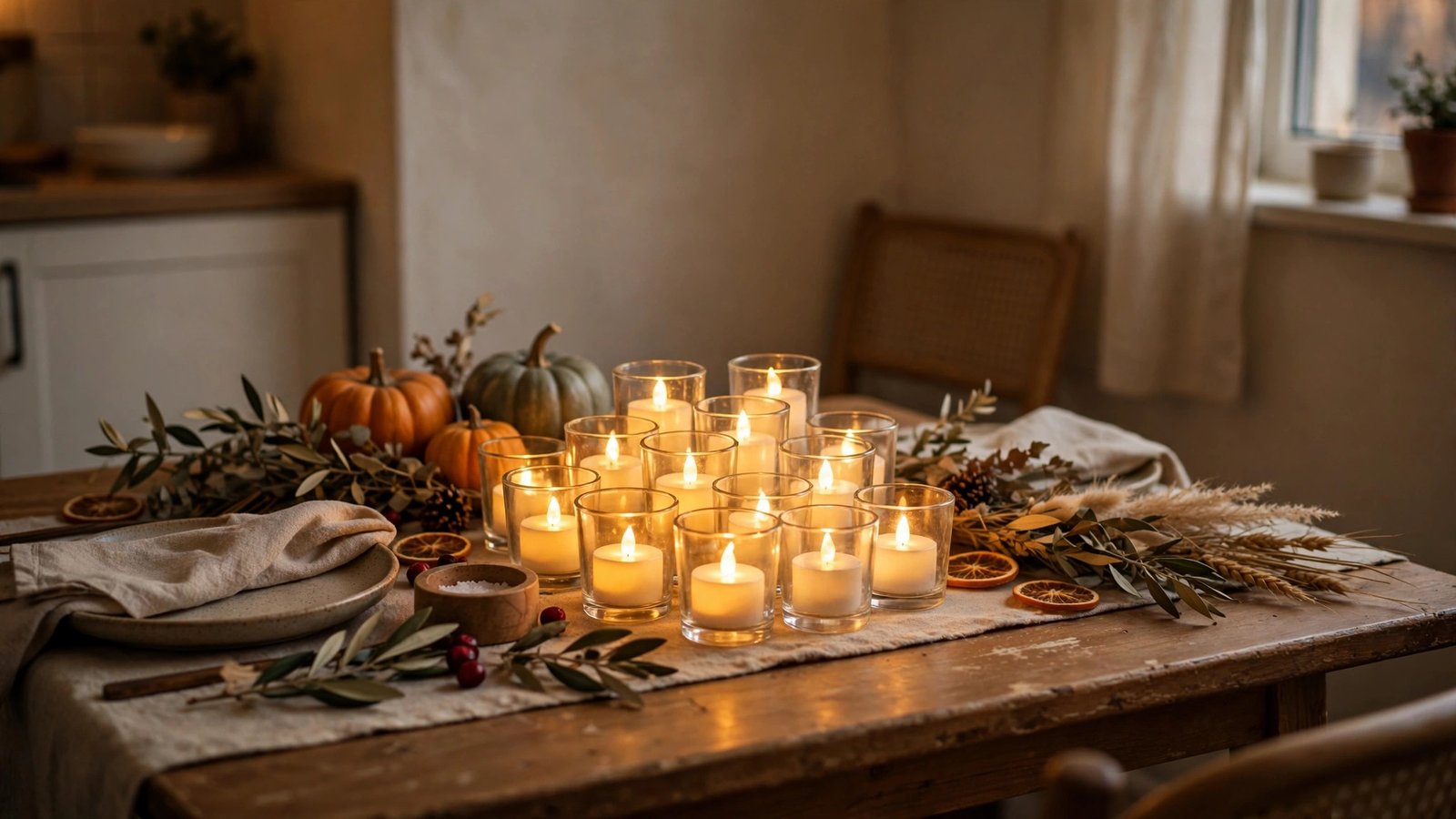
What it is: Clusters of LED tea lights and flameless votives in small glass holders, kept low so sightlines across the table stay open.
Why it works for renters: Most leases and rental insurance policies restrict or outright ban open flames, and one scorched tabletop is a deposit deduction waiting to happen. Battery candles give you the same warm flicker with zero wax drips, zero smoke, and zero risk to the landlord’s table.
How to do it:
- Buy a set of LED tea lights or flameless votives — warm white only, which reads as candlelight rather than flashlight.
- Set them in short glass holders, mason jars, or small bowls; glass diffuses the light and looks intentional.
- Cluster in odd numbers (three, five, seven) at low heights along the center, leaving room for dishes.
- Turn them all on about thirty minutes before guests arrive so the table glows as people walk in.
- Keep one spare set of batteries on hand — LED candles dim suddenly, not gradually.
Approximate cost: $10–$25 for a multi-pack of LED tea lights plus simple holders.
Renter tip: Light one candle the night before so you know exactly how long the batteries last.
4. Build a Mini Thankful Tree Centerpiece

What it is: A few bare branches in a jar or vase, with small paper tags guests hang from them, each written with something they’re thankful for.
Why it works for renters: It costs almost nothing, takes ten minutes, and doubles as the evening’s activity — no purchases that need storing afterward. Branches go back outside, the jar goes back in the cabinet, and the tags become a keepsake.
How to do it:
- Gather 5–7 interesting bare branches from outside, about 18–24 inches tall; trim off any leaves.
- Anchor them in a sturdy jar or vase filled with stones, dried beans, or marbles so the branches stand upright.
- Cut small tags from kraft paper or cardstock, punch a hole in each, and thread short pieces of twine through.
- Set out a pen and invite each guest to write one thing they’re thankful for and hang their tag.
- Photograph the finished tree before anyone leaves — it becomes part of your holiday record.
Approximate cost: $0–$10 if you already own a jar and twine.
Renter tip: Set the jar on a trivet — top-heavy branches plus a crowded table is a spill waiting to happen.
5. Grab Budget Florals from the Grocery Store
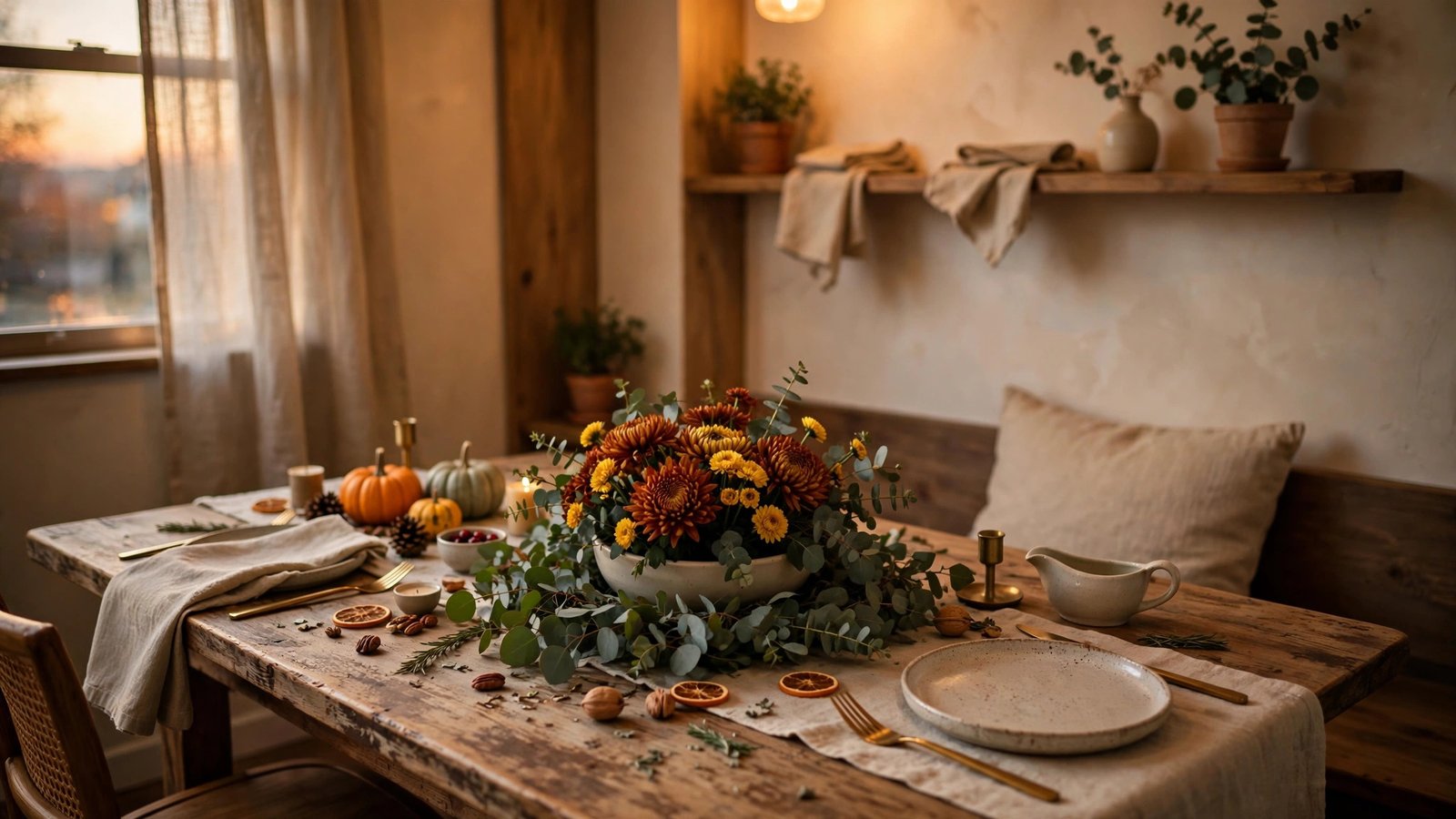
What it is: Two or three bunches of grocery-store flowers — chrysanthemums, alstroemeria, eucalyptus — arranged low in whatever vessel you own.
Why it works for renters: Florist arrangements are priced for weddings, not rentals. Grocery bunches cost a fraction and look just as good when you keep them low, full, and in warm autumn tones. The whole arrangement composts afterward, so there’s nothing to store in a small apartment.
How to do it:
- Buy 2–3 bunches in complementary warm tones — rust, gold, cream — plus one bunch of greenery like eucalyptus.
- Strip the lower leaves from every stem so nothing sits in the water but stems.
- Trim stems at an angle to slightly different lengths and arrange in a low, wide vessel — a serving bowl works beautifully.
- Keep the finished height under twelve inches so guests can see each other across the table.
- Change the water on day two and the arrangement will still look fresh for leftover night.
Approximate cost: $12–$25 for two or three bunches.
Renter tip: Buy the flowers two days early; tight buds will have opened beautifully by Thursday.
6. Tie Napkins with Fresh Herb Sprigs

What it is: Cloth or paper napkins bundled with a sprig of fresh rosemary or thyme and a short piece of twine — a fragrant napkin ring that costs pennies.
Why it works for renters: It makes the most basic place setting look styled, uses something you’d buy for cooking anyway, and leaves no trace. The herbs smell like the holiday itself, and any leftovers go straight into the stuffing or the stockpot.
How to do it:
- Buy one or two bunches of fresh rosemary or thyme — the sturdier herbs hold up best out of water.
- Cut twine or kitchen string into eight-inch pieces, one per guest.
- Lay a napkin flat, fold it into a rectangle, and place two or three herb sprigs across the center.
- Tie the twine in a simple knot or bow around the napkin and herbs — snug, not crushing.
- Set one bundle at each plate, angled slightly, with the herbs facing up so guests smell them first.
Approximate cost: $3–$8 for herb bunches and twine.
Renter tip: Assemble the napkin ties the morning of the dinner so the herbs stay fresh and fragrant.
7. Lay Cloth Napkins in Warm Tones
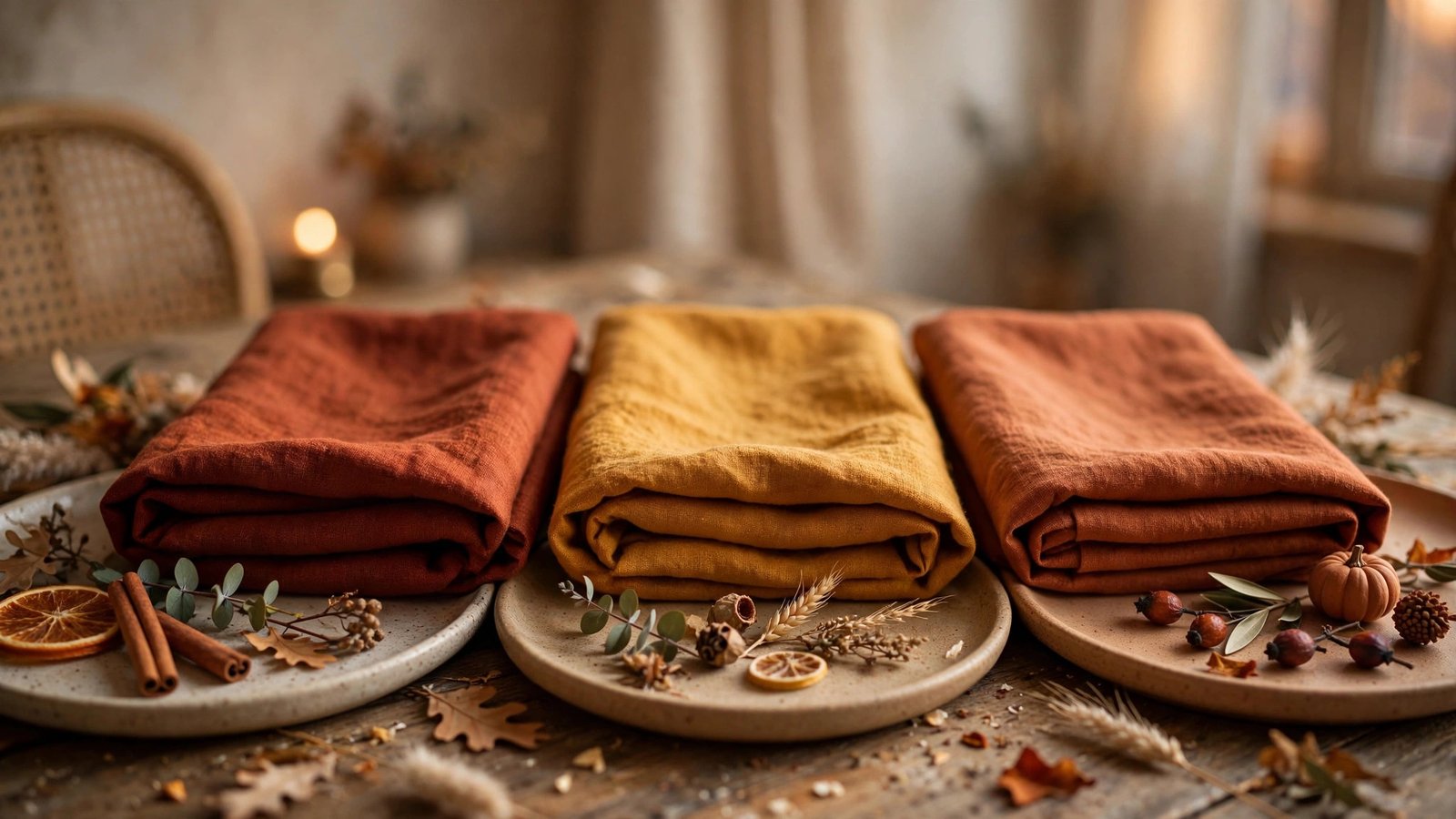
What it is: Simple cloth napkins in autumn colors — rust, mustard, terracotta, deep gold — replacing paper napkins at every seat.
Why it works for renters: Cloth napkins are one of the cheapest upgrades with the biggest visual payoff. A twelve-pack costs less than two fancy paper sets, they photograph beautifully, and they go through the washing machine and back into a drawer — perfect for small kitchens with no storage for seasonal paper goods.
How to do it:
- Buy one set of 8–12 cloth napkins in a warm solid tone; cotton or a linen look works best.
- Don’t stress about ironing — fold them in simple rectangles or a loose pocket fold, and slight wrinkles read as relaxed and intentional.
- Choose one tone for all napkins, or mix two neighboring tones (rust and mustard) for a collected-over-time feel.
- Layer each napkin on the plate or under the fork, depending on your place-setting style.
- Toss them in the wash the next day — skip fabric softener so they keep their grip for future folds.
Approximate cost: $12–$20 for a set of 8–12.
Renter tip: Choose napkins a shade darker than your table — the contrast photographs richer.
8. Make Place Cards That Double as Favors
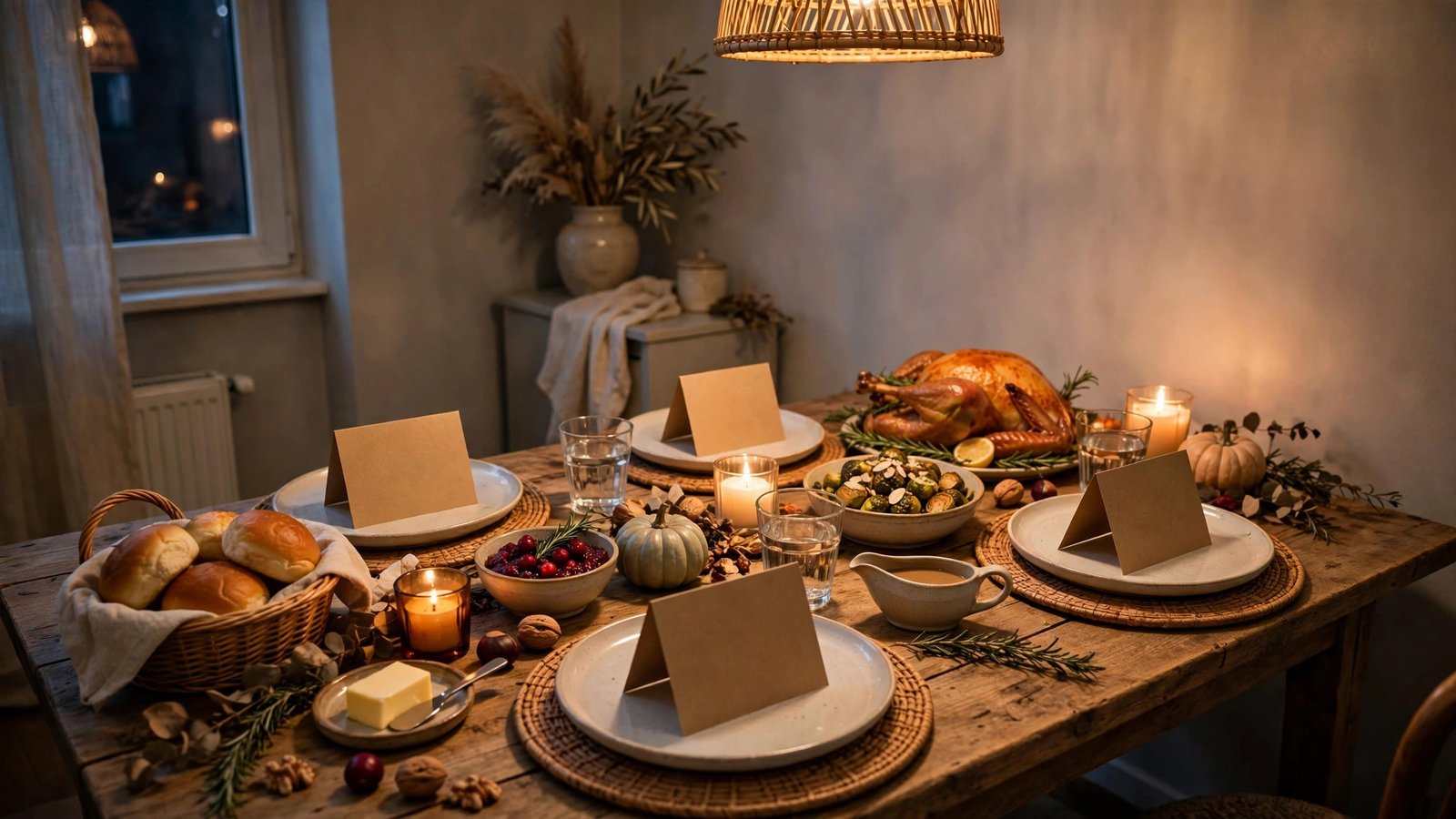
What it is: Handwritten place cards on kraft or cardstock, with a small thank-you note or a favorite recipe on the back — guests take them home.
Why it works for renters: Assigned seats end the “where do I sit” shuffle in small dining spaces, and a card that doubles as a favor means one item does two jobs. Everything is paper, so there’s nothing to clean, store, or return.
How to do it:
- Cut kraft paper or cardstock into small tent cards, about 3 by 2 inches, folded in half.
- Write each guest’s name on the front in your best handwriting or a simple marker script.
- On the back, write a one-line thank-you or a short recipe — your cranberry sauce, your pie crust ratio.
- Prop one card on each plate or lean it against a glass so guests find their spots naturally.
- Tell guests to take theirs home — the favor is built in, and your table clears itself of clutter.
Approximate cost: $3–$7 for cardstock and a marker.
Renter tip: Keep one blank card and a pen handy for the guest who shows up with a plus-one.
9. Style Mismatched Thrifted Goblets Like You Mean It
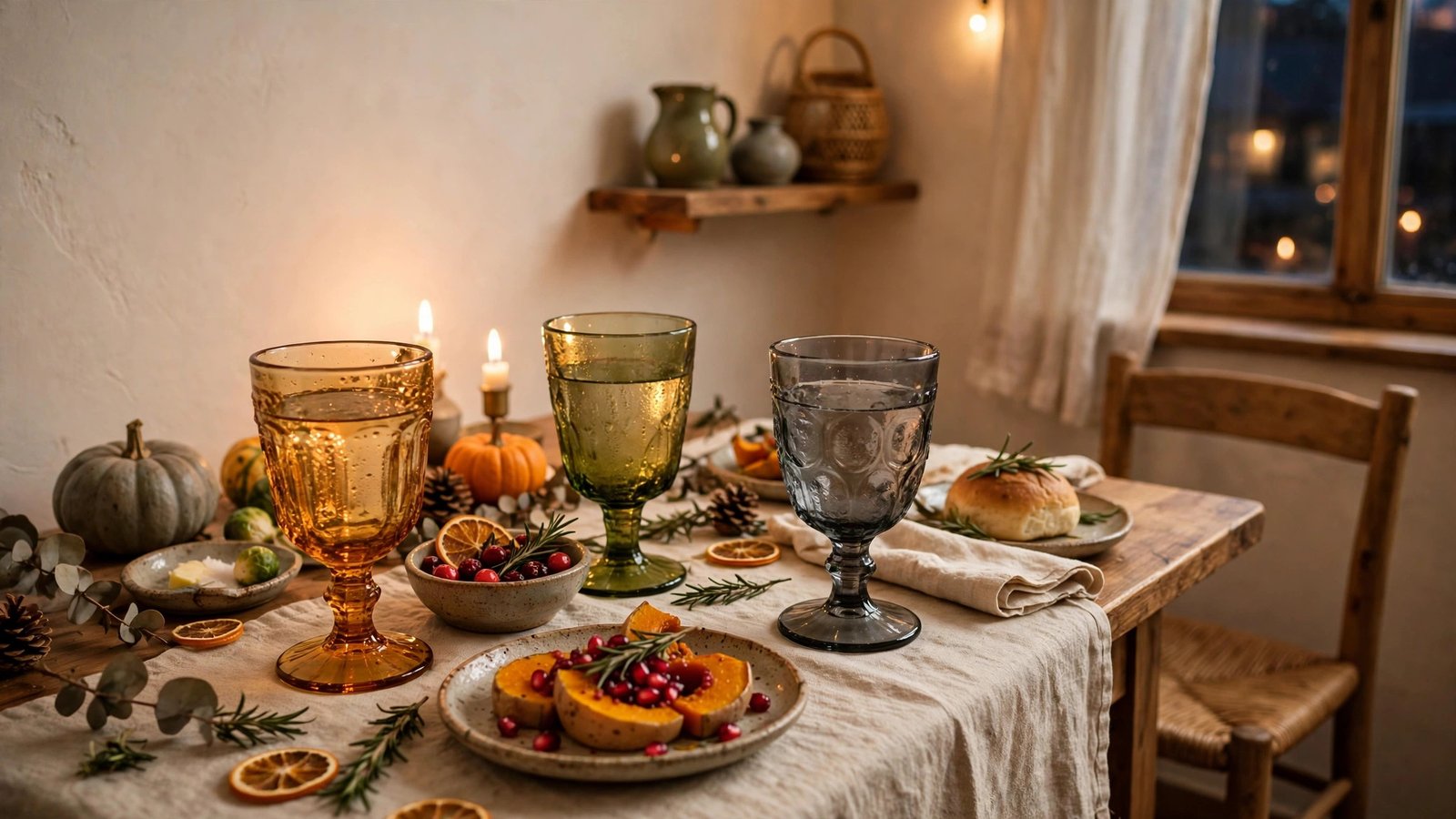
What it is: A collection of secondhand glasses in two or three neighboring tones — amber, olive green, smoky gray — styled as an intentional set rather than a matching one.
Why it works for renters: Renters rarely own twelve matching glasses, and buying a full set for one dinner is expensive. A curated mix looks more interesting than matching glassware anyway, costs a few dollars at a thrift store, and every piece is useful year-round afterward.
How to do it:
- Visit a thrift store and pick 8–10 glasses in two or three warm tones — amber with green, or smoke with clear — avoiding anything chipped.
- Wash them thoroughly in hot soapy water; thrifted glass cleans up beautifully.
- Group by tone when you set the table — alternate tones seat to seat for rhythm, or keep one tone per side for a bolder look.
- Fill each with water before guests sit down; filled glasses catch the candlelight and look abundant.
- Keep the collection — mismatched glassware in a color family works for every future dinner party.
Approximate cost: $8–$15 for a thrifted set of 8–10.
Renter tip: Stay inside one tone family; truly random colors read as clutter, not curation.
10. Protect Your Landlord’s Table Like a Pro
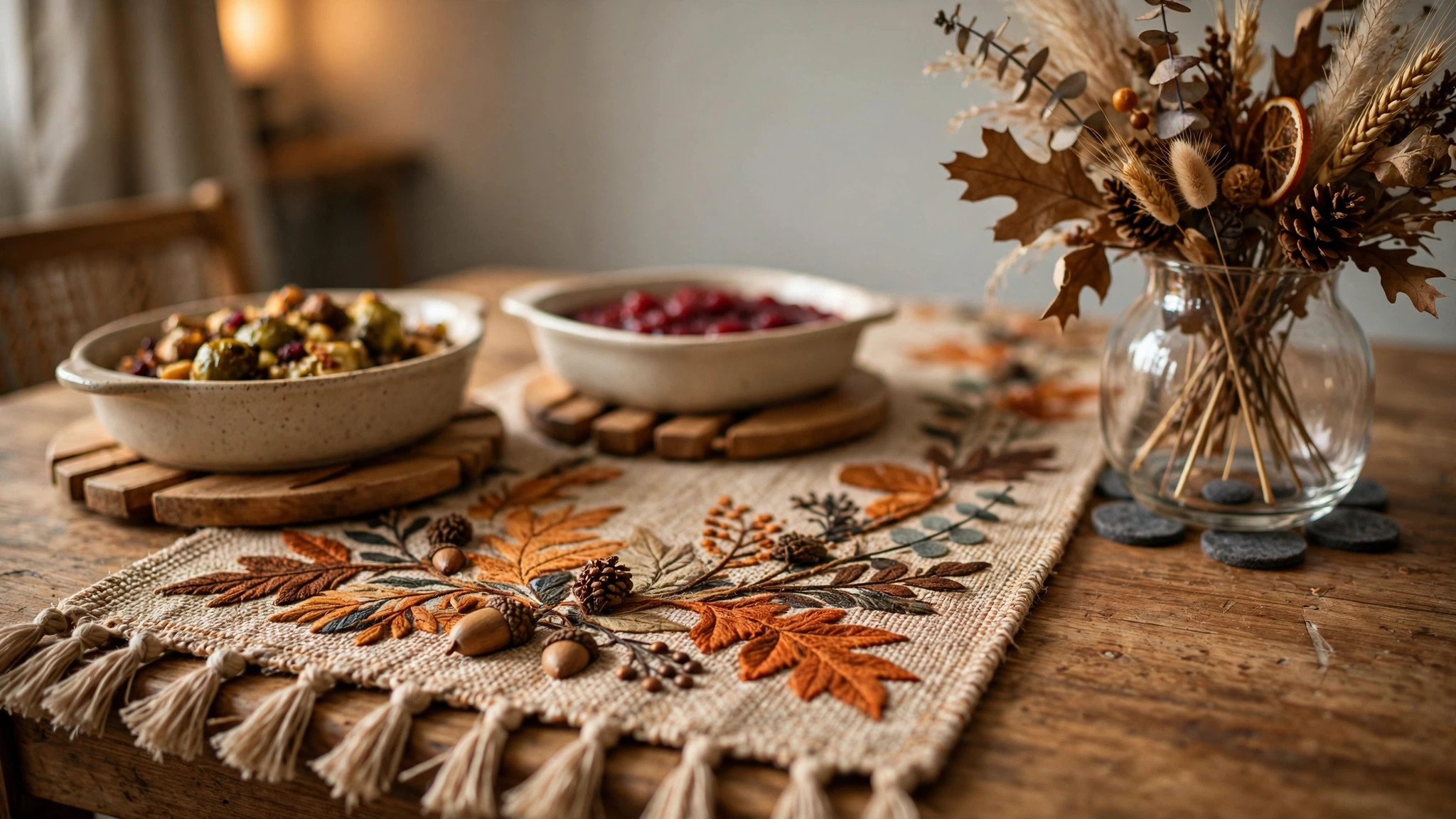
What it is: A deliberate protection layer — runner first, felt pads under every decor base, trivets under every hot dish — treated as part of the decor plan, not an afterthought.
Why it works for renters: This is the idea that saves your deposit. Heat rings, wax, and scratches on a landlord’s table are among the most common move-out deductions, and every one of them is preventable. The best part: protection layers double as decor when you choose them well.
How to do it:
- Start with a full-length runner or tablecloth as your base layer — it catches spills and cushions everything above it.
- Stick small adhesive felt pads under the bottom of every heavy decor item: vases, candle holders, the thankful tree jar.
- Place cork or wood trivets at every spot where a hot serving dish will land, and put them out before the food arrives.
- Set a coaster or small napkin under every glass — condensation rings are the sneakiest damage of all.
- Do a quick scan before guests sit: if anything hard or hot touches bare table, add a layer.
Approximate cost: $10–$20 for felt pads, trivets, and a basic runner if you don’t own them.
Renter tip: Photograph the protected table before guests arrive — dated proof of condition helps at move-out.
11. Create a Sideboard-to-Table Flow for Tiny Dining Spaces
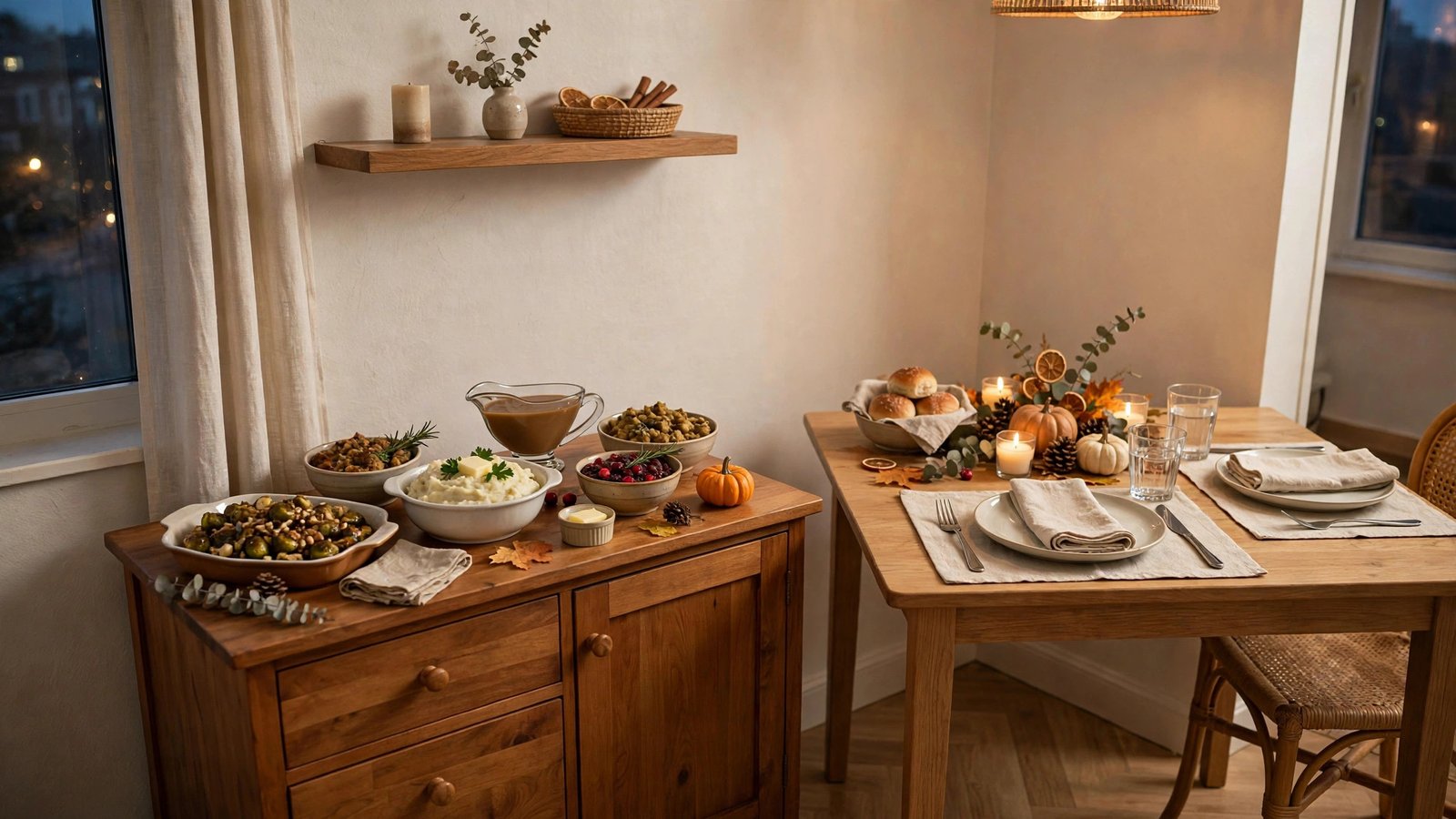
What it is: Staging your serving dishes on a nearby sideboard, shelf, or even a cleared bookshelf, so the dining table holds only place settings and a centerpiece.
Why it works for renters: Small dining tables can’t hold dinner and decor at the same time — something has to give, and it shouldn’t be the decor you worked on. Moving serving dishes six feet away gives your table room to breathe, and the sideboard becomes a second styled surface. I’ve seen this single move make a four-top feel like a dining room.
How to do it:
- Clear the nearest flat surface — sideboard, console, sturdy shelf, or the top of a low bookcase.
- Lay a runner or folded cloth on it to mark it as part of the tablescape, not just storage.
- Group your serving dishes there by course: sides together, turkey or main on its own board, gravy boat nearby.
- Keep the dining table for place settings, glasses, and one low centerpiece only.
- Direct traffic verbally once — “grab your sides from the sideboard” — and the flow runs itself.
Approximate cost: $0 if you own a cloth or runner; $8–$12 if you buy one.
Renter tip: Keep the turkey carving spot separate from the sideboard so the cook has elbow room.
12. Dress a Fold-Out Card Table Like Real Dining
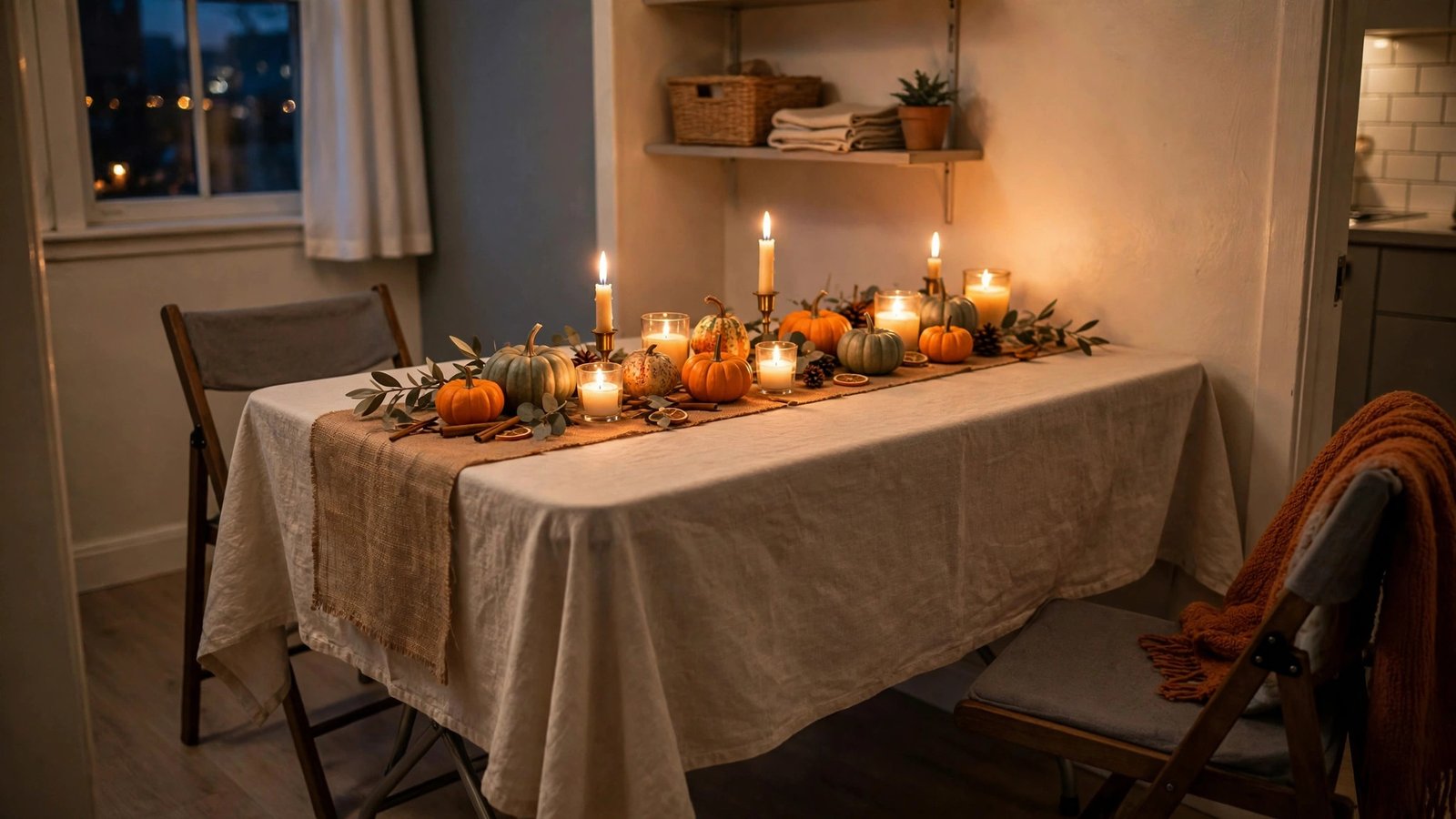
What it is: A floor-length tablecloth over a folding card table, layered with a runner and real place settings, so extra seating looks like part of the plan.
Why it works for renters: When the guest list outgrows the dining table, the card table comes out — and nothing says “overflow seating” like bare folding legs. A cloth that reaches the floor hides the entire table, and suddenly it’s just… a table. I’ve dressed card tables that guests genuinely didn’t realize were folding.
How to do it:
- Drape a floor-length tablecloth over the card table — measure from the floor on one side, over the top, to the floor on the other; a cheap polyester cloth works fine.
- Lay a runner down the center and repeat your main table’s centerpiece in miniature — three mini pumpkins and two battery candles.
- Use the same napkins, plates, and glasses as the main table so the two surfaces read as one event.
- Tuck a small rug or blanket under the table if the floor is cold — guests at card tables notice their feet.
- After dinner, the cloth goes in the wash and the table folds flat against a wall.
Approximate cost: $15–$30 for a floor-length cloth and a small runner.
Renter tip: Weigh the cloth corners with small pumpkins if your dining area gets a draft from a door.
13. Set Up a Kids’ Corner of the Table
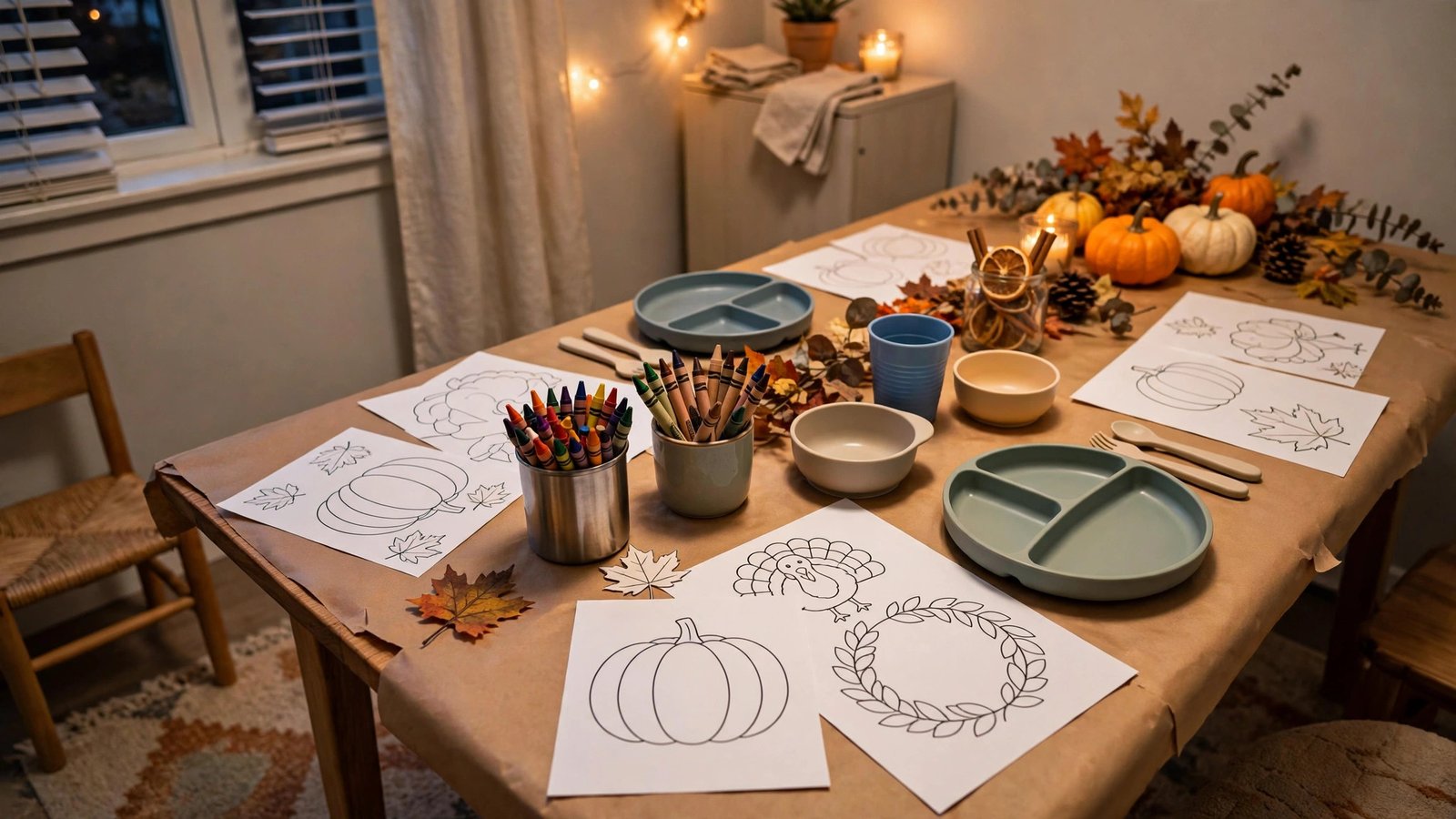
What it is: One end of the table — or the card table — covered in butcher paper with crayons, coloring sheets, and kid-proof dishes, so children have their own zone.
Why it works for renters: Kids and white tablecloths are a bad combination, and a stressed host ruins the evening for everyone. Giving children a decorated corner of their own protects your styling investment everywhere else, keeps little hands busy, and costs almost nothing. The paper catches every spill.
How to do it:
- Cover the kids’ section with butcher or kraft paper, taped underneath with painter’s tape.
- Set out cups of crayons or washable markers — one cup per two kids, shared, to limit the chaos radius.
- Print simple Thanksgiving coloring sheets or draw a few turkeys and pumpkins on the paper yourself.
- Use sturdy, low-center-of-gravity cups and plates at this end — nothing tall, nothing precious.
- Let the kids’ artwork stay up through dessert; it’s the most photographed part of the table.
Approximate cost: $5–$12 for paper, crayons, and printed sheets.
Renter tip: Corral crayons in a muffin tin at the kids’ end — instant spill-proof caddy.
14. Elevate Dessert on a Tiered Stand or Cake Riser
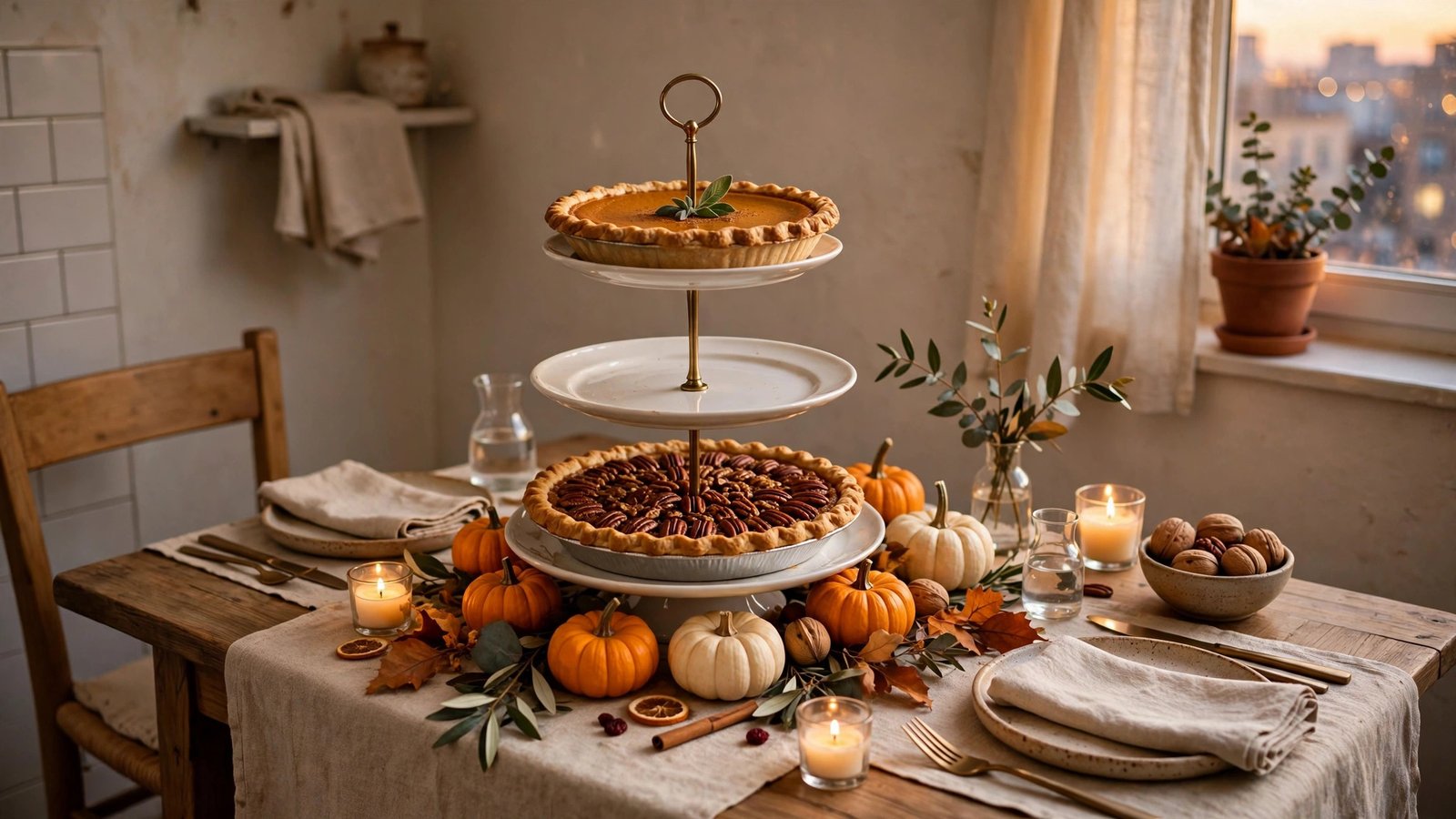
What it is: Pies and desserts arranged on a tiered stand or cake riser at one end of the table, turning dessert into part of the decor.
Why it works for renters: Dessert deserves better than the counter. A riser adds height to a flat tablescape — the single biggest difference between a “set table” and a “styled table” — and it keeps pies off the limited table surface. One thrifted stand works for every holiday from now on.
How to do it:
- Find a tiered stand, cake riser, or even a sturdy upside-down bowl with a plate on top — height is the goal, not pedigree.
- Place the heaviest pie on the lowest, sturdiest tier and build upward with lighter items.
- Position the stand at one end of the table or on the sideboard so it doesn’t block conversation.
- Tuck a few mini pumpkins or herb sprigs around its base to tie it into the rest of the tablescape.
- Slice the first pie tableside if you can — the stand makes the moment feel ceremonial.
Approximate cost: $0 if you own a stand; $10–$20 thrifted or on sale.
Renter tip: Tuck a pie server under the stand so serving is graceful instead of a balancing act.
15. Restyle the Same Table for Leftover Night
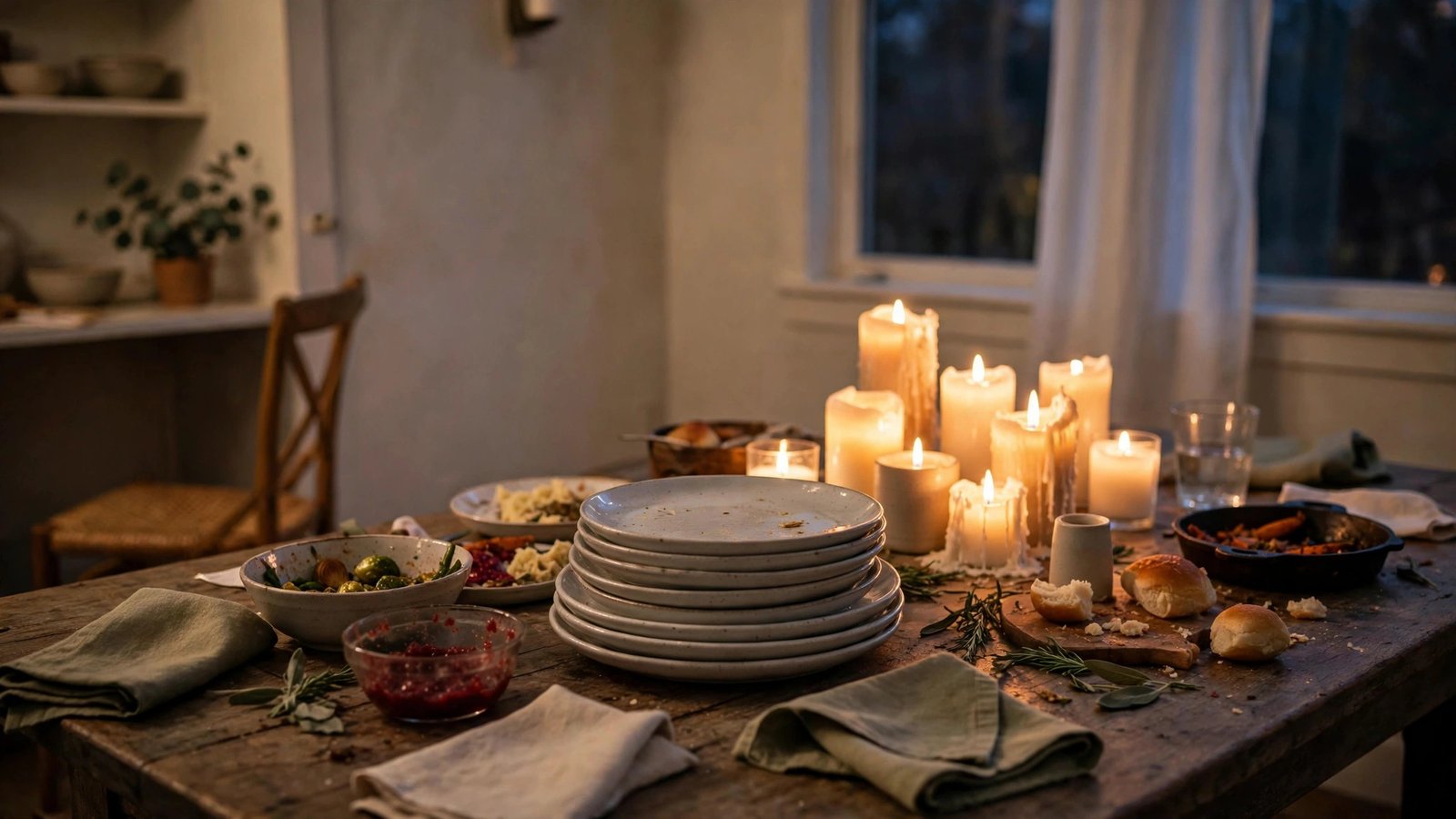
What it is: A five-minute refresh the day after — perished items cleared, candles re-clustered, napkins refolded — so Friday’s leftovers feel like an occasion, not a chore.
Why it works for renters: You already own everything on this table, and most of it still looks good. A quick restyle extends the holiday feeling into the weekend, uses up the florals and candles you bought, and costs nothing. I’ve noticed the leftover-night table is the one people actually remember — it’s relaxed, it’s just family, and it still looks beautiful.
How to do it:
- Clear anything wilted or perished — spent flowers, crushed tags, the written-on runner if it’s full.
- Lay a fresh section of kraft paper or flip the runner to its clean side.
- Re-cluster the battery candles into one tighter group for a cozier, lower light.
- Refold the cloth napkins simply — no herb ties this time, just clean rectangles.
- Stack plates in the center family-style; leftover night is casual, and the table should say so.
Approximate cost: $0 — everything is already on the table.
Renter tip: Save the leftover herb bundles — they go straight into Friday’s soup pot.
Conclusion
Here’s what I want you to take away: a rental dining space is not a limitation on Thanksgiving — it’s an invitation to be clever. The landlord’s table, the folding chairs, the too-small room — none of it shows once the surface is styled with intention. Start with the kraft-paper runner for instant protection and personality, add the glow of battery candles, and build from there until the table looks like the heart of the holiday. Every single idea here lifts off in minutes, leaves no trace, and keeps your deposit exactly where it belongs. Your guests will remember the warmth, the laughter, and the table that somehow looked like it belonged in a magazine. Please save this visual guide on Pinterest and come back to it when your table needs its Thanksgiving glow-up.

Amelia leads HavenlyStyle’s editorial vision with a passion for elegant interiors and practical home living. With years of experience in home décor and lifestyle content, she ensures every article is accurate, inspiring, and easy to follow. From timeless decorating ideas to the latest interior design trends, Amelia is committed to helping readers create beautiful, functional spaces while maintaining HavenlyStyle’s trusted and welcoming voice.