
Small bedrooms and Christmas decor have a complicated relationship. I have walked into so many rentals where the holiday spirit stopped at the bedroom door, not because the renter did not care, but because there was simply nowhere to put it. The bed takes up most of the floor, the walls belong to the landlord, the closet door needs to swing free, and anything too bright or too busy ruins the one thing a bedroom has to do well: help you sleep.
I have helped dozens of renters solve exactly this puzzle, and here is what I have learned: a small bedroom does not need less Christmas. It needs Christmas in the right places. When you decorate the surfaces you already touch every day — your bed, your headboard, your window, your nightstand — the room feels festive without getting crowded, and every single idea comes down cleanly in January with your deposit intact.
This guide gives you twelve ideas built for cozy small rooms, not borrowed from big-house decorating. Nothing here needs paint, drilling, or a nail. Nothing blocks a door, a closet, or your path to the bed in the dark. And nothing steals floor space, because in a small bedroom, floor space is the one thing you cannot afford to give away. Pick three or four favorites, layer them in over a weekend, and your bedroom will feel like the coziest room in the apartment — which, honestly, is exactly what a bedroom in December should be.
Executive Summary
- Decorate the bed, headboard, window, and nightstand first — the surfaces you already use — instead of adding furniture or floor pieces.
- Choose warm, dimmable, timer-set lighting so your Christmas glow helps you wind down instead of keeping you awake.
- Go vertical and flat: wall trees, door wreaths, and garlands on ledges add festivity without taking a single square foot of floor.
- Swap soft things, not hard things: bedding, pillow covers, throws, and prints in existing frames transform the room and pack away flat.
- Every idea here is deposit-safe and removable — Command hooks, tension rods, over-door hooks, and freestanding pieces only, no drilling or painting.
- Keep walkways, closet doors, and the space around the bed completely clear, and let one small focal point, like a mini tree, do the talking.
1. Swap in Cozy Christmas Bedding

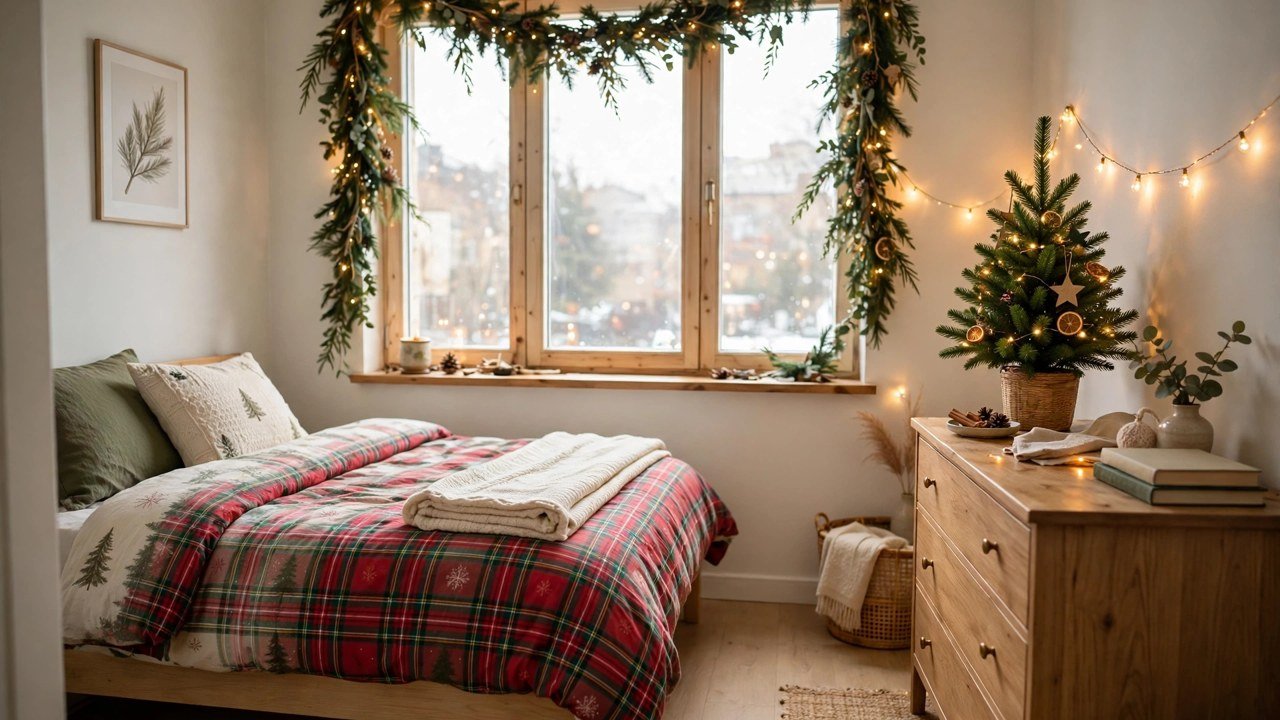
Your bed is the biggest surface in a small bedroom, so it is also your biggest decorating opportunity. A bedding swap changes the whole room in ten minutes, and it costs nothing in floor space because the bed was already there. I have personally seen renters transform a plain white room just by changing the duvet cover, and guests always notice the bed first.
This works so well for renters because bedding is completely reversible. You are not touching a wall, a landlord fixture, or anything you need permission for. In January you wash the cover, fold it away, and your regular bedding goes straight back on. There is no damage to repair and nothing to explain at move-out.
Start by choosing a duvet cover in a deep, cozy Christmas palette — classic red and cream plaid, forest green, or a soft cream with a subtle seasonal pattern. Keep the pattern calm rather than loud, since you sleep under it every night. Next, layer a chunky knit or fleece throw across the foot of the bed, folded neatly so it does not slide off. Then swap your regular pillowcases for flannel or brushed-cotton ones in a coordinating solid color. Finally, step back and check the overall effect in daylight and lamplight; if it feels busy, remove one layer rather than adding another.
Approximate cost: $40 to $90 for a duvet cover set and a throw, less if you already own a solid throw in a seasonal color. The trick in a small room is restraint: one patterned piece plus solids reads cozy, while three competing patterns read cluttered. Choose the pattern you love most, and let everything else support it.
2. Wrap Warm Fairy Lights Around Your Headboard

Nothing says Christmas in a bedroom quite like a soft glow behind the bed, and fairy lights on a headboard deliver that feeling without a single new piece of furniture. In a small room, this is my favorite lighting trick, because it turns the bed itself into the focal point and makes the whole room feel warm the moment you walk in.
For renters, this idea is beautifully low-risk. You are not wiring anything or drilling into a wall. Battery-operated or plug-in copper-wire lights can be wrapped around a headboard, tucked behind it, or clipped along its top edge with small removable clips. When the season ends, you unwind them and there is not a mark left behind.
First, choose warm white lights, not cool white or multicolor, so the glow feels like candlelight rather than a storefront. Second, pick a set with a built-in timer, and set it to switch off an hour or so after bedtime, so the lights never keep you awake. Third, wrap the strand loosely around the headboard slats or drape it in gentle swags across the top, keeping the wire away from pillows and bedding for safety. Fourth, if your headboard is upholstered or flat against the wall, use small removable adhesive clips along the top edge instead of wrapping. Finally, pair the lights with your regular bedside lamp on its lowest setting for the first few evenings, and adjust until the room feels cozy but still sleep-friendly.
Approximate cost: $10 to $25 for a quality warm-white set with a timer. The sleep-friendly part matters here: keep the lights dim, warm, and on a timer, and your Christmas bedroom will help you wind down instead of winding you up.
3. Put a Mini Tree on Your Dresser or Nightstand
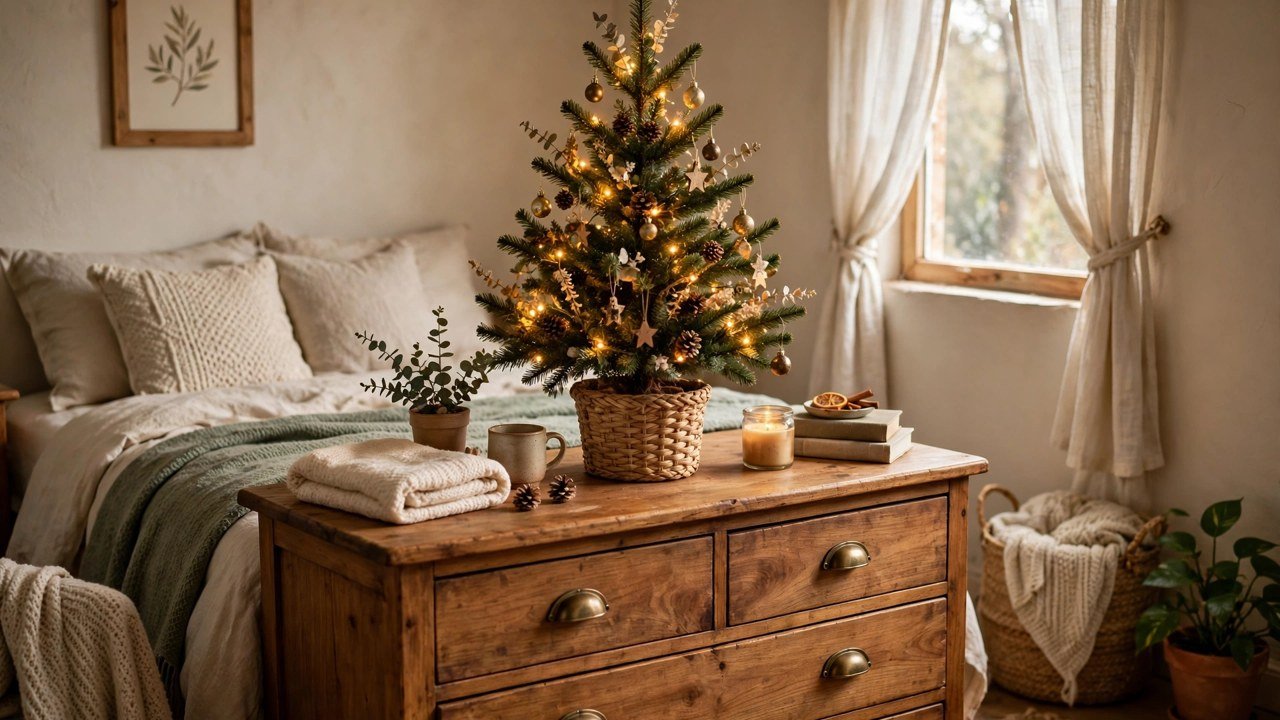
A full-size tree has no business in a small bedroom. A mini tree, on the other hand, is perfect. Set on a dresser or a nightstand, it gives you the full Christmas-tree feeling — the shape, the ornaments, the little glow — at a scale your room can actually handle, and it leaves your floor completely untouched.
This is a renter dream because a mini tree is freestanding. No stand screwed into anything, no wall mount, no landlord conversation. You set it down, decorate it, and in January you lift it into a box. I have helped renters who were convinced they had no room for a tree discover that the top of a dresser was waiting for one all along.
Start by measuring your surface before you shop, and choose a tree between 18 and 24 inches tall so it does not overwhelm a nightstand or crowd a dresser. Next, set it in a pretty pot, basket, or wrapped base so it looks finished rather than store-bought. Then decorate with a small set of lightweight ornaments in just two colors, plus a short strand of battery fairy lights if you want a glow. Keep the tree away from the edge of the surface and away from anything you reach for in the dark, like a phone charger or water glass. Finally, put a small tray or felt pad underneath to catch any fallen needles if you choose a real mini fir, or to protect the furniture surface if you choose a faux one.
Approximate cost: $20 to $50 for a faux mini tree, ornaments, and lights. In a shared room, a mini tree is also wonderfully personal: it marks your side of the room as festive without taking over your roommate’s space.
4. Dress the Window With a Tension-Rod Garland
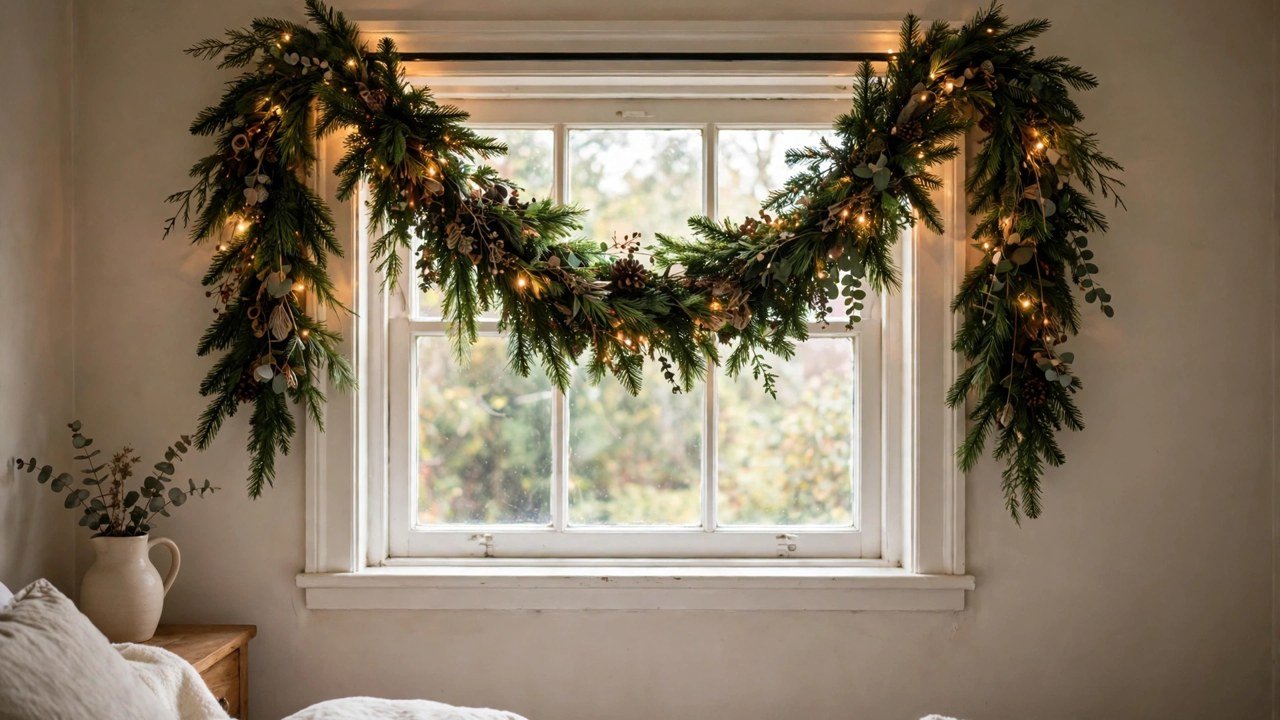
Small bedrooms often have just one window, which makes it prime decorating real estate. A garland draped across the window frame, held by a tension rod, frames your view with greenery and catches the light beautifully, and it does all of this without a single nail or screw in the wall.
Renters love tension rods because they work by pressure, not hardware. The rod wedges inside the window frame, holds the garland, and twists out cleanly in January. Your landlord never needs to know it was there, and your window trim stays exactly as you found it.
First, measure the inside width of your window frame and buy a tension rod that fits that range, plus a lightweight faux garland you can drape rather than a heavy real one. Second, install the rod across the top inside edge of the frame and test that it holds firm before you hang anything on it. Third, drape the garland over the rod in a gentle swag, letting the ends hang a few inches down each side, and fluff the branches so it looks full rather than flat. Fourth, weave a short strand of warm battery fairy lights through the garland if you like a glow, keeping the battery pack tucked behind the curtain or on the sill. Finally, check that the garland does not block the window from opening, and that curtains or blinds still move freely around it.
Approximate cost: $25 to $55 for a tension rod, garland, and lights. If your bedroom window faces the street, this idea does double duty: it looks lovely from inside while you fall asleep, and from outside it makes your whole apartment look festive.
5. Hang a Flat Felt Tree on the Wall

When there is truly no surface left for a tree, the wall itself can become the tree. A flat felt tree — fabric tree shapes with Velcro ornaments that stick to a felt backing — hangs on the wall like a piece of art, takes up zero floor space, and is endlessly charming in a small bedroom, especially if kids visit or you just love a playful touch.
The renter case here is airtight. A felt tree hangs from one or two removable adhesive hooks, weighs almost nothing, and peels off the wall without a trace. You are not mounting anything heavy, and you are not committing to a single spot for the whole season — you can move it in five minutes if it crowds a light switch or a closet door.
Start by picking a blank stretch of wall that you see from the bed but do not walk past, such as the wall beside the dresser or above a low chest. Next, hang the felt tree with removable hooks rated for its light weight, and press the felt flat so it hangs smoothly. Then arrange the felt ornaments loosely at first, stepping back to check the balance before pressing them firmly in place. After that, add a small strand of battery lights around the edge only if the felt is light-colored enough to glow nicely; otherwise let the ornaments carry the color. Finally, keep the bottom of the tree above furniture height so it never snags on bedding or bags on the floor.
Approximate cost: $15 to $35 for a felt tree set with ornaments. This is also the kindest tree for a shared room: it adds big Christmas energy to a flat surface and asks for nothing in return — no floor, no table, no clutter.
6. Hang a Wreath on the Bedroom Door With an Over-Door Hook
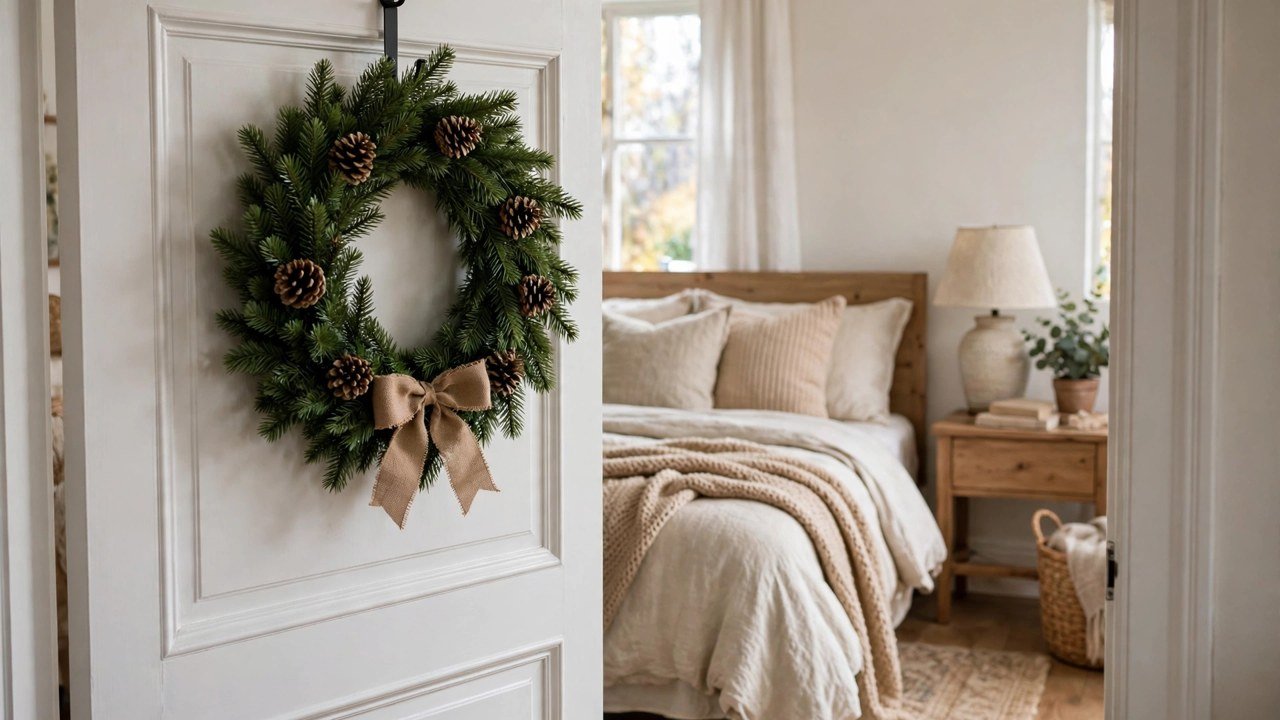
The bedroom door is one of the most overlooked decorating spots in a small apartment, and it is completely free space. A wreath hung on the inside of your bedroom door, or on a closet door, greets you every time you walk in and adds Christmas character without touching a wall at all.
Over-door hooks are a renter staple for a reason: they hook over the top of the door, hold the wreath on the other side, and lift off without a mark. There is no adhesive on painted wood, no nail hole to fill, and no argument about whether the door counts as a fixture you were allowed to alter.
First, choose a lightweight wreath, ideally faux greenery with a few pinecones or berries, so it does not swing heavily every time the door moves. Second, hang it on an over-door hook on the inside face of the bedroom door, so you see it when you enter and it does not block the hallway. Third, check the full swing of the door — open and close it slowly — and make sure the wreath clears the door frame, nearby furniture, and any wall hooks. Fourth, if you prefer the closet door, hang it there instead, but only if that door stays closed most of the time; a wreath on a door you open ten times a day will wear out fast. Finally, add a small bow at the top if you like, tied rather than glued, so you can reuse the wreath next year.
Approximate cost: $15 to $40 for a wreath and an over-door hook. One caution from experience: skip the front door of the apartment for this one if your building has rules about hallway decor, and keep the festive welcome inside your own bedroom where it belongs.
7. Create a Battery-Candle Glow on the Nightstand
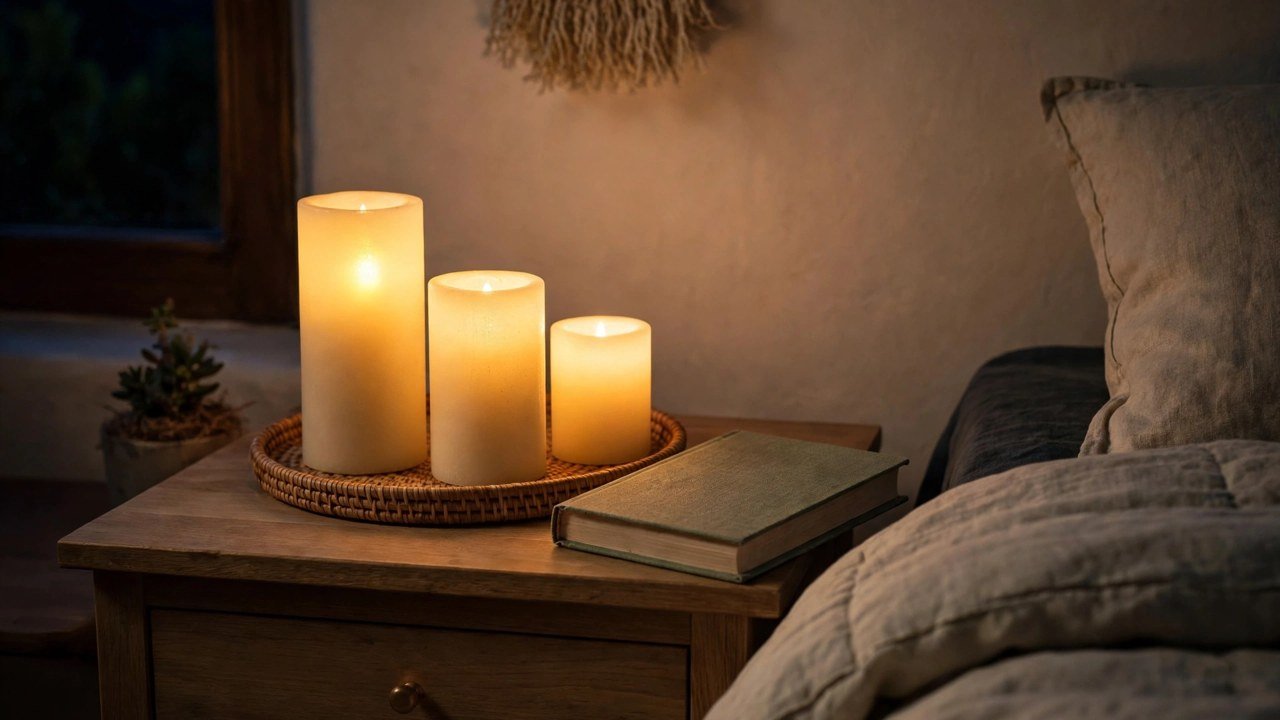
Real candles and small bedrooms do not mix well — bedding, curtains, and sleepy late nights are a risky combination. Battery candles give you the same flickering, golden glow with none of the worry, and a little cluster on your nightstand turns your bedtime routine into something that feels like a holiday ritual.
This idea passes the renter test without even trying. Battery candles sit on a surface, need no installation, and leave no wax, soot, or scorch marks behind. They are also genuinely sleep-friendly: a warm flicker at bedside is calming in a way that overhead light never is, and most sets come with timers so they switch themselves off after you fall asleep.
Start with a set of three battery pillar candles in different heights, grouped on a small tray or mirrored coaster so they read as one intentional display. Next, set the built-in timer for the evening hours, so they glow while you wind down and fade out on their own. Then add one small seasonal touch beside them — a pinecone, a sprig of faux greenery, or a tiny ornament — but keep the display low and compact so it never crowds your lamp, book, or water glass. After that, test the glow with your overhead light off, and remove one candle if the light feels too bright for sleep. Finally, keep spare batteries in the nightstand drawer so a dead candle never leaves the display half-lit in the middle of December.
Approximate cost: $12 to $30 for a set of battery candles and a tray. In a shared room, this glow is beautifully contained: it lights your side of the bed, and your roommate can sleep in darkness on theirs.
8. Hang Stockings From Removable Hooks Along a Wall Rail

No mantel is no problem. In a small bedroom, stockings hung in a neat row along a picture rail, a headboard, or a stretch of wall on removable hooks look just as festive as stockings over a fireplace — and in some ways they look better, because they are right where you see them every morning.
Removable adhesive hooks are the key to this idea, and they are exactly what landlords expect renters to use. They hold a lightweight stocking easily, peel off cleanly when you follow the removal instructions, and never leave a hole. The trick is choosing the right surface: smooth painted walls and finished wood work best, while textured or brick walls may not hold as reliably.
First, choose a spot you see but do not bump into — the wall above a low dresser, the side of a headboard wall, or a picture rail if your room has one. Second, space three or four removable hooks evenly, about a foot apart, and press each one firmly for the time the package recommends before hanging anything. Third, hang lightweight stockings, one per person or pet, and keep them empty or very lightly filled so they do not pull on the hooks overnight. Fourth, add a tiny name tag or a small ornament to each stocking for a personal touch, tied on rather than glued. Finally, check the row from the doorway: it should read as a deliberate display, not a random line of socks, so adjust the spacing until it looks even.
Approximate cost: $15 to $35 for stockings and a pack of removable hooks. If you share the room, this is a lovely shared tradition: one stocking each, hung side by side, and no mantel required to make it feel like Christmas morning.
9. Drape Garland Along a Picture Ledge or Headboard Shelf
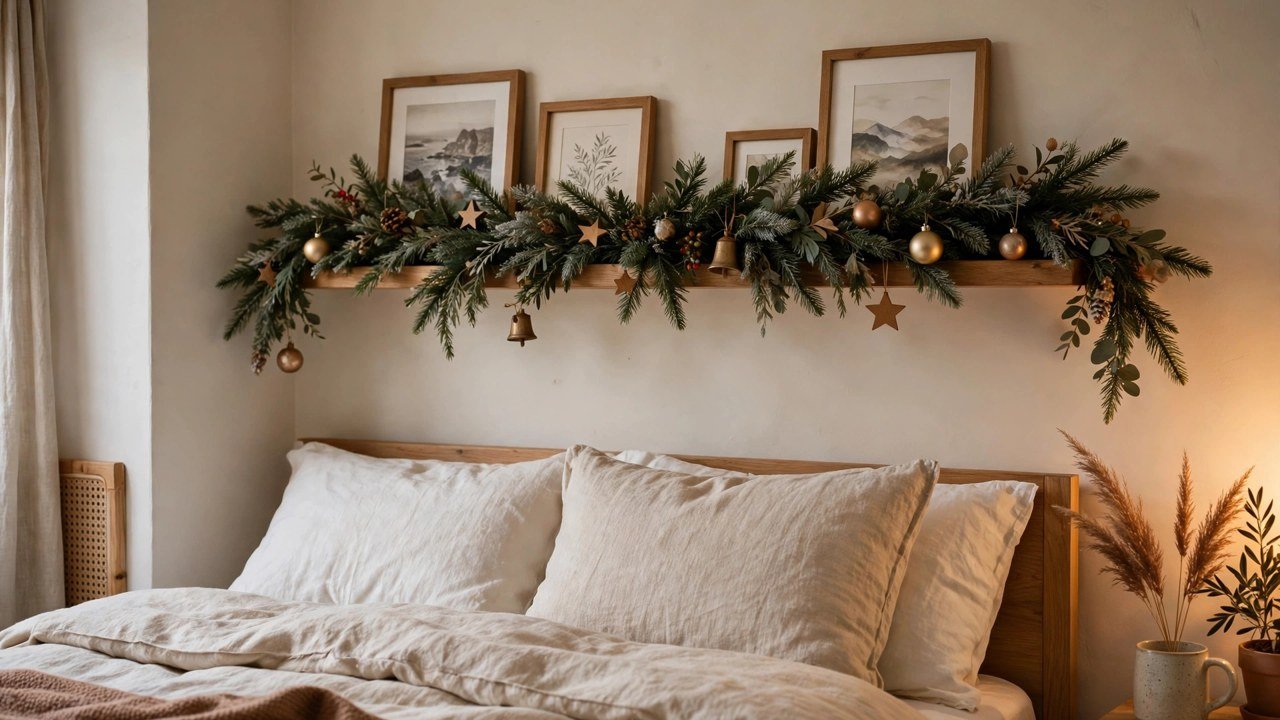
If your bedroom has a picture ledge, a floating shelf, or even a wide headboard shelf, you already own a perfect garland runway. A garland laid along that shelf, with a few ornaments tucked in, adds a long, lush line of Christmas greenery at eye level — and because the shelf is already there, you add zero furniture and zero clutter.
For renters, the beauty of this idea is that it uses existing surfaces. You are not installing the shelf; you are simply dressing one that is already part of the room. A lightweight faux garland laid, not nailed, along the shelf lifts off in January and leaves the shelf exactly as it was.
Start by clearing the shelf of anything you will not need during December, and dust it so the garland sits cleanly. Next, lay the garland along the shelf, letting one end drape a few inches over the edge for a relaxed, natural look, but never so far that it brushes bedding or blocks a light switch. Then tuck in three to five small ornaments or pinecones at intervals, rather than covering the whole garland, so it still reads as greenery first and decoration second. After that, weave in a short battery light strand if the shelf is in a spot where a glow will show, keeping the battery pack hidden behind a book or frame. Finally, step back and check the shelf from the bed: the garland should frame the pictures or books behind it, not hide them completely.
Approximate cost: $20 to $45 for a faux garland and a few ornaments. This idea works especially well in rooms where the walls are strictly off-limits, because you have decorated generously without attaching a single thing to a wall.
10. Swap the Art in Your Existing Frames for Seasonal Prints

Here is a renter trick I wish more people knew: you do not need new wall decor for Christmas. You just need new paper inside the frames you already have. Swapping the prints in your existing frames for seasonal artwork — a snowy woodland scene, a simple wreath illustration, a vintage-style Christmas quote — instantly changes the room’s mood, and it involves no nails, no hooks, and no landlord permission at all.
This is the ultimate deposit-safe idea, because the frames never move. You open the back of a frame that is already hanging, slide in a seasonal print, and close it again. In January you reverse the swap in five minutes. The walls, the hooks, and the frames all stay exactly where they were.
First, count how many framed pieces your bedroom already has, and choose just two or three to swap — swapping every frame can feel like a theme park, while swapping a few feels like a thoughtful seasonal touch. Second, print seasonal artwork at home or order inexpensive prints in the exact sizes your frames already hold, so you never need to trim awkwardly or force a fit. Third, pick art in a calm, muted palette that suits a bedroom — soft greens, creams, and dusty reds rather than bright, high-contrast graphics that fight with sleep. Fourth, swap the prints, rehang nothing, and simply close the frames back up where they already hang. Finally, store your regular prints flat in a folder or between sheets of paper so they stay pristine until January.
Approximate cost: $10 to $30 for printed artwork, or less if you print at home. In a small room, this idea is quietly powerful: the art you look at from bed changes with the season, while the room itself stays calm, uncluttered, and entirely yours.
11. Tuck a Blanket Basket Into a Dead Corner

Every small bedroom has a dead corner — the awkward triangle beside the dresser, the gap between the bed and the wall, the space next to the closet that is too small for furniture but too big to ignore. A blanket basket turns that dead corner into the coziest spot in the room, filled with rolled throws and extra blankets for cold December nights.
Baskets are a renter’s best friend because they are freestanding, portable, and endlessly reusable. You are not building storage or attaching anything; you are placing one beautiful, useful object in a spot that was previously wasted. When you move, the basket moves with you, which is more than you can say for most decorating choices.
Start by measuring your dead corner and choosing a basket that fits it with a little breathing room, not one you have to wedge in. Next, roll rather than fold your throws — rolled blankets look fuller, take up less visual space, and are easier to grab on a cold night. Then add two or three throws in seasonal textures: a chunky knit, a soft fleece, and a plaid wool-look throw, with the prettiest one on top. After that, tuck a small sprig of faux greenery or a pinecone into the basket’s edge for a subtle Christmas nod, without turning the basket into a decoration instead of a useful object. Finally, keep the basket’s spot clear of bags, shoes, and laundry so it stays a welcoming corner rather than a dumping ground.
Approximate cost: $20 to $45 for a basket and one new throw, less if you already own throws to fill it. On a cold night, this is the idea you will actually use — and a bedroom that is cozy to live in beats a bedroom that only looks cozy in a photo.
12. Build a Tiny Nightstand Vignette With a Mini Village
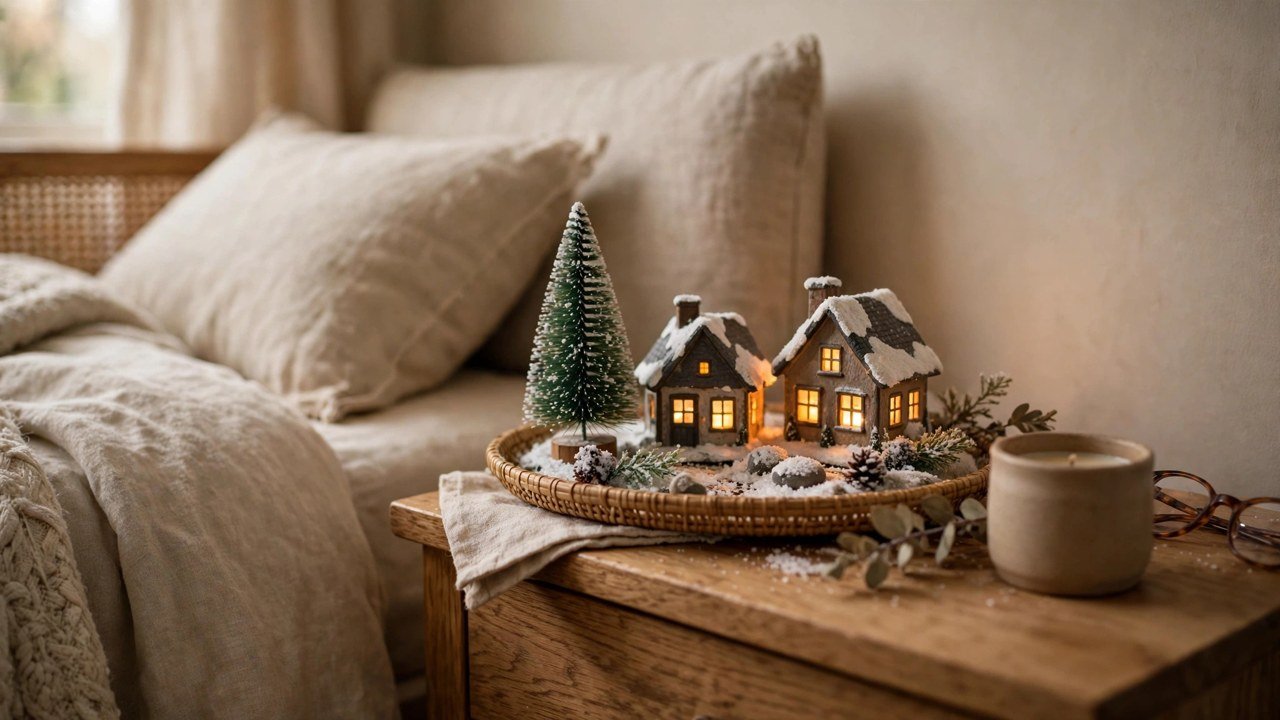
The last idea is the smallest and, in my experience, the most delightful: a tiny vignette on your nightstand. A miniature village house or two, a bottle-brush tree, and a pinch of faux snow on a small tray create a whole Christmas scene in a space no bigger than a book — and because it lives on the nightstand, it is the last thing you see before sleep and the first thing you see in the morning.
A tray-based vignette is perfectly renter-safe. Everything sits on a tray, so nothing touches the furniture directly, and the whole scene lifts away in one move for cleaning or for January pack-up. There is no installation, no adhesive, and no risk to any surface.
First, choose a small tray that fits your nightstand with room left for your lamp, phone, and water glass — the vignette should never crowd out the things you actually need at night. Second, set down one or two miniature houses, a tiny bottle-brush tree, and a dusting of faux snow or a small piece of white felt as the ground. Third, add one warm battery tea light behind a house window if the house has cut-out windows, so it glows softly in the evening. Fourth, keep the scene low and compact, with nothing tall enough to topple if you reach for your phone in the dark. Finally, dust the vignette gently once a week, since tiny scenes show dust quickly in a small room.
Approximate cost: $15 to $35 for a tray, miniature houses, and a bottle-brush tree. This little scene is proof of the whole guide’s point: in a small bedroom, Christmas does not need to be big to be beautiful. It just needs to be in the right place.
Conclusion
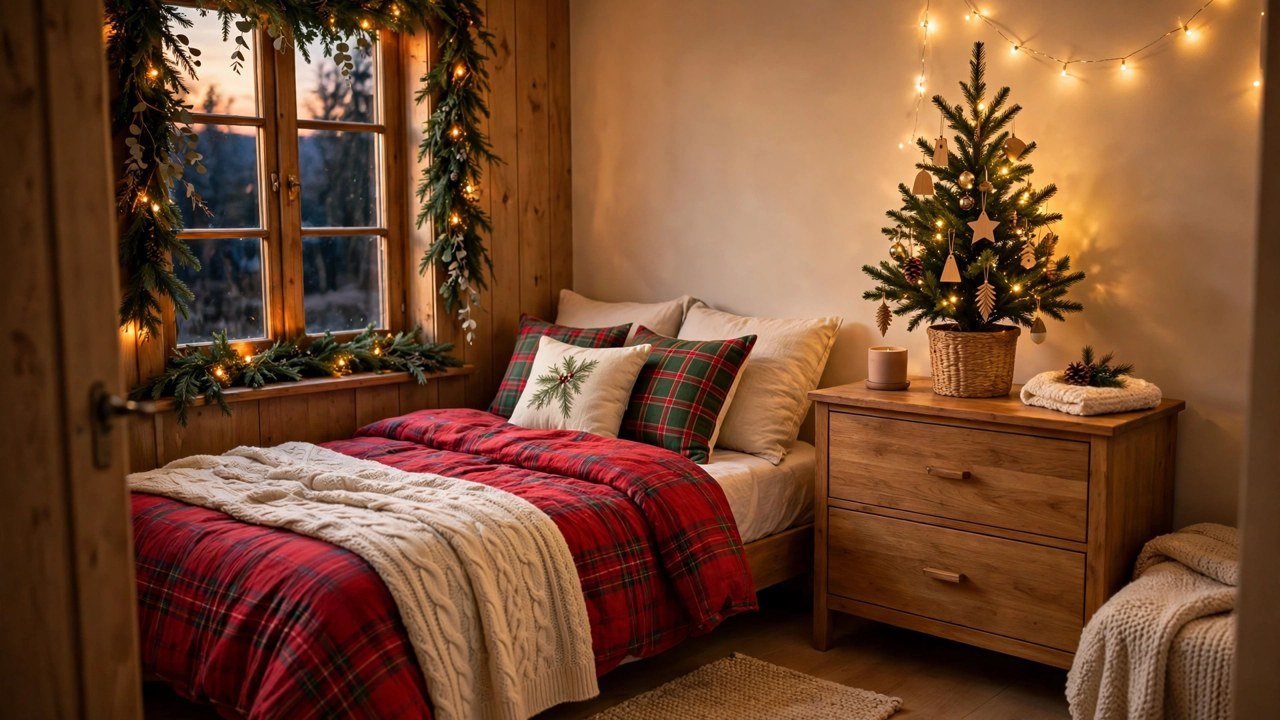
A small bedroom does not have to sit out Christmas, and it does not have to feel crowded to feel festive. When you decorate the bed you already sleep in, the headboard behind you, the window beside you, and the nightstand within reach, the whole room changes without a single piece of new furniture, a single nail, or a single inch of lost floor space. That is the real secret to Christmas in a cozy room: let the surfaces you already live with do the decorating.
Start with two or three ideas from this guide this weekend — the bedding swap and the headboard lights alone will transform the room — and add one more each week as December arrives. Keep the lights warm and on a timer, keep your walkways clear, and keep everything removable, so January pack-up feels as easy as December set-up. Your bedroom should be the coziest room in your home this Christmas, not the most cluttered one, and now you have twelve deposit-safe ways to make it so.
Please save this visual guide on Pinterest and share it with a renter friend who thinks their small bedroom is too tiny for Christmas — they will be glad you did, and their deposit will be safe too.

Amelia leads HavenlyStyle’s editorial vision with a passion for elegant interiors and practical home living. With years of experience in home décor and lifestyle content, she ensures every article is accurate, inspiring, and easy to follow. From timeless decorating ideas to the latest interior design trends, Amelia is committed to helping readers create beautiful, functional spaces while maintaining HavenlyStyle’s trusted and welcoming voice.