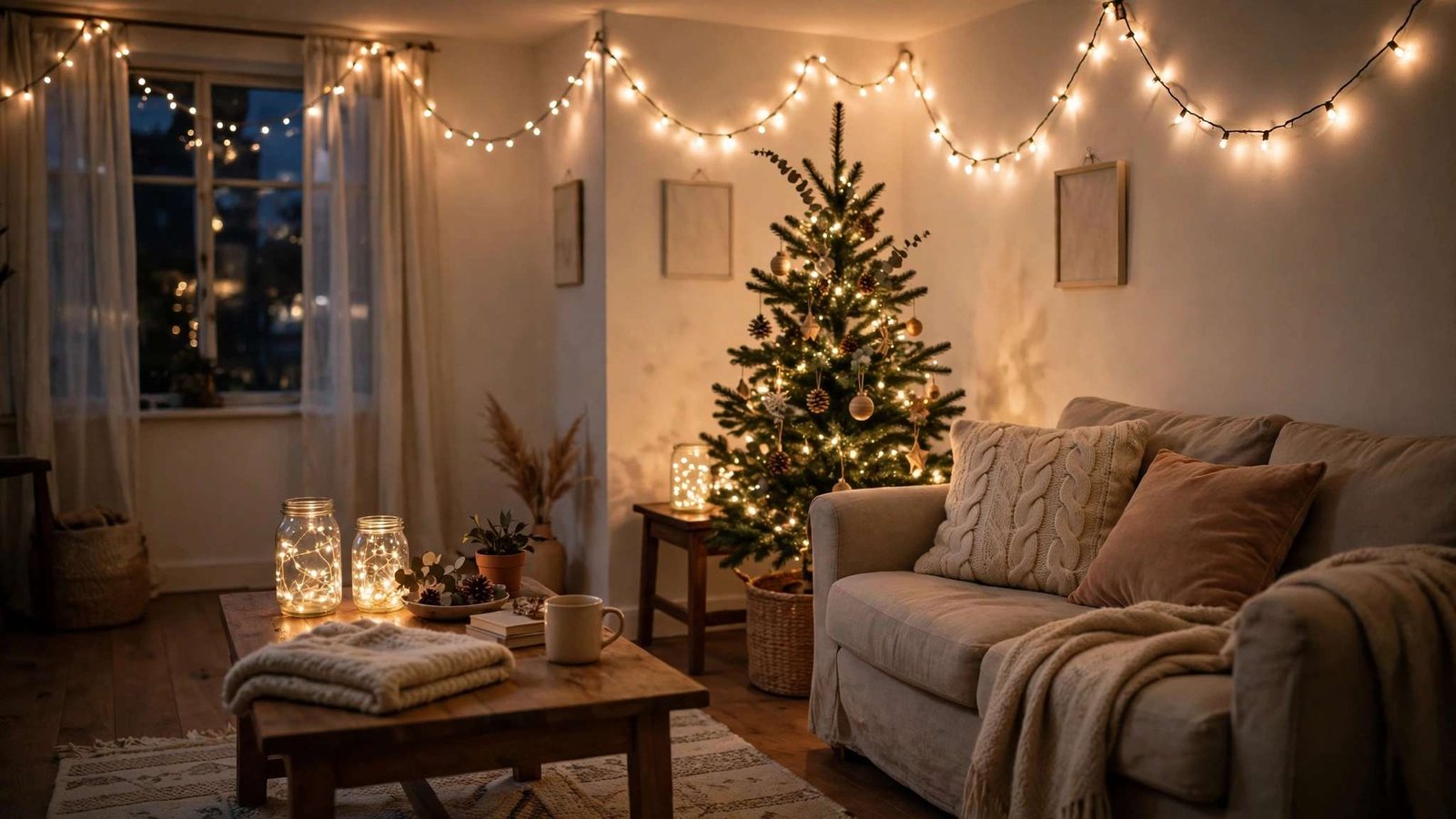
I’ve decorated rental apartments for Christmas more times than I can count, and every single year the same problem shows up before the first string of lights comes out of the box: how do you hang anything when the lease says no nails, no screws, no staples, and no “damage” of any kind? Most Christmas light advice assumes you own the place — staple guns along the roofline, drilled clips on the porch, nails in the mantel. None of that survives a rental walkthrough.
Here’s what I’ve learned after years of making rentals glow without touching the walls: the constraint is actually the style. When you can’t staple lights to the eaves, you hang them *inside* the windows, along the ceiling line, across tension rods, and inside glass jars — and the result is a warm, layered look that feels more intentional than a house outlined in clip lights ever does. The ideas below use only removable, reversible methods: adhesive hooks, suction cups, tension rods, magnetic clips, and battery or micro-LED strings that don’t need an outlet every six feet.
Every idea is genuinely removable, deposit-safe, and honest about cost. No ladders on the roof, no landlord negotiations, no patching holes in January. Just light, exactly where your apartment wants it.
Executive Summary
- Hang from the room, not the walls. Adhesive hooks, suction cups, tension rods, and magnetic clips carry Christmas lights with zero holes — every idea below uses at least one.
- Battery and micro-LED strings solve the outlet problem. Small apartments rarely have outlets where you want glow; battery strands and USB-powered micro-LEDs free you from the wall socket map.
- Windows are your best surface. Glass takes suction cups beautifully, and lights in a window read as festive from inside *and* outside the apartment.
- Cluster small glows instead of chasing one big display. Jars of fairy lights, LED candles, and a lit shelf beat one ambitious installation you can’t anchor safely.
- Everything here comes down in minutes. If it can’t be removed without a trace, it didn’t make the list.
1. Swag String Lights Along the Ceiling Line with Adhesive Hooks
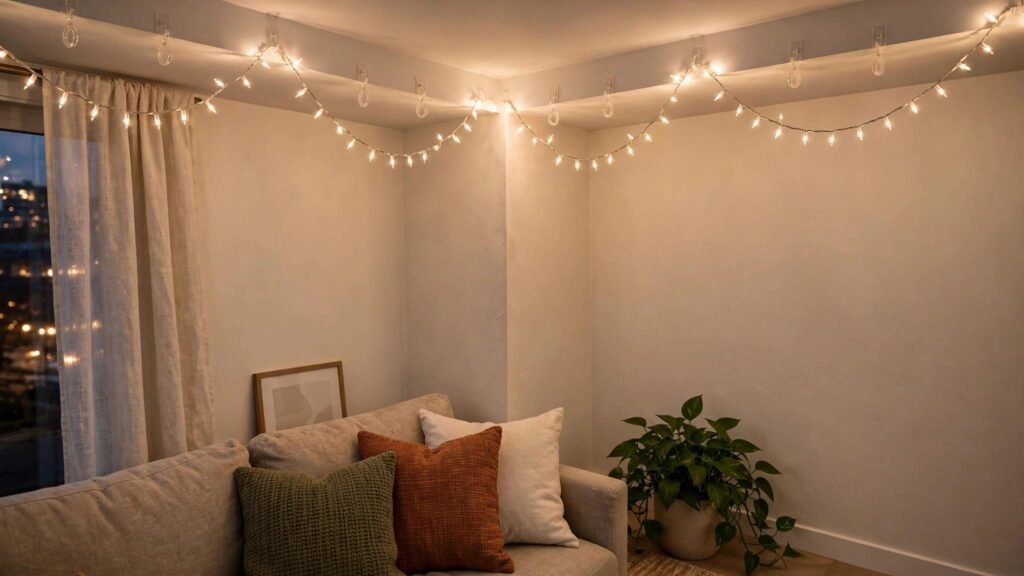
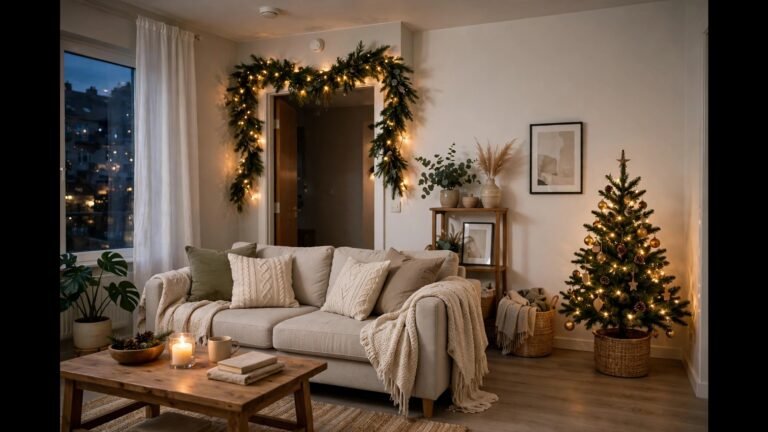
The single highest-impact move in a rental living room is a swagged string of warm-white lights running where the wall meets the ceiling. It frames the whole room in glow, photographs beautifully, and uses nothing but small clear adhesive hooks — the kind with strips engineered to pull off cleanly. I’ve done this in three different apartments and the line always looks custom, like the room was designed around it.
Why it works for renters: The hooks stick to painted walls and trim, hold a light string’s modest weight easily, and remove with a slow downward pull that leaves no residue. You’re never touching the wall with a tool, and the whole installation reverses in under ten minutes.
How to do it:
- Plan the line first: one long wall, two walls meeting at a corner, or a full perimeter if you’re ambitious — measure so you buy a long enough string.
- Stick small clear adhesive hooks every 18 to 24 inches along the ceiling line, pressing each firmly for 30 seconds per the package instructions.
- Drape the light string in gentle swags between hooks rather than pulling it taut; the dips are what make it look designed.
- Tuck the battery pack or plug end behind furniture, and use a plug-in timer or battery strand with a built-in timer so it runs evenings only.
- Approximate cost: $12–$25 for a warm-white LED string plus a pack of small adhesive hooks.
What to avoid
Don’t be tempted by “temporary” nails, tacks, or staples for a cleaner line — even tiny holes count as damage on most move-out inspections, and patching never quite matches the paint. Also respect the hook weight ratings: one hook per swag dip, and keep heavy vintage-style bulb strings for surfaces that can take real hardware. Lightweight LED strings are what adhesive hooks were made for.
2. Suction-Cup Fairy Light Curtains Right on the Window Glass
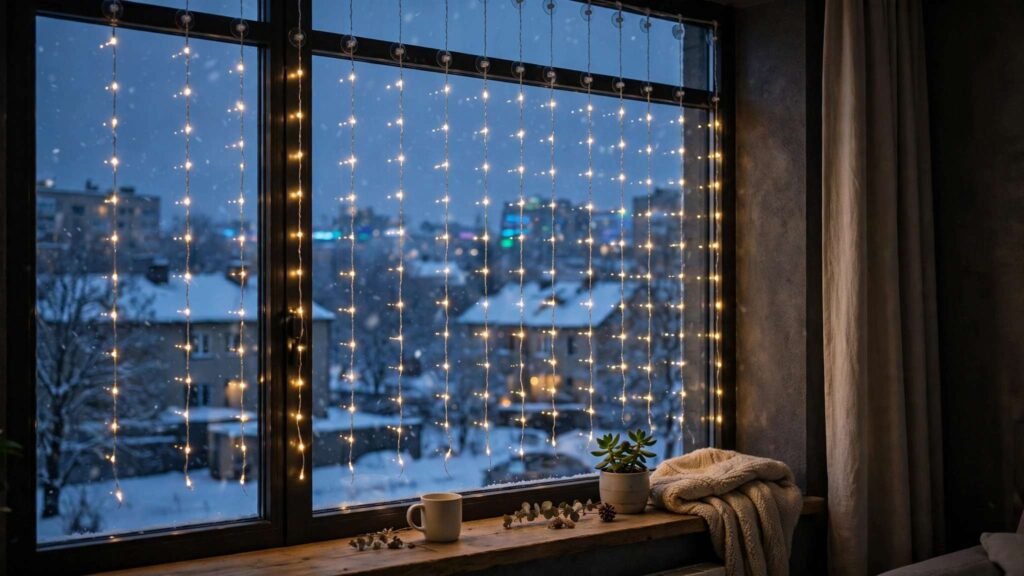
Windows are the renter’s dream surface for Christmas lights because glass is the one thing suction cups love. A curtain of micro-LED fairy lights hung directly on the windowpane — vertical strands falling like a beaded curtain — turns an ordinary apartment window into the glowing centerpiece of the room after dark, and it’s visible from the street, which gives you that classic “decorated house” feeling from inside a rental.
Why it works for renters: Suction cups grip clean glass with no adhesive at all, so there’s nothing to strip, peel, or residue-check at move-out. The strands themselves are featherweight, and everything lifts off the glass in seconds.
How to do it:
- Clean the inside of the window glass so the suction cups seat fully — a quick wipe with glass cleaner makes the difference between cups that hold for weeks and cups that pop off overnight.
- Press small suction cups with hooks along the top of the window frame or directly on the upper glass, spaced 6 to 8 inches apart.
- Hang one vertical micro-LED strand from each cup, letting the strands fall to slightly varied lengths for a natural curtain effect.
- Choose battery-operated strands with a timer function and hide the battery packs on the sill behind a small plant or stack of books.
- Approximate cost: $10–$20 for micro-LED curtain strands and a set of suction-cup hooks.
3. A Tension-Rod Light Curtain in a Window or Doorway
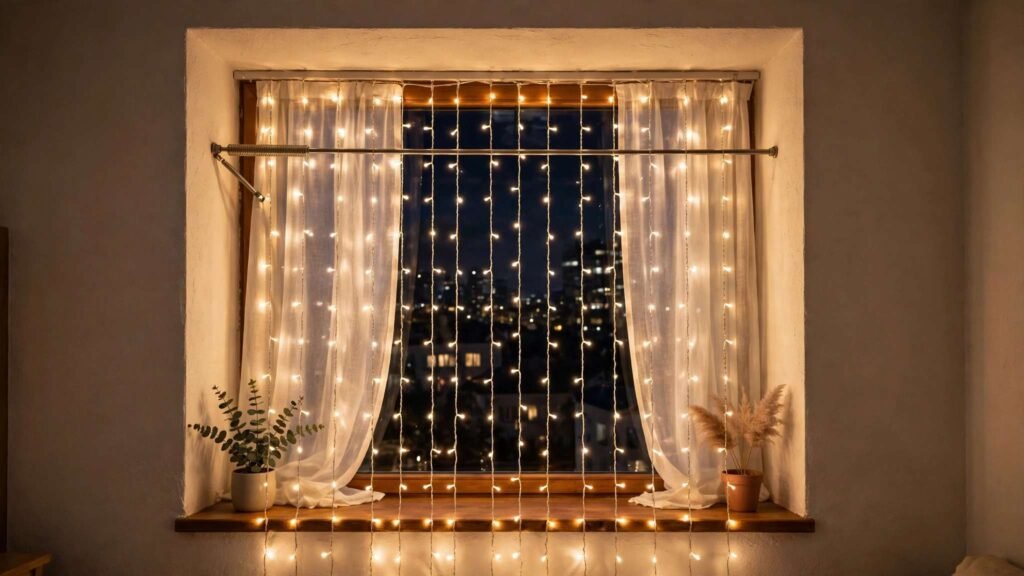
If you want the drama of a full light curtain without touching the window at all, a tension rod is your answer. Wedge one inside a window recess or across a wide doorway, then hang strands of lights from it like a curtain. I’ve used this in a doorway between a living room and dining nook, and walking through a doorway framed in warm light every evening genuinely changes how the apartment feels.
Why it works for renters: Tension rods grip with pressure, not fasteners — no holes, no adhesive, nothing to remove but the rod itself. They also adjust to fit, so the same rod works in your next apartment’s windows.
How to do it:
- Measure the inside width of the window recess or doorway and choose a tension rod that spans it at its mid-adjustment, not fully extended.
- Twist the rod into place high in the recess, then test it with a firm downward tug before hanging anything.
- Drape light strands over the rod so they hang in vertical falls, spacing them evenly across the width.
- Layer sheer curtains behind or in front of the lights if you want a softer, diffused glow.
- Approximate cost: $15–$30 for a tension rod and a set of light strands.
Layering options
For the softest look, hang sheer white curtains on the same rod in front of the lights so the glow filters through fabric. For more sparkle, skip the curtain and let the strands hang bare against the window glass — the reflections double the lights after dark. In a wide doorway, try two rods at different heights with staggered strand lengths for a waterfall effect.
4. Fairy Lights Glowing Inside Glass Jars and Vases
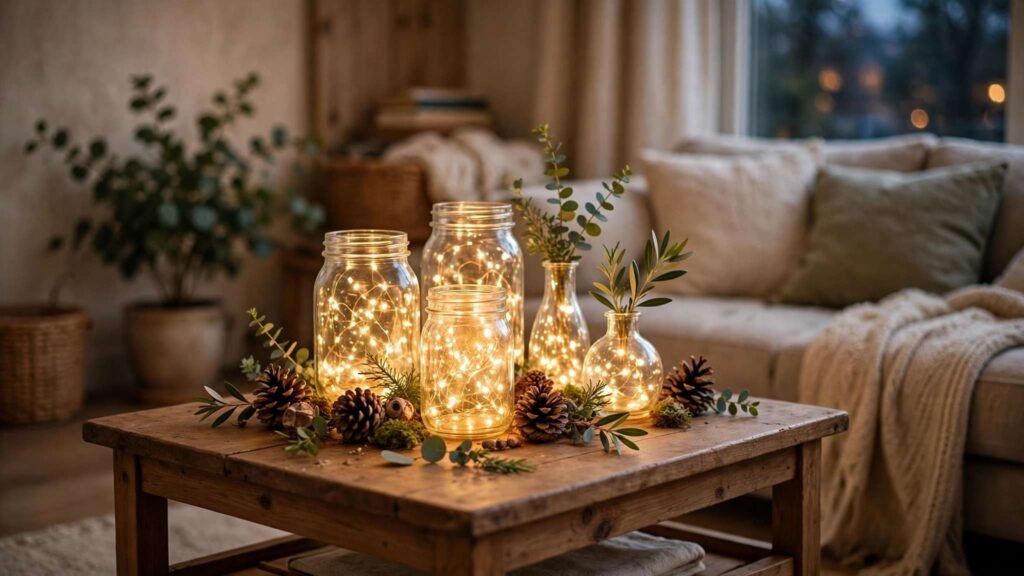
Not every light needs to hang. Some of the prettiest Christmas glow I’ve seen in rentals comes from clusters of glass jars, vases, and hurricanes with fairy lights coiled inside, set on side tables, bookshelves, and the dining table. They read as intentional decor rather than “string lights,” they need no hanging hardware at all, and you can move them wherever the room needs warmth.
Why it works for renters: Zero wall contact, zero installation. Jars sit on furniture you already own, the lights are battery-powered, and the whole arrangement packs into a box in January.
How to do it:
- Gather glass vessels you already own — mason jars, vases, hurricanes, even drinking glasses — in mixed heights for a collected look.
- Coil one short battery micro-LED strand inside each vessel, letting the tiny battery pack tuck behind or beneath the coils.
- Group vessels in odd numbers (three or five) on a side table, mantel shelf, or windowsill.
- Add pinecones, faux cranberries, or a sprig of greenery around the bases for a finished seasonal vignette.
- Approximate cost: $10–$22 for battery micro-LED strands if you already own the glassware.
Jar-light variations worth trying
A single oversized hurricane with warm lights makes a striking dining-table centerpiece, while a row of small jars along a windowsill turns an outlet-scarce wall into a glowing feature. I’ve even seen renters use the jars as nightlights in hallways — the timer function handles the on-off automatically.
5. Magnetic Clips for Lights on Metal Surfaces
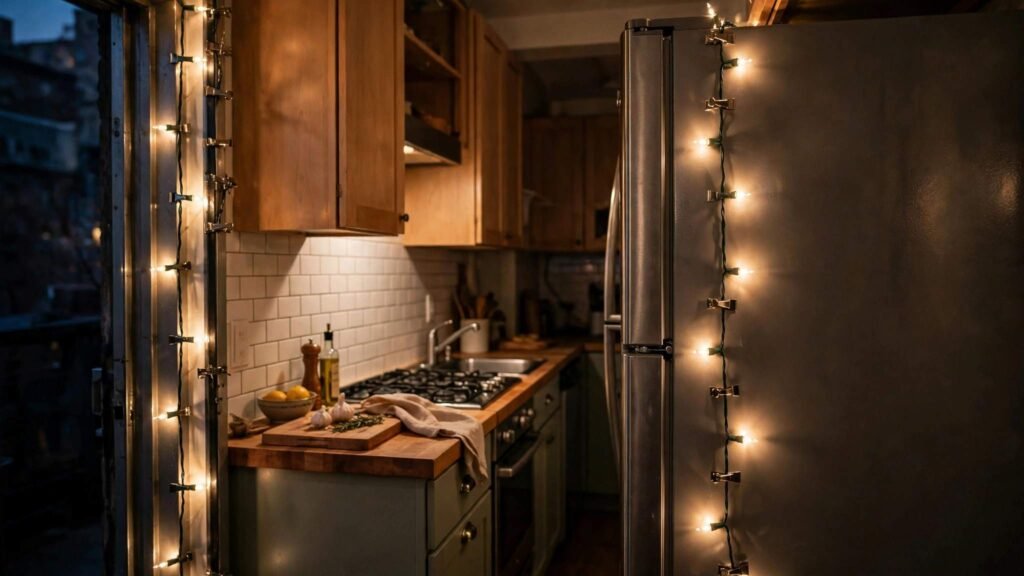
Here’s the trick most renters never think of: apartments are full of metal. The side of the refrigerator, a metal door frame, a radiator cover, the range hood, a steel shelving unit — all of it will hold a magnetic clip, and a magnetic clip will hold a light string. I’ve run lights along the side of a fridge in a galley kitchen and across a metal-framed doorway, and guests always ask how they’re attached. The answer is magnets, and the look is seamless.
Why it works for renters: Magnets touch the surface with zero adhesive and zero pressure marks. They lift off instantly, reposition endlessly, and work on any ferrous metal in the apartment.
How to do it:
- Test your surfaces with a fridge magnet first — stainless-look appliances vary, and you want to confirm the magnetism before planning around it.
- Clip small magnetic hooks or magnetic cable clips along the metal edge where you want the light line to run.
- Rest the light string in the clips, keeping swags shallow so the weight stays modest.
- Use battery strands on the fridge side so no cord has to travel to an outlet.
- Approximate cost: $8–$18 for magnetic clips plus a battery light strand.
6. The No-Damage Mantel Glow on a Shelf or Console
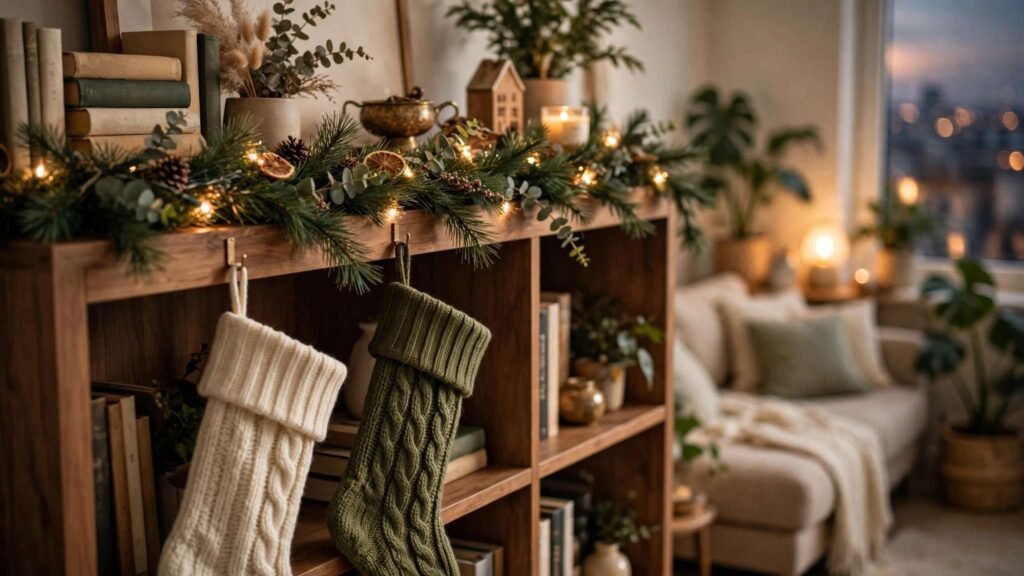
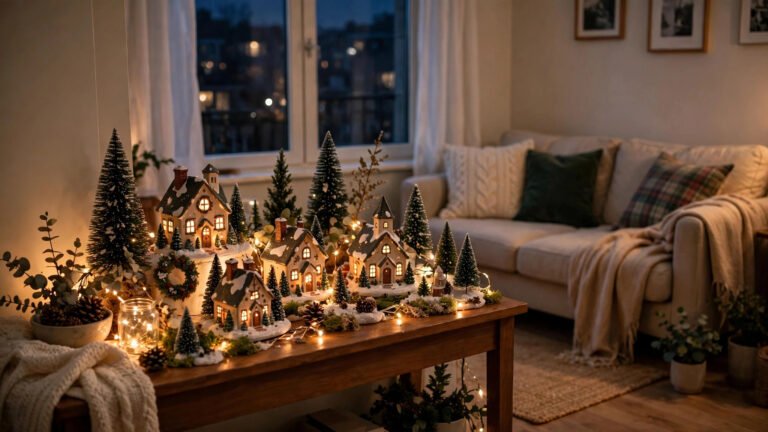
You don’t need a fireplace to have a mantel moment. A bookshelf top, a console table, or even the top of a low dresser becomes a glowing focal point with three elements: a faux pine garland laid along the back edge, a warm light string woven through it, and stockings hung from the front edge on adhesive hooks. I’ve built this exact arrangement on top of a rental bookshelf and it anchored the entire room’s Christmas decor.
Why it works for renters: The garland and lights simply rest on the furniture — gravity does the work. Stockings hang from adhesive hooks stuck to the furniture’s front face or underside, which strip off cleanly. Nothing is nailed, stapled, or screwed.
How to do it:
- Clear the top of a shelf, console, or low dresser and lay a faux pine garland along the back edge, letting the ends drape slightly.
- Weave a warm-white or multicolor light string through the garland, tucking the battery pack behind it.
- Stick two to four adhesive hooks along the front edge or underside of the furniture top, one per stocking.
- Hang stockings, then step back and adjust the garland so the lights peek through the greenery evenly.
The beauty of this arrangement is how easily it scales. A narrow console gets one garland and two stockings; a wide bookshelf top can carry the garland, a row of jar lights from idea 4, and a full set of stockings. Because nothing is attached to the wall, you can also move the whole “mantel” — garland, lights, stockings and all — to a different room mid-season if the light is better there.
- Approximate cost: $20–$40 for garland, lights, stockings, and adhesive hooks.
7. Glowing Star Silhouettes in the Windows
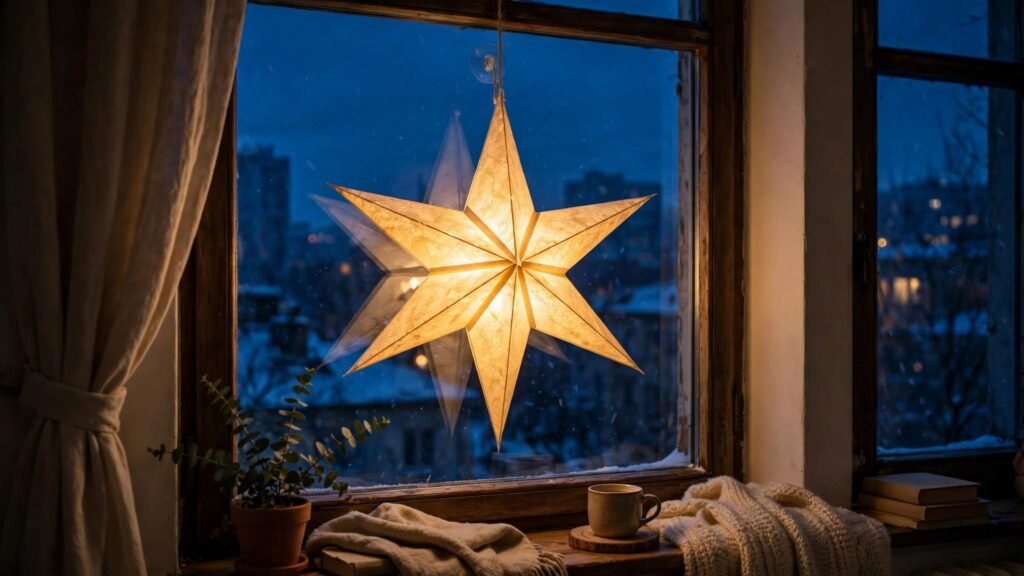
A lit star in the window is a Scandinavian Christmas tradition that happens to be perfect for renters: paper or plastic star lanterns hang in the window on a suction cup, glow from within with a small light, and read as pure Christmas from both sides of the glass. One large star in the living room window is a complete decoration — no other lights required in that room if you want restraint.
Why it works for renters: The star hangs from a single suction cup on the glass — no adhesive, no holes. It folds flat for storage, and the whole thing is one self-contained decoration.
How to do it:
- Choose a paper star lantern sized to your window — 20 to 28 inches reads well from the street without overwhelming a small apartment window.
- Attach a suction cup with a hook to the inside top of the window glass and hang the star’s loop from it.
- Place a battery LED light or the star’s included bulb inside so it glows warmly after dark.
- Hang one star per prominent window, or cluster three small stars at varied heights in a wide window.
- Approximate cost: $12–$25 per star lantern with a suction-cup hook and battery light.
8. Drape Lights Over Your Existing Curtains
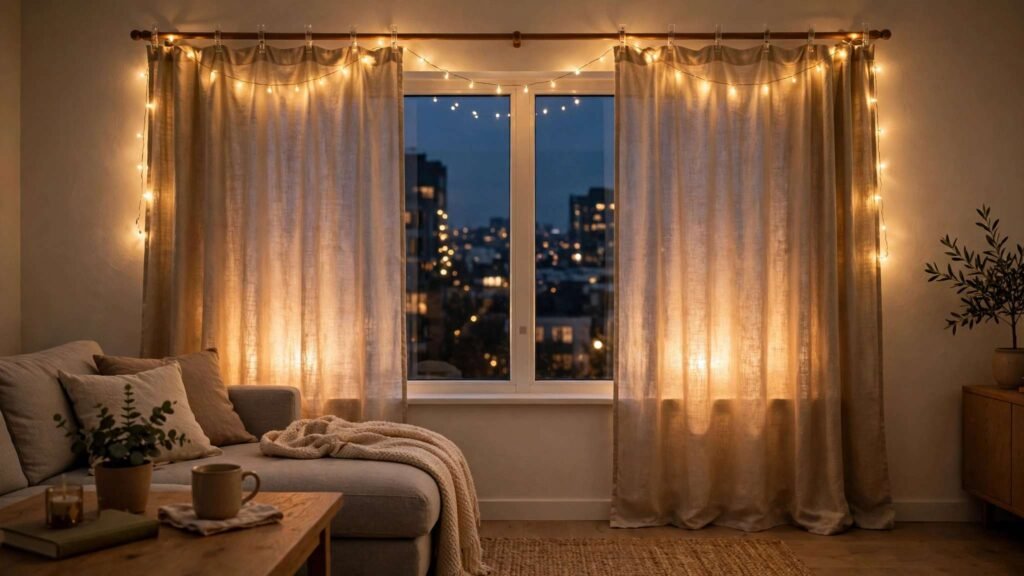
Your curtains are already hung, already span the window, and already reach toward the ceiling — which makes them the perfect scaffolding for Christmas lights. Drape a light string over the curtain rod or clip strands along the top edge of the curtain panels, and the fabric diffuses the glow into something soft and layered. I’ve done this with sheer curtains for a dreamy effect and with heavier drapes for a more traditional look; both work.
Why it works for renters: You’re using hardware that’s already installed — the curtain rod and the curtains themselves. Small clip rings or drapery clips hold the lights, and everything unclips without a trace.
How to do it:
- Choose a lightweight micro-LED strand so the added weight doesn’t drag the curtains or strain the rod.
- Drape the strand over the curtain rod in swags, or clip individual strands along the top hem of each curtain panel with small drapery clip rings.
- Let some strands fall behind sheer panels so the light filters through the fabric.
- Keep the battery pack or plug tucked behind one curtain panel near the window edge.
- Approximate cost: $8–$18 for micro-LED strands and a set of clip rings.
9. LED Candle and Lantern Clusters for Outlet-Scarce Corners

Every apartment has that corner — the reading nook, the hallway stretch, the bedroom side of the bed — where there is simply no outlet within reach and no good way to run a cord. That’s where flameless LED candles and small lanterns earn their place. A cluster of them on a side table or along a windowsill gives you genuine Christmas glow with zero cords, zero hanging, and a flicker effect that reads as real candlelight from across the room.
Why it works for renters: No installation of any kind, no cords to route, no outlets needed. They sit on existing furniture, run on batteries or USB, and many come with timers and remotes.
How to do it:
- Choose flameless LED candles in mixed heights — pillars and votives together look collected rather than staged.
- Cluster them in odd-numbered groups on side tables, the dining table, or a deep windowsill.
- Add one or two small metal or glass lanterns with an LED candle inside for height and structure.
- Set the built-in timers so the whole cluster glows each evening without you touching it.
- Approximate cost: $15–$30 for a set of LED candles and one or two lanterns.
Where the clusters work hardest
The hallway console you pass every evening, the bedroom nightstand, the bathroom counter for a spa-like December soak, and the entryway table that greets you at the door — these are the spots where a small cluster of LED candles delivers the most atmosphere per dollar. I keep one cluster on a timer in the entryway all season; it’s the first thing I see coming home and it makes the whole apartment feel intentional.
10. Weave Micro-LEDs Through a Bookcase or Open Shelving

Open shelving and bookcases are some of the most underused Christmas light real estate in a rental. A micro-LED strand woven along the shelves — tucked behind books, looped around plants, draped over framed photos — turns everyday storage into a glowing display. Because the lights thread through objects you already own, the whole thing looks styled rather than strung up, and it works in any room with a shelf.
Why it works for renters: The lights rest on and weave between your own belongings — no hooks, no adhesive, no wall contact at all. Rearrange the shelf and the lights move with it.
How to do it:
- Start with a long, thin copper-wire micro-LED strand — the wire is nearly invisible, so the lights appear to float among your objects.
- Weave the strand along one shelf at a time, tucking it behind books and around vases so it peeks through rather than lying on top.
- Let a few strands drape down the side of the bookcase for a cascading effect.
- Hide the battery pack behind books on the lowest shelf, and choose a strand with a timer.
- Approximate cost: $8–$16 for copper-wire micro-LED strands.
11. Battery String Lights Along the Balcony Railing
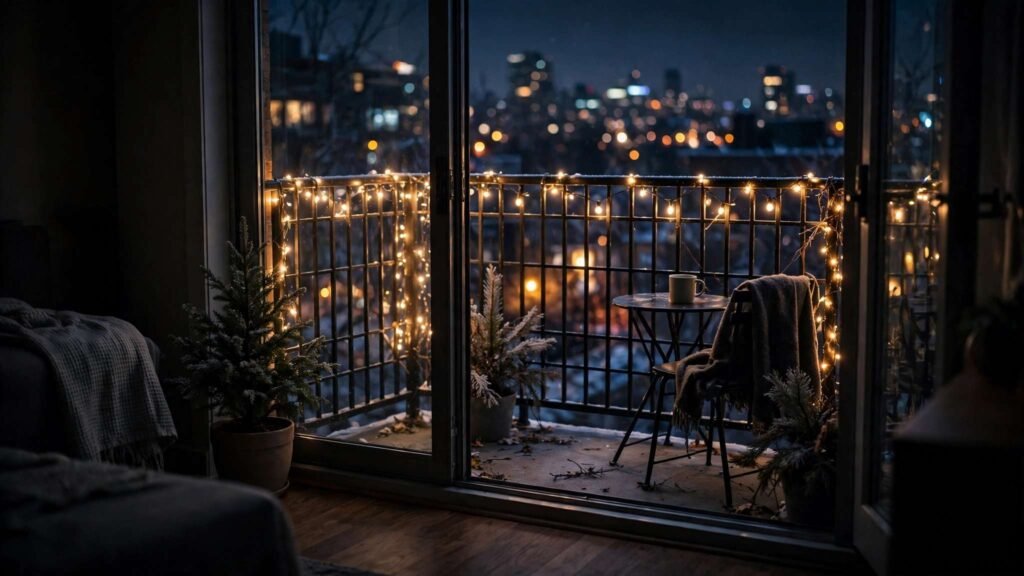
If your apartment has a balcony, patio, or even a wide Juliet railing, the railing is begging for lights — and renters can absolutely do this without drilling into anything. Battery-operated string lights wrap along the railing and fasten with reusable twist ties or small adhesive cable clips, giving you an outdoor glow visible from inside that makes the whole apartment feel bigger and more festive after dark.
Why it works for renters: Nothing penetrates the railing or the building exterior. Twist ties and adhesive clips are fully removable, battery strands need no outdoor outlet, and LED strings made for outdoor use handle winter weather.
How to do it:
- Choose LED string lights rated for outdoor use and a battery pack you can shelter — tuck it behind a planter or inside a small weatherproof box.
- Wrap the strand along the top rail, securing it every 12 inches or so with reusable twist ties or adhesive cable clips.
- Keep the lights on the inside face of the railing if your building has rules about exterior alterations — inside-face mounting reads as interior decor.
- Set the timer so the balcony glows each evening, and bring battery packs inside during heavy rain if they’re not weatherproof.
- Approximate cost: $12–$25 for outdoor-rated battery LED strings and twist ties or clips.
A note on building rules
Some buildings restrict anything visible from outside, including balcony decor. A quick check of your lease or a question to the building manager takes two minutes and avoids a January argument. When in doubt, keep the lights on the inside face of the railing or move this idea to a window instead.
12. Outline a Christmas Tree Right on the Wall
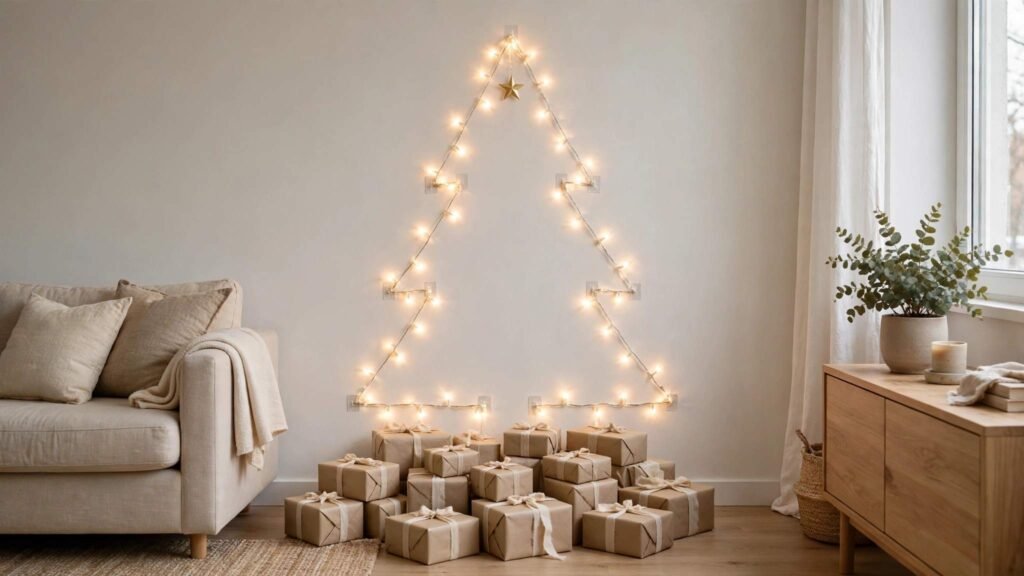
For the small apartment with no room for a tree — or the renter who doesn’t want to deal with a tree at all — a tree outlined in lights directly on the wall is the answer. Arrange adhesive hooks in a simple triangle tree shape on an empty wall, then string warm lights along the hooks to trace the outline. Add a star at the top on one more hook and pile wrapped gifts or a basket of ornaments beneath it. I’ve seen this in a studio apartment and it was genuinely charming — unmistakably a Christmas tree, using zero floor space.
Why it works for renters: The entire tree is adhesive hooks and a light string — both fully removable, both leaving the wall untouched. It uses vertical wall space instead of precious floor space, which is exactly what small apartments need.
How to do it:
- Mark a large triangle on the wall with painter’s tape first — roughly 4 to 5 feet tall — and step back to check the shape and placement.
- Stick small clear adhesive hooks along the taped outline, spacing them 8 to 12 inches apart, plus one at the very top for the star.
- Remove the tape, then zigzag the light string between the hooks to trace the tree outline, starting at the top.
- Hang a lightweight star or bow from the top hook and arrange gifts, a basket, or a small stool beneath the tree.
Small apartments benefit most from this idea because it converts dead wall space — the blank stretch beside the TV, the wall at the end of a hallway — into the Christmas focal point without claiming a single square foot of floor. And unlike a real tree, it never drops needles, never needs watering, and never leans.
- Approximate cost: $15–$30 for adhesive hooks, a light string, and a lightweight star topper.
Conclusion
Christmas lights in a rental don’t have to mean a sad single strand around a window or nothing at all. With adhesive hooks, suction cups, tension rods, magnetic clips, and battery-powered strands, you can swag lights along the ceiling line, curtain them across the windows, glow them inside jars, trace a whole tree on the wall — and take every bit of it down in January without a single mark to explain. I’ve watched renters go from assuming Christmas decor was off-limits to having the warmest-looking apartment on the floor, all with methods their landlords would never notice.
Start with the easy wins this weekend: a swag line along the living room ceiling, fairy lights in jars on the side tables, and a glowing star in the front window. Those three alone transform the evening feel of an apartment. Add the mantel glow and the wall tree if you want the full effect. Your rental deserves to feel like Christmas too — no holes required. Please save this visual guide on Pinterest and pin the light idea you’re trying first — your future self, walking into a warmly glowing apartment on a dark December evening, will thank you.

Amelia leads HavenlyStyle’s editorial vision with a passion for elegant interiors and practical home living. With years of experience in home décor and lifestyle content, she ensures every article is accurate, inspiring, and easy to follow. From timeless decorating ideas to the latest interior design trends, Amelia is committed to helping readers create beautiful, functional spaces while maintaining HavenlyStyle’s trusted and welcoming voice.